How I Use AI to Build and Monetize a Profitable Email Newsletter in 2026

Why I Bet on an AI-Powered Newsletter This Year
If you had told me a few years ago that a simple email newsletter would become one of the most reliable income streams in my business, I would have laughed. Blogs, YouTube, social media — those felt like the real growth channels. But here we are in 2026, and the numbers don’t lie: email is quietly having its biggest moment ever, and AI is the reason a single person can now run a newsletter operation that used to require a small media team.

The scale of this shift is hard to overstate. According to beehiiv’s State of Newsletters 2026 report, the platform now hosts over 1.2 million active newsletter creators, and the top 5% of them generate an average of $184,000 per year from subscriptions, sponsorships, and premium tiers. Substack’s Q1 2026 transparency report showed paid subscribers crossing 8.4 million — a 68% jump in a single year — with more than $510 million in annualized revenue flowing to creators.
In this guide, I’ll walk you through exactly how I use AI to build, grow, and monetize an email newsletter — the tools, the workflows, the monetization math, and the mistakes I made so you don’t have to. Whether you’re starting from zero subscribers or sitting on a dormant list, this playbook will work for you.
Why Newsletters Beat Almost Every Other Channel in 2026
Before we get tactical, let’s establish why this channel deserves your energy. Email marketing returns an average of $36–$42 for every dollar spent, according to 2026 benchmark data compiled by Searchlab — that dwarfs paid search (around $2), social ads ($2.80), and display advertising ($1.35). No other channel comes close on ROI.
There’s also the ownership factor. Your email list is the only audience asset you actually control. Algorithm changes have gutted organic reach on every social platform, and AI-generated answers are now absorbing a growing share of search clicks — something I covered in depth in my guide to optimizing for AI search (GEO and AEO). When Google’s AI Overviews answer a question directly, the click never happens. But an email lands in the inbox every single time you hit send.
And the money is following the attention. The creator economy crossed $250 billion globally in 2026 according to Venture Lab’s creator economy analysis, and paid newsletter subscriptions are one of its fastest-growing segments — beehiiv reports that the share of its revenue-generating creators earning through paid subscriptions doubled from 15% in Q1 2024 to 30% in Q1 2026.
Step One: Pick a Niche the AI Era Rewards
Not all newsletter niches monetize equally, and AI has made the gap wider. Generic news roundups are dying — readers can ask ChatGPT for a summary of anything. What still commands attention (and money) is judgment: curation, opinion, and specialized expertise that a general-purpose AI can’t replicate.

The data backs this up. beehiiv’s State of Paid Newsletters 2026 found the median free-to-paid conversion rate is just 0.62%, but the top 10% of finance and investing newsletters convert at 18–20%. Niches where readers make money from your information — investing, B2B marketing, e-commerce operations, niche software — convert dramatically better than entertainment or general interest.
My niche selection checklist
I ask four questions before committing to any newsletter niche: Does the audience have buying power? Are there affiliate programs or sponsors already spending in this space? Can I add judgment that AI summaries can’t? And can I sustain 100+ issues without running dry? If I can’t answer yes to all four, I move on. This mirrors the approach I use for choosing profitable blogging niches — the fundamentals are the same.
Step Two: Build the List With AI-Powered Lead Magnets
A newsletter with no subscribers is a diary. The fastest list-building lever I’ve found is a hyper-specific lead magnet, and AI has collapsed the production time from days to hours. I use ChatGPT and Claude to draft checklists, swipe files, calculators, and mini-courses tailored to one painful problem in my niche — then I polish them with real examples from my own experience.
I wrote a full walkthrough of this process in my guide to creating AI lead magnets that grow your email list, so I won’t repeat it all here. The short version: specificity wins. “The 27-Point Pre-Send Email Checklist” converts multiples better than “The Ultimate Email Marketing Guide.”
Where does the traffic come from? For me, it’s a mix of SEO-driven blog content, repurposed social posts, and newsletter recommendation networks. beehiiv’s recommendation engine and paid Boosts have become genuine growth channels — newsletter audiences across platforms now exceed 900 million total subscribers according to beehiiv’s 2026 creator report, and cross-promotion taps directly into that pool.
Step Three: My AI Writing Workflow (That Doesn’t Sound Like AI)
Here’s the workflow I use to produce a weekly issue in about 90 minutes instead of a full day.
Research and curation
I feed my AI assistant a folder of links, notes, and screenshots collected during the week and ask it to cluster them into themes, flag the most surprising items, and draft one-line summaries. This turns hours of reading into a 15-minute review. The judgment — what’s actually worth my readers’ time — stays human.
Drafting
I write the opening take myself, always. It’s my voice, my opinion, and it’s the reason people subscribe. Then I let AI expand my bullet-point outline into body sections, which I edit heavily. My rule: AI drafts structure, I supply stories, numbers, and opinions. Readers can smell fully synthetic content, and trust is the entire business model of a newsletter.
Optimization
Subject lines get the most AI leverage. Organizations using AI to generate and test subject lines see a 26% increase in open rates compared to manually written ones, according to 2026 email trend data from Verified Email — and my own results match. I generate 10 variants, shortlist three, and A/B test. I broke down my exact prompt stack in my post on AI email subject lines. Add AI send-time optimization on top and you pick up roughly another 14% lift.
Deliverability
None of this matters if you land in spam. Since Apple’s Mail Privacy Protection made open rates fuzzy, I focus on clicks and replies as my health metrics, keep my list clean with automated sunset flows, and follow the authentication basics — SPF, DKIM, DMARC. If deliverability is new territory for you, start with my guide to common email delivery issues.
Step Four: The Four Monetization Layers I Stack
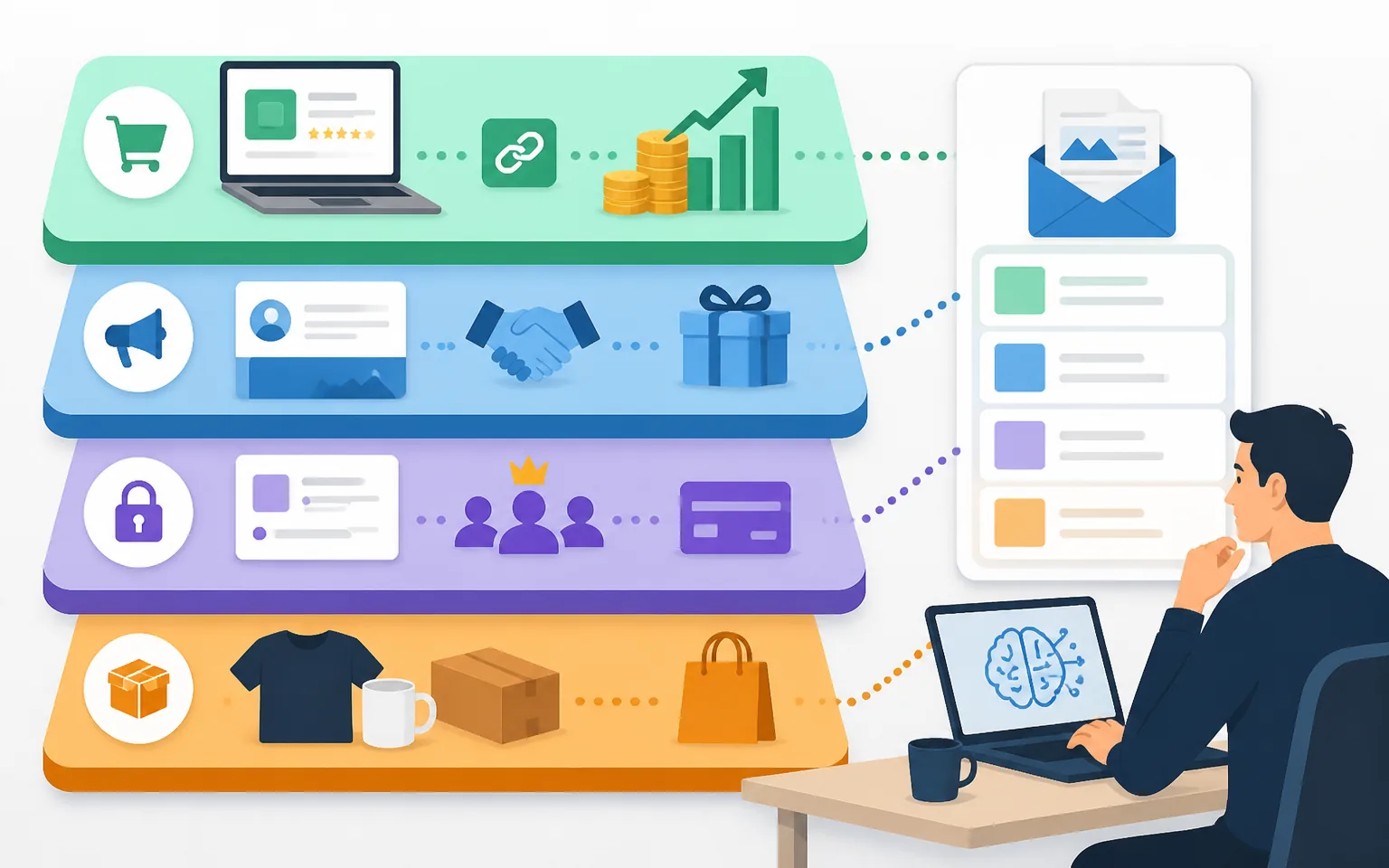
Most newsletter advice pushes a single revenue model. I stack four, in this order of implementation.
Layer one: affiliate revenue
This is where I tell most people to start because it works from your very first hundred subscribers. Recommend tools you actually use, disclose the relationship, and track everything. In niches like software and marketing, a single well-placed recommendation in a trusted newsletter can outperform a banner ad seen by 100x more people. I’ve written a complete playbook on affiliate email marketing if you want the deep dive.
Layer two: sponsorships
Once you pass roughly 1,000 engaged subscribers in a valuable B2B niche, sponsors become viable. Sponsors in 2026 care far less about raw list size and far more about click-through rates and audience quality — a 2,000-subscriber list of e-commerce founders can charge more per placement than a 20,000-subscriber general list. I keep a simple one-page media kit, and I use AI to draft personalized sponsor outreach at scale.
Layer three: paid subscriptions
The market standard has settled at $10/month or $100/year across nearly every niche, according to beehiiv’s paid newsletter data. The playbook that works: keep the free tier genuinely valuable, then gate depth — extra analysis, templates, tools, community, or Q&A. Even at the median 0.62% conversion rate, a 10,000-subscriber list yields around 62 paid members, or roughly $6,200/year. Push conversion to 2–3% with a strong paid offer and it becomes real income. Subscription revenue on beehiiv alone grew 138% year-over-year, from $8 million in 2024 to $19 million in 2025, with $35 million projected for 2026.
Layer four: your own products
The highest-margin layer. Courses, templates, services, software — sold to a warm list that already trusts you. This is where the newsletter stops being the product and becomes the distribution engine. My guide on creating and selling digital products covers this step by step.
The Numbers: What a Realistic Year One Looks Like
Let me ground this in realistic math, because too many “newsletter income” posts are fantasy. Say you grow to 5,000 subscribers in year one — very achievable with consistent lead magnets and cross-promotion. With a 40% open rate and 3% CTR, affiliate placements might earn $300–$800/month in a decent niche. Two sponsor slots monthly at $250 each adds $500. A paid tier converting 1% at $100/year adds about $5,000 annually. That’s roughly $15,000–$20,000 in year one from an asset that compounds.
Compare the effort against the return: companies using AI-driven email strategies see up to 41% more revenue than traditional batch-and-blast approaches, per Omnisend’s 2026 statistics. The AI leverage is what makes this a one-person business rather than a team sport — a theme I explored in my post on running a one-person business with AI.
Mistakes I Made (So You Don’t Have To)
First, I automated too much too early. My fully AI-written issues had noticeably lower reply rates, and replies are the leading indicator of a healthy list. I pulled back to the hybrid workflow above and engagement recovered within a month.
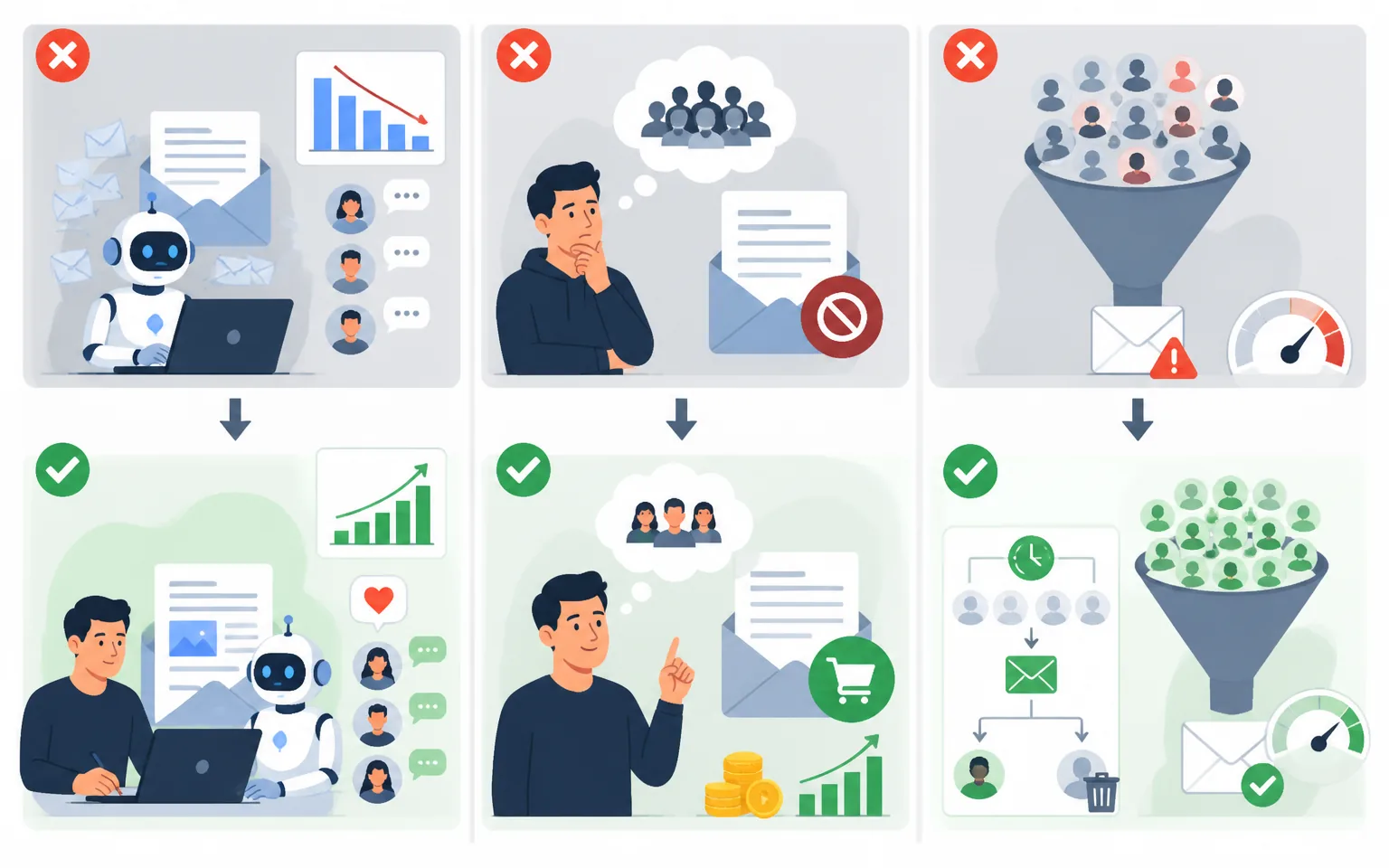
Second, I waited too long to monetize. I believed the myth that you need 10,000 subscribers before making an offer. My first affiliate income came from a list of 400 people. Monetizing early also teaches you what your audience will actually pay for — data you can’t get any other way.
Third, I ignored list hygiene. Unengaged subscribers drag down deliverability for everyone else. Now an automated flow tries to re-engage anyone inactive for 90 days and removes them if they don’t respond. Painful to watch the number drop; great for the business.
Frequently Asked Questions
How many subscribers do I need before monetizing a newsletter?
Fewer than you think. Affiliate offers work from a few hundred engaged subscribers. Sponsorships generally become practical around 1,000 in a B2B niche. Paid tiers work best after you’ve proven consistent engagement, typically 2,000+.
Will readers unsubscribe if they find out I use AI?
Not if the judgment and voice are yours. Readers pay for perspective, not typing. Use AI for research, structure, and optimization; keep opinions, stories, and recommendations human. Disclose if your audience would care.
Which platform should I start on?
beehiiv if growth tools and ad network access matter most; Substack if you want the simplest path to paid subscriptions and network discovery; ConvertKit (Kit) if you’re selling your own digital products. All three support the full monetization stack described here.
How often should I send?
Weekly is the sweet spot for most niches — frequent enough to stay top of mind, sustainable enough to maintain quality. Consistency beats frequency: a reliable weekly issue outperforms an erratic daily one.
Is it too late to start a newsletter in 2026?
No — but the bar is higher. With 1.2 million active creators on beehiiv alone, generic content won’t cut it. Specific niches with buying-power audiences are still wide open, and AI has never made production cheaper. The scarce resource is trust, and trust compounds from whenever you start.
Final Thoughts: Start Small, Stack Layers, Let AI Do the Heavy Lifting
An email newsletter in 2026 is the closest thing I know to a compounding asset you can build with almost no capital. The channel delivers the highest ROI in marketing, the audience is yours forever, and AI has collapsed the production cost to the point where one focused person can compete with media companies.
Start with a niche where readers have money on the line. Build the list with specific, AI-accelerated lead magnets. Write with a hybrid workflow that keeps your voice front and center. Then stack monetization layers in order: affiliate, sponsors, paid tier, your own products. Do that consistently for twelve months and you’ll have an asset that pays you for years.
If you found this useful, you know what to do — get on my list, and see the whole playbook in action from the inside.