AI Email Subject Lines: How I Write Openers People Actually Click in 2026

If you want higher open rates in 2026, here is the short answer: write subject lines of 28–50 characters, personalize them with behavioral data (not just first names), and use AI trained on your own past campaigns to generate and test variants. That combination is what moved my open rates more than any design tweak, send-day experiment, or list-growth hack I have tried. Your subject line is the gatekeeper for everything else — the offer, the copy, the click — and in this guide I will show you exactly how I use AI to write subject lines that earn the open, without sounding like a robot or a spammer.
Why Subject Lines Still Decide Your Open Rate
Email remains the highest-leverage channel I run. According to Omnisend’s email marketing statistics, email generates an average return of $36–$42 for every dollar invested — and for ecommerce brands it climbs to roughly $45 per $1. But none of that ROI exists if the email never gets opened, and the subject line is 80% of that decision.
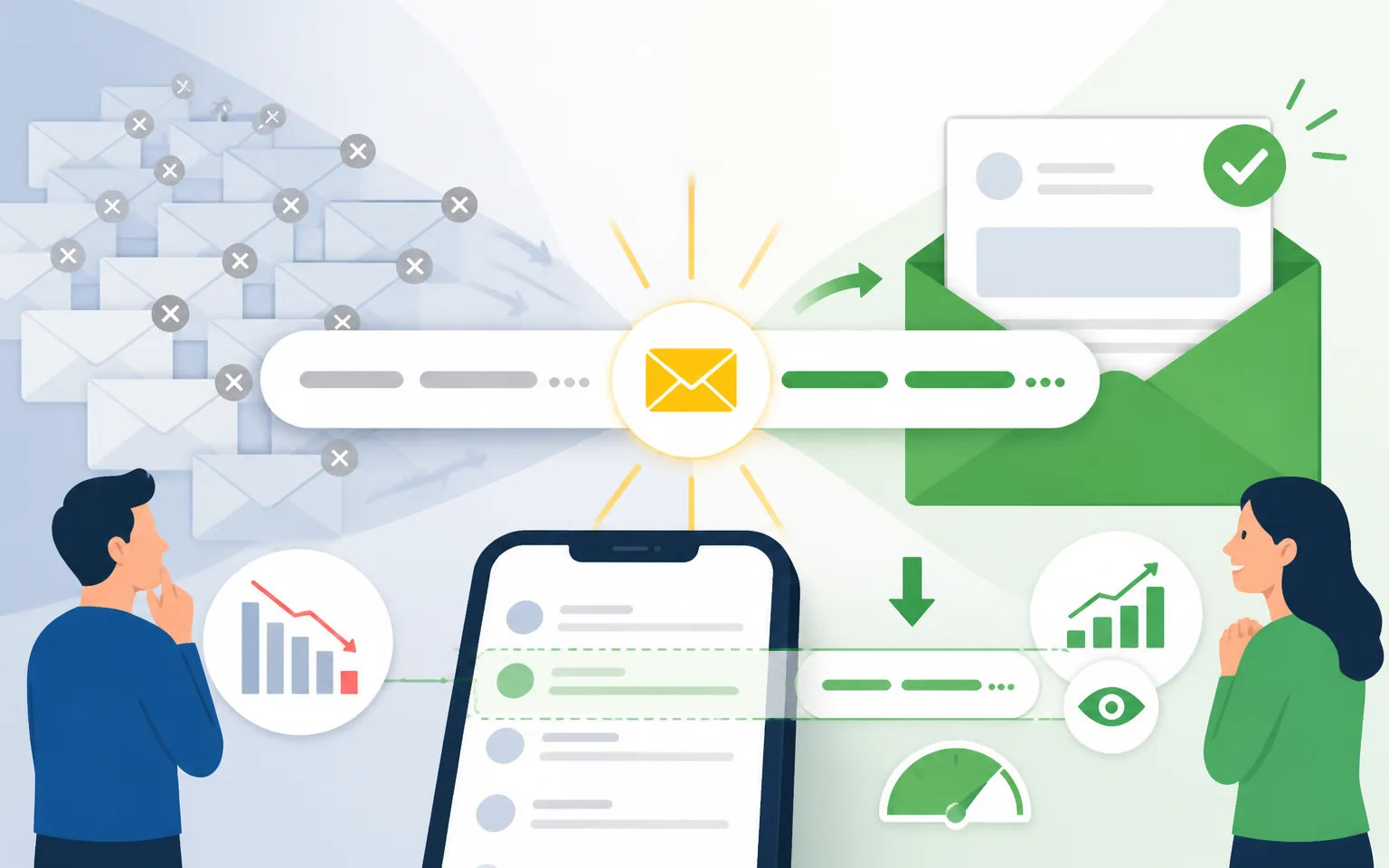
The benchmark to beat keeps moving. Constant Contact’s analysis of 4.3 billion emails puts the average open rate at 32.55%, though as Shno’s open rate research notes, Apple Mail Privacy Protection inflates reported opens by an estimated 4–8 percentage points, so treat your own trend line as more trustworthy than any industry average.
Here is the part most marketers still underweight: the inbox is now a mobile surface. Per SearchLab’s benchmarks, 62% of all emails are opened on mobile devices, and 70% of recipients delete emails that are not mobile-friendly within three seconds. Your subject line is competing on a screen that shows 30-something characters before it truncates. Write for that screen first.
What Makes a Subject Line Work in 2026?
Length: the 28–50 character sweet spot
Data from Digital Applied’s statistics report shows subject lines between 28 and 50 characters see 21% higher open rates than longer alternatives, largely because mobile inbox previews cut off anything beyond that range. My rule: put the payoff in the first 30 characters. If the value proposition survives truncation, the length is fine.
Personalization: go beyond the first name
Personalization is the single biggest lever in the data. Research compiled by Mailmend found personalized subject lines drive roughly 50% higher open rates than generic baselines — but the type of personalization matters. First-name tokens lift opens by 10–14%, while behavioral personalization (referencing what someone browsed, bought, downloaded, or clicked) lifts opens by 26%. “Sk, your SEO checklist is expiring” beats “Sk, check this out” every time, because the first one proves you know something relevant about me.
The same pattern holds in cold outreach. Snov.io’s analysis of 10M+ cold emails found personalized subject lines achieved a 20.79% open rate versus 14.96% for generic ones. Relevance is the whole game.
Curiosity vs. clarity
Curiosity gets opens; clarity gets the right opens. A vague teaser (“You won’t believe this…”) may spike opens once, but it trains subscribers to distrust you, and the click-through and conversion numbers pay the price. I aim for what I call “specific curiosity”: name the topic clearly, withhold only the result. “The subject line test that lifted my opens 31%” tells you exactly what the email is about while still leaving one loop open.
How I Use AI to Write Subject Lines
This is where the leverage is in 2026. Organizations using AI to generate and optimize subject lines see a 26% increase in open rates compared to manually written alternatives, according to Digital Applied’s AI subject line testing research, and AI-assisted testing programs have produced open-rate gains of 35–95% across Mailchimp, Klaviyo, and HubSpot benchmarks. The reason is simple: a model can pattern-match across thousands of your past sends in a way no human calendar allows.
Step one: feed the AI your own data
Generic prompts produce generic subject lines. Before I ask for a single idea, I paste in 20–30 of my past subject lines with their open rates — the winners and the flops. Then I describe my audience in one paragraph and state the email’s single goal. The AI now writes inside my voice and my audience’s proven preferences instead of averaging the entire internet.
Step two: my exact prompt template
Here is the prompt skeleton I use for nearly every campaign:
- Context: “You are writing for [audience] who subscribed to get [promise]. Past winners: [list]. Past losers: [list].”
- Task: “Write 15 subject lines for an email about [topic], goal: [open/click/reply].”
- Constraints: “28–50 characters, payoff in first 30, no clickbait, no spam words, at most one emoji across all 15, vary the angle: benefit, curiosity, question, number, urgency.”
- Output: “Rank them by predicted open rate and explain the top 3 picks.”
Asking for 15 variants across five angles matters more than any single instruction. The first five ideas from any model are usually the obvious ones; the gold shows up in variants 8 through 15.
Step three: let AI pick the send time too
Subject line and timing compound. Mailpool’s research found AI-optimized send times lift open rates by 15–23% because the email lands at the top of the inbox when each subscriber actually checks it. Most major ESPs now ship this feature; if yours does, turn it on and let the subject line fight a fair fight. I covered how I wire this into automated flows in my AI email segmentation and automation guide.
My Subject Line Formulas That Keep Working
Formulas are starting points, not templates to copy verbatim. These six earn their keep in my campaigns:
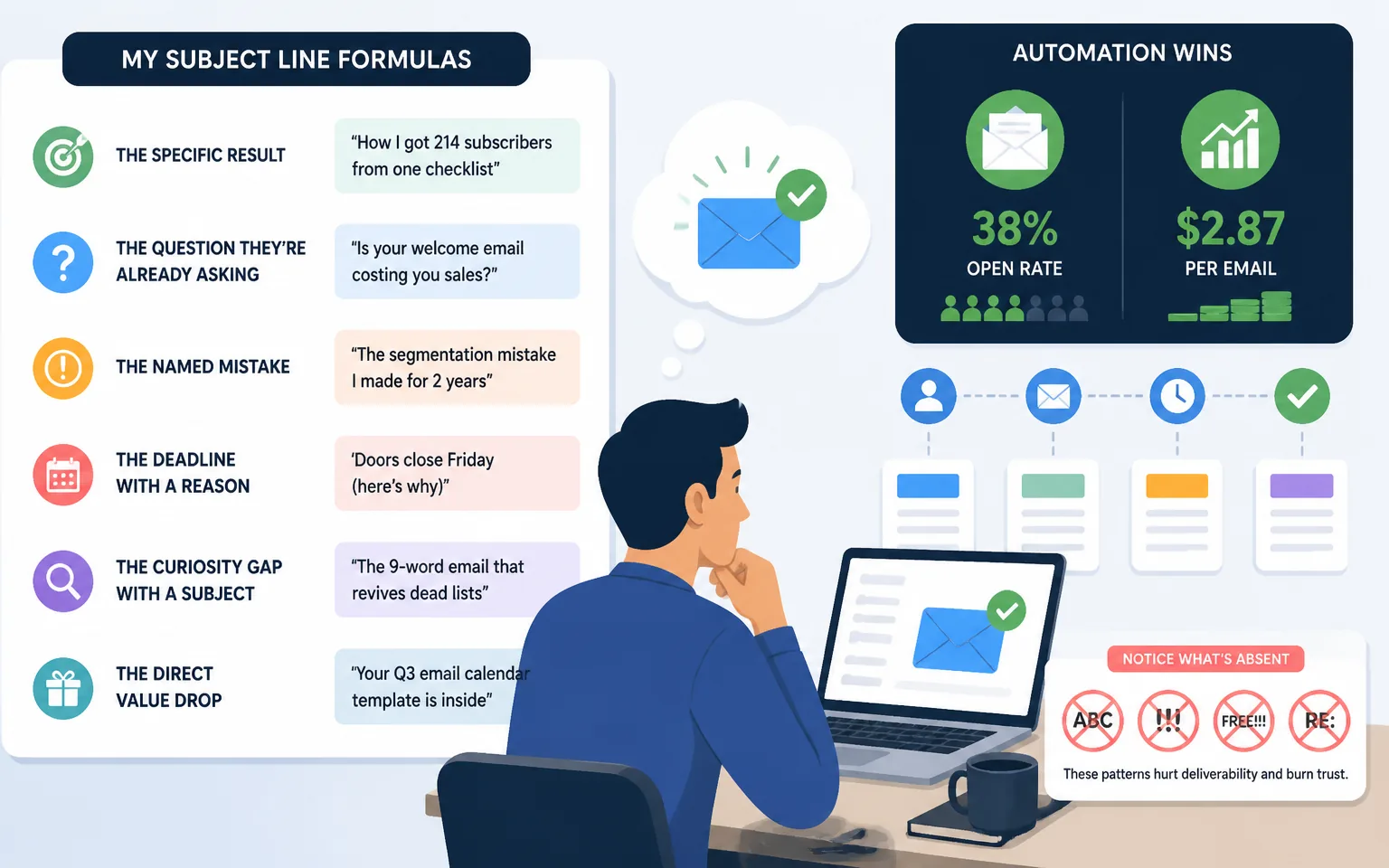
- The specific result: “How I got 214 subscribers from one checklist” — numbers in the subject text build credibility (just never in the URL slug).
- The question they’re already asking: “Is your welcome email costing you sales?”
- The named mistake: “The segmentation mistake I made for 2 years”
- The deadline with a reason: “Doors close Friday (here’s why)”
- The curiosity gap with a subject: “The 9-word email that revives dead lists”
- The direct value drop: “Your Q3 email calendar template is inside”
Notice what is absent: ALL CAPS, multiple exclamation marks, “FREE!!!”, and misleading “Re:” prefixes. Those patterns hurt deliverability and burn trust. Automated behavior-triggered emails are the perfect place to deploy these formulas — EntrepreneursHQ’s 2026 report shows automated emails reach 38% open rates and generate $2.87 per email versus $0.18 for one-off campaigns, so a strong subject line on an automation pays out every single day.
A/B Testing Subject Lines With AI (The Right Way)
Most subject line tests fail because they test noise. Two near-identical variants on a 2,000-person list will never reach significance. Here is my testing discipline:
- Test angles, not words. Benefit vs. question vs. curiosity — not “tips” vs. “tricks.”
- One variable per test. If you change the angle and add an emoji, you learned nothing.
- Judge by clicks and conversions, not opens alone. With Apple MPP inflating opens, click-through rate is the honest scoreboard. The average email CTR sits around 2.6% in 2026, so anything above 3.5% is a genuine win.
- Log every result. My winners-and-losers spreadsheet is the training data that makes my AI prompts smarter each month.
After each campaign, I paste results back into the AI and ask why the winner won. The explanations are hypotheses, not truth, but over months they surface patterns I would have missed — my audience opens questions on Tuesdays and numbers on weekends, for example.
One more testing habit that pays off: keep a swipe file of subject lines from other people’s newsletters that made you open. Once a month I feed that file to the AI alongside my own results and ask it to identify which patterns would translate to my audience and which are specific to that sender’s brand. It is a cheap way to import fresh angles without copying anyone, and it keeps my testing queue full so I am never reduced to testing synonyms against each other out of desperation.
Preview Text: The Second Subject Line Everyone Ignores
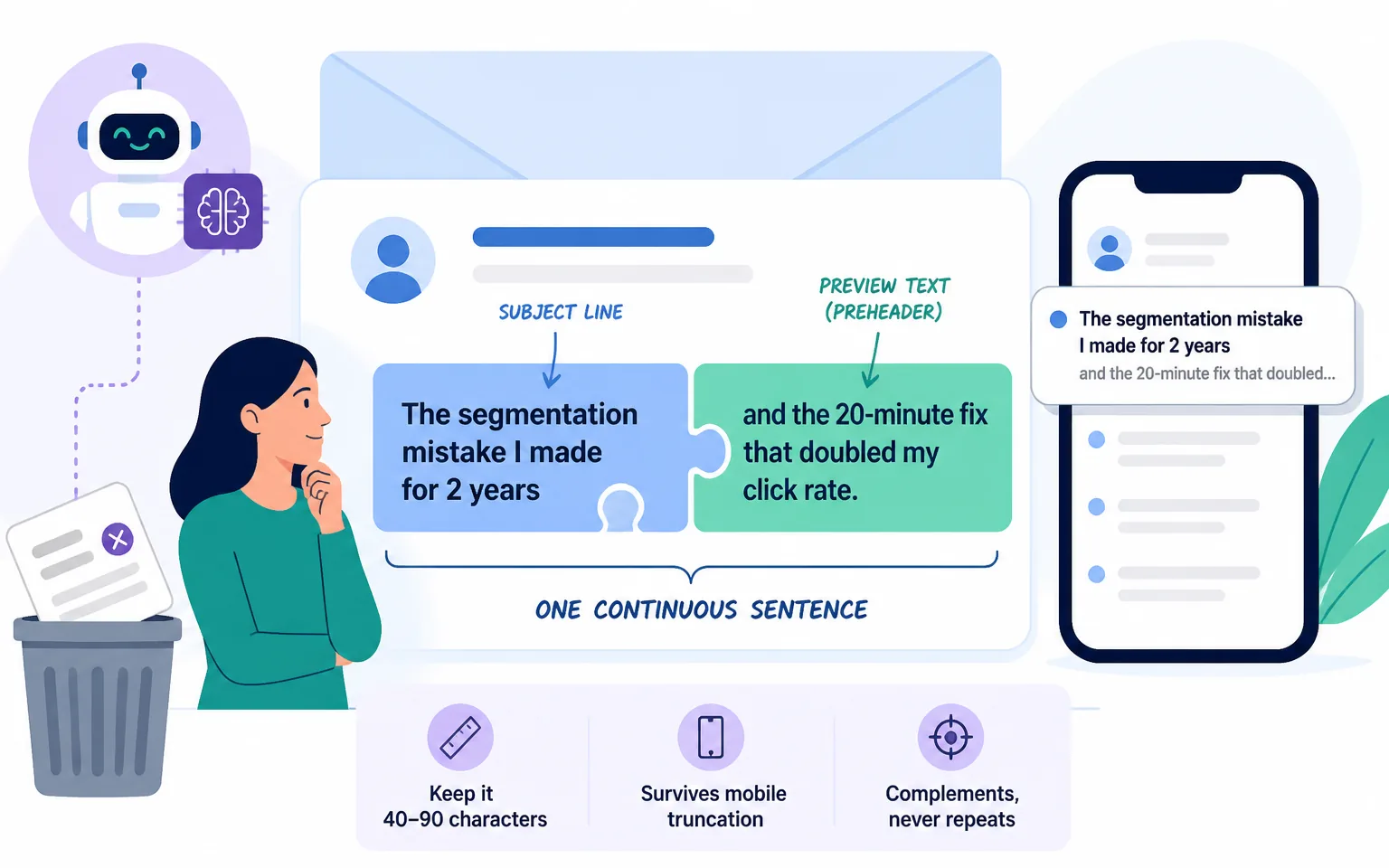
The preheader is free real estate that most senders waste on “View this email in your browser.” I treat subject line and preview text as one continuous sentence. Subject: “The segmentation mistake I made for 2 years” → Preview: “and the 20-minute fix that doubled my click rate.” When I generate subject lines with AI, I always ask for a matching preheader in the same request — the pair is written as a unit. Keep preheaders to 40–90 characters so they survive mobile truncation, and never let them repeat the subject line.
Deliverability: Don’t Let a Good Subject Line Land in Spam
A brilliant subject line in the spam folder scores zero. Modern filters weigh sender reputation and engagement far more than individual trigger words, but subject line choices still matter at the margin: avoid all-caps words, currency symbols stacked with exclamation points, and deceptive prefixes like “Re:” or “Fwd:” on cold sends. The bigger deliverability lever is list hygiene and authentication (SPF, DKIM, DMARC) — I wrote a full breakdown in my guide to email campaign best practices. And remember the mobile reality from earlier: most opens happen on a phone, so a subject line that reads as shouty on a small screen gets flagged — by humans, via the spam button, which is the report that really kills you.
Segment First, Then Write: Why One Subject Line Never Fits All
Here is a lesson that took me embarrassingly long to learn: the “best” subject line does not exist at the list level. A subject line that wins with your buyers can lose badly with your free-lead-magnet crowd, because the two groups open email for different reasons. Before I write anything, I decide which segment the email is for — new subscribers, engaged readers, past customers, or the quiet middle — and I tell the AI who it is writing for. The same core message might ship as a question to cold subscribers (“Still struggling with open rates?”) and as a direct value drop to buyers (“Your subject line swipe file is ready”). Writing one subject line per segment takes five extra minutes with AI and routinely outperforms any single “winner” broadcast to everyone.
Common Subject Line Mistakes I Still See Everywhere
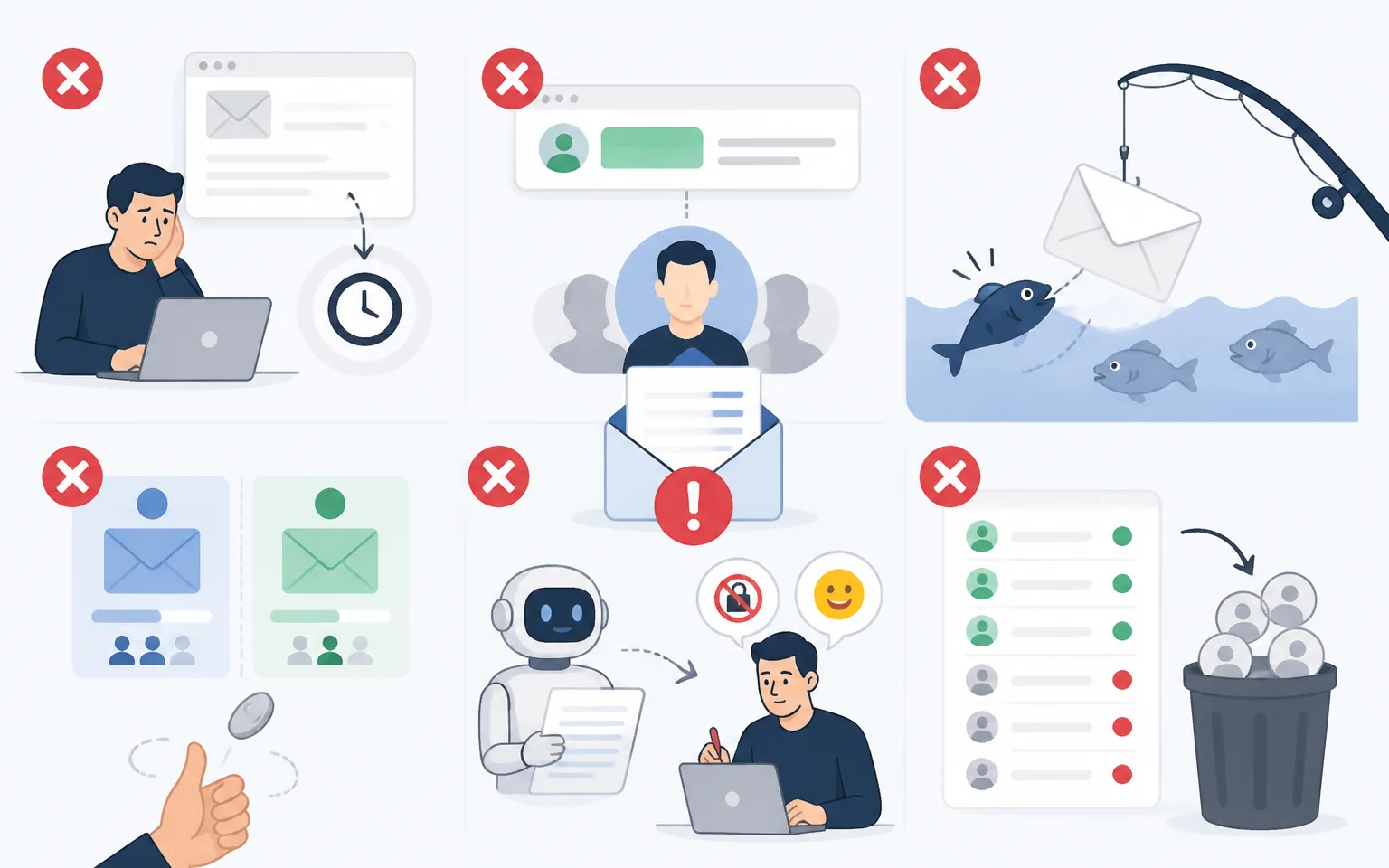
- Writing the subject line last. It deserves as much time as the email body. I draft it first; it forces clarity about the one thing the email delivers.
- Personalizing the token, not the message. A first name bolted onto a generic pitch fools no one. Behavioral relevance is what earns the 26% lift.
- Chasing opens while ignoring clicks. Clickbait inflates the top of the funnel and poisons everything below it.
- Testing without volume. Under ~1,000 recipients per variant, call it a coin flip, not a test.
- Using AI output raw. AI drafts; you edit. The model does not know that “unlock” is banned in your brand voice or that your audience hates emojis.
- Never cleaning the list. Engagement rates are per-recipient. Dead subscribers drag down the metrics that filters and algorithms judge you by. If your list needs fresh, engaged subscribers, my AI lead magnets guide covers how I grow mine.
FAQ: AI Email Subject Lines
Can AI really write better subject lines than a human?
AI plus a human editor beats either alone. The data shows AI-optimized subject lines outperform manually written ones by around 26% on opens, but the best results come from feeding the model your historical winners and then editing its output for voice and accuracy.
How long should an email subject line be in 2026?
Aim for 28–50 characters with the core payoff inside the first 30. This range survives mobile truncation, which matters because roughly two-thirds of opens now happen on phones.
Do emojis in subject lines help or hurt?
They are seasoning, not strategy. One relevant emoji can lift visibility in a crowded inbox; multiple emojis or irrelevant ones read as spam. Test with your own audience and watch clicks, not just opens.
Should I still trust open rates with Apple Mail Privacy Protection?
Directionally yes, absolutely not literally. MPP inflates opens by several percentage points, so compare like-for-like trends over time and lean on click-through rate as your primary decision metric.
Which AI tool is best for subject lines?
The model matters less than the prompt and the data you feed it. ChatGPT, Claude, or your ESP’s built-in AI all perform well once you supply past subject lines with results, a clear audience description, and tight constraints. Start with whatever is already in your stack.
How many subject line variants should I generate per email?
I generate 15 and shortlist 3. Forcing the model past its first obvious ideas is where the interesting angles appear, and three finalists is enough for a meaningful A/B/C test on a mid-sized list. If your list is small, pick two and alternate winners into your next automation instead of running underpowered split tests that cannot reach statistical significance anyway.
Final Thoughts
Subject lines are the cheapest test bed in marketing: zero design, zero build time, instant feedback at scale. The playbook that works for me in 2026 is short — keep it under 50 characters, personalize with behavior instead of tokens, write the preheader as the second half of the sentence, generate 15 AI variants trained on your own history, and judge every test by clicks. Do that consistently for a quarter and your open rate will stop being a mystery and start being a system. The inbox is crowded, but most of the crowd is still writing subject lines the way they did five years ago. That is your edge.
If you take only one action from this article, make it this: before your next send, paste your last twenty subject lines and their results into your AI tool of choice and ask it what your audience responds to. That single ten-minute exercise will teach you more about your subscribers than a month of guessing — and it becomes the foundation every future subject line is built on. Start there, test weekly, and let the compounding do the rest.