How to Start a One-Person Business With AI in 2026: My Complete Solopreneur Playbook

Can One Person Really Build a Profitable Business With AI?
Yes — and 2026 is the best year yet to do it. I’ve been running byskh.com as essentially a one-person operation for years, and I can tell you this without hesitation: there has never been a better moment to start a business by yourself. Not because entrepreneurship suddenly got easy — it didn’t — but because the gap between what one person can do and what a small team can do has almost disappeared. AI closed it.
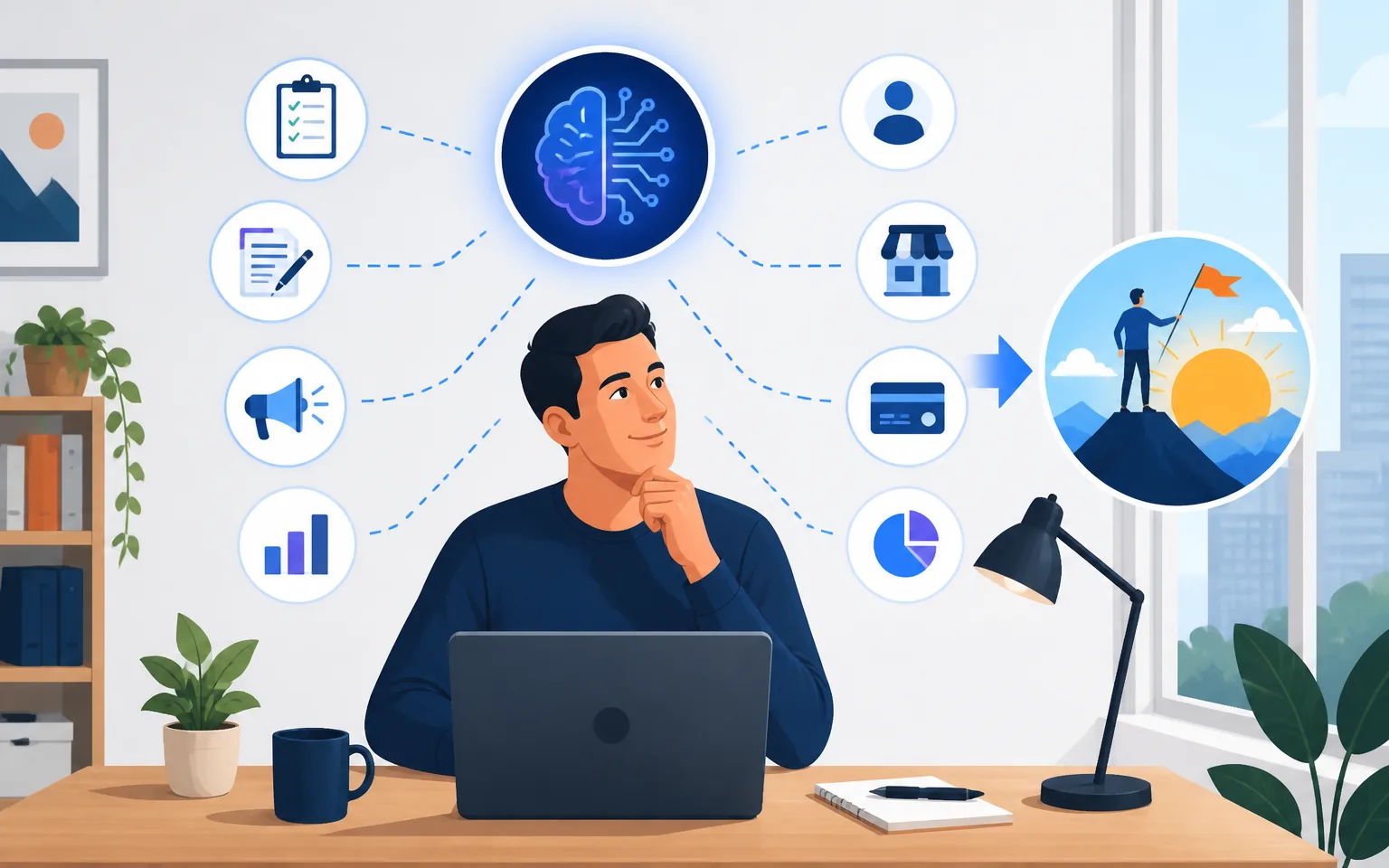
The numbers back this up. According to 2026 solopreneur market research from Solo Business Hub, there are now roughly 29.8 million solo businesses in the United States alone, generating an estimated $1.7 trillion — about 6.8% of U.S. GDP. That’s not a side-hustle statistic. That’s an economy.
In this playbook, I’m going to walk you through exactly how I would start a one-person business from zero in 2026: choosing a model that runs lean, building an AI operating stack, setting up marketing systems that compound, and launching within thirty days. Everything here is based on what I actually do, not theory.
Why 2026 Is the Best Time to Start a One-Person Business
For most of business history, going solo meant staying small. You could freelance, sure, but building anything with real leverage required hiring — and hiring required capital, management skill, and risk tolerance most people don’t have.
AI changed that equation. Research tracked by Crevio found that the share of solo-founded startups has jumped from 23.7% to 36.3% since 2019, largely because AI has slashed the operating costs of running a business alone. Tasks that used to require a copywriter, a designer, a bookkeeper, and a customer support rep can now be handled by one focused founder with the right tools.
And solopreneurs are adopting these tools fast. AI adoption among solo founders reached 74% in 2026, according to solopreneur industry surveys — meaning three out of four people running one-person businesses now use AI for content, customer service, research, or operations. The broader small business world is moving the same direction: the 2026 U.S. Chamber of Commerce Small Business Survey found 89% of small businesses now leverage AI in some capacity, up from just 36% in 2023.
Here’s the part that matters most for you: this isn’t about working more. Studies of AI-assisted founders show automation returns between 10% and 40% of a solopreneur’s daily working time. That reclaimed time is the raw material you’ll use to build.
Step One: Pick a Business Model That Runs Lean
The single biggest mistake I see aspiring solopreneurs make is choosing a business model that secretly requires a team. If your idea needs inventory, fulfillment staff, or round-the-clock live support, you’ve designed yourself into a job, not a business.
Four models work exceptionally well for one person plus AI:
Digital Products
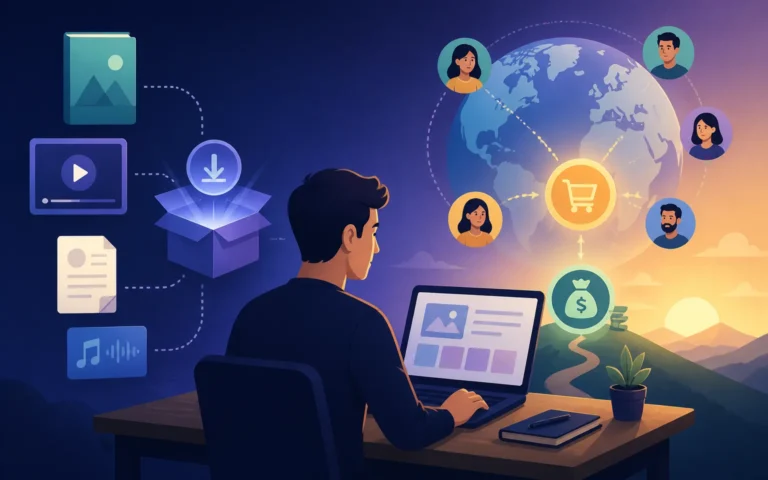
Ebooks, templates, courses, swipe files, Notion systems, prompt libraries — anything you create once and sell repeatedly. AI compresses creation time dramatically: what used to take me six weeks of writing and design now takes days, because AI handles first drafts, outlines, and visual assets while I focus on the expertise only I can add.
Affiliate Content Business
This is closest to what I do at byskh.com. You build an audience around a topic, recommend products you trust, and earn commissions. The industry is healthy and growing: the global affiliate marketing market is projected to exceed $20 billion in 2026, growing at roughly a 15% compound annual rate according to industry analyses from Post Affiliate Pro. If this model appeals to you, I’ve written a complete guide on how to use AI to scale affiliate marketing that pairs perfectly with this article.
Productized Services
Instead of custom freelancing (trading hours for money with unpredictable scope), you sell a fixed-scope, fixed-price service: “LinkedIn ghostwriting, eight posts a month, $1,500.” AI handles research, drafting, and revision cycles, letting you serve more clients than a traditional freelancer ever could.
Niche Media or Newsletter
A focused newsletter or content site monetized through sponsorships, affiliate deals, and eventually your own products. Slower to start, but the compounding is extraordinary once traffic and subscribers stack up.
Whichever model you pick, the economics of going solo are more forgiving than people assume. Solopreneur statistics for 2026 show 77% of solo businesses reach profitability within their first year — a rate most venture-backed startups would envy. The ceiling is real too: about 20% of solopreneurs earn between $100,000 and $300,000 annually, though only a tiny fraction (0.2%) ever cross $1 million. Set your expectations accordingly: this is a path to excellent income and freedom, not guaranteed unicorn status.
Step Two: Build Your AI Operating Stack
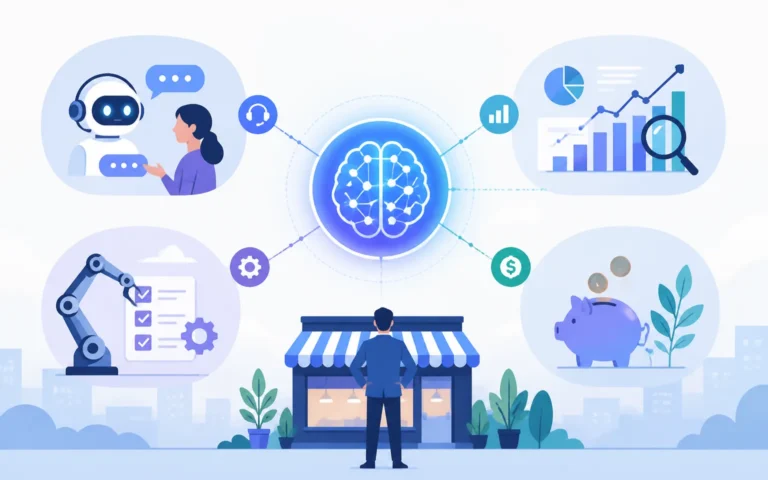
Think of your business as three departments you’d normally hire for: production, front office, and back office. You’re going to staff each one with AI.
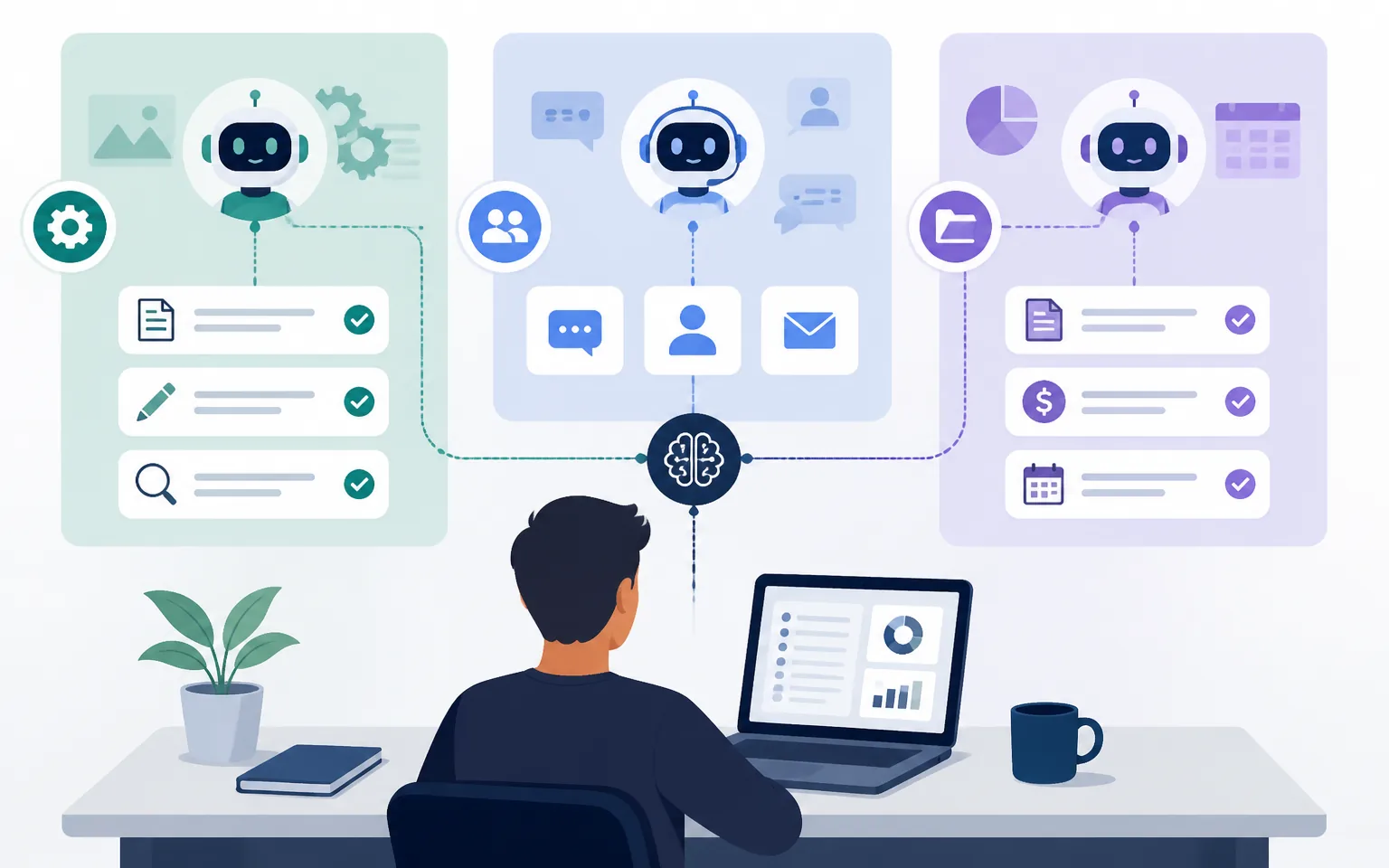
Production: Your Content and Product Engine
This is where AI delivers the most value, and the data agrees: among small businesses that use AI, roughly 71% use it for writing and content generation — by far the most common use case in 2026 small business surveys. My workflow is simple: I use an AI assistant for research synthesis, outlining, and first drafts, then I rewrite in my own voice, add my own experience, and fact-check every claim. The AI does the heavy lifting; I do the thinking. If you want specific tool recommendations, my roundup of the top AI marketing tools covers what I actually use.
Front Office: Customer Service and Sales
AI chatbots and support assistants are the second most common AI use case among small businesses at 38% adoption. For a solopreneur, an AI assistant trained on your FAQ, product details, and policies can handle the majority of inbound questions instantly — the difference between answering emails at midnight and waking up to a clean inbox.
Back Office: Admin, Finance, and Scheduling
Around 29% of AI-adopting small businesses now use AI for scheduling and administrative automation. Invoice generation, expense categorization, meeting scheduling, contract first-drafts — none of this deserves your prime creative hours. Automate it early, because admin debt compounds just like technical debt.
One caution from experience: don’t build a stack of fifteen tools. Pick one AI assistant, one email platform, one payment processor, and one website platform. Every additional tool is a subscription, a login, and a maintenance burden. Lean is the whole point.
Step Three: Set Up Marketing Systems That Compound
A one-person business lives or dies on leverage, and the highest-leverage marketing assets are the ones that keep working while you sleep: search content and an email list.
Search and AI-Search Content
Publish genuinely useful content targeting questions your customers actually ask. In 2026 that means optimizing not just for Google but for AI search engines and answer engines that cite sources. Structure your articles with clear headings, direct answers, and FAQ sections (you’ll notice I practice what I preach).
Your Email List: The Only Audience You Own
I consider the email list the single most valuable asset in my business, and the economics explain why: email marketing returns between $36 and $45 for every $1 spent according to industry ROI benchmarks compiled by Litmus and emailmonday — dwarfing every other channel. Even better for a solo founder, automated email sequences generate 320% more revenue than non-automated sends, which means the welcome sequence you write once keeps selling for years.
AI supercharges both sides of this. It helps you create the lead magnets that grow the list — I broke down my exact process in how to grow your email list with AI lead magnets — and it personalizes what you send. Brands using AI-driven email personalization report up to 42% higher revenue from the channel, per 2026 email marketing research. As one person, you can’t manually segment and personalize for thousands of subscribers. AI can.
Step Four: Automate Operations With AI Agents
Tools respond when you prompt them. Agents work while you don’t. The practical difference in 2026: an AI agent can monitor your inbox and draft replies, watch your niche for news and summarize it every morning, or run your weekly analytics report and flag anomalies — all without you initiating anything.
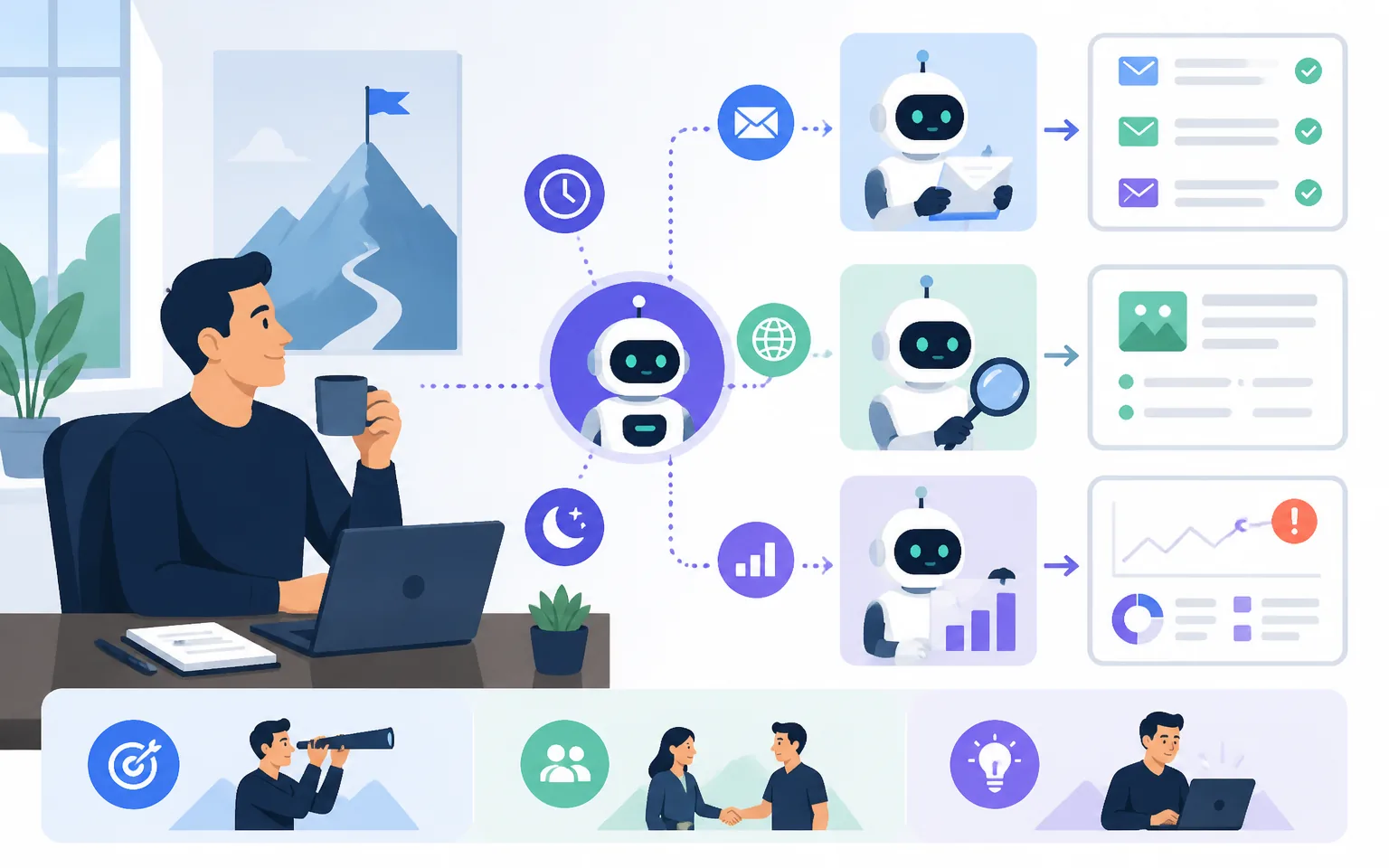
Start small. My rule: automate a task only after you’ve done it manually at least five times, so you understand what “good” looks like well enough to check the agent’s work. Then automate ruthlessly. The solopreneurs winning right now treat themselves as the CEO of a staff of agents, spending their human hours only on strategy, relationships, and the creative work customers actually pay for. I wrote a full breakdown in AI agents for small business if you want to go deeper.
Does the payoff justify the setup time? Salesforce research says yes emphatically: 91% of small businesses using AI report that it directly boosts their revenue. That’s about as close to a consensus as business research ever gets.
Step Five: Price, Launch, and Get Your First Customers
Everything before this step is preparation. Revenue starts here.
Price on value, not hours. As a solopreneur your hours are finite, so hourly pricing caps your income at your calendar. Price digital products on the outcome they deliver and productized services on the business result, not the time invested.
Launch before you’re ready. Your first version should embarrass you slightly. A landing page, a payment link, and a clear promise beat six more weeks of polishing. I use AI to draft launch emails, social posts, and landing page copy in a single afternoon — a task that used to consume a week.
Go where trust already exists. Your first ten customers will come from people who already know you: past colleagues, online communities where you’ve contributed, your personal network. Cold traffic comes later, after your content and SEO systems mature.
Collect proof obsessively. Testimonials, results, screenshots. Social proof is the currency that lets a one-person business punch above its weight against bigger competitors.
The Mistakes I See New Solopreneurs Make
After years in this space, the failure patterns are predictable. Tool obsession: spending months assembling the perfect stack instead of selling something. Full automation of voice: letting AI publish in a generic voice until the audience tunes out — AI should amplify your perspective, never replace it. No email list: building on rented land (social platforms) and losing everything to an algorithm change. Underpricing: charging freelancer rates for entrepreneur-level value. And quitting at month four: right before the compounding kicks in. Traffic, lists, and authority all grow slowly and then suddenly.
My Recommended Thirty-Day Launch Plan
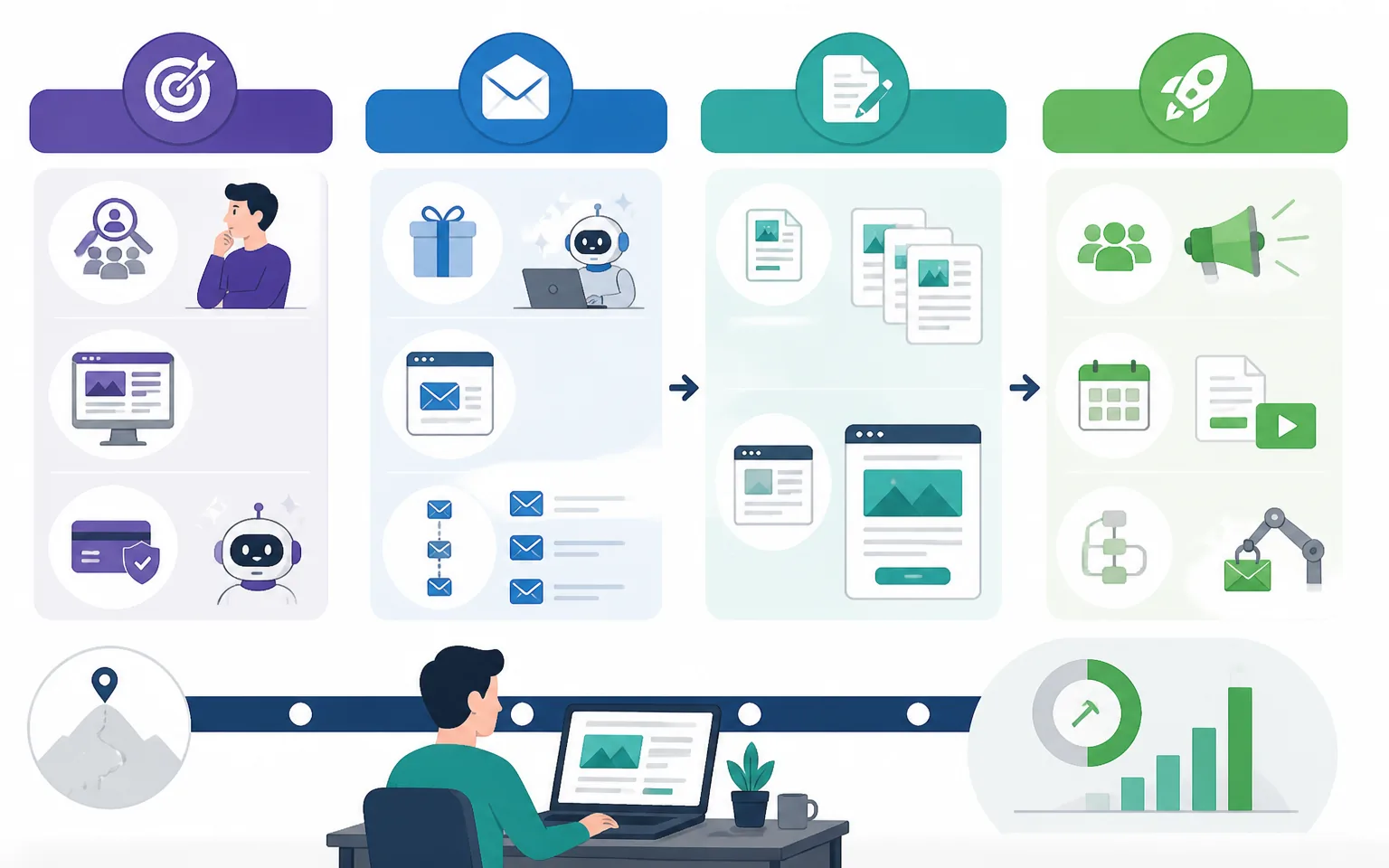
Week one: choose your model and niche, set up your website, payment processing, and one AI assistant. Week two: create your lead magnet with AI assistance, set up your email platform, and write a five-email welcome sequence. Week three: publish your first three cornerstone articles and build your product or service offer page. Week four: launch to your network, start your weekly content cadence, and set up your first automation. That’s it. Thirty days from zero to a functioning business — the QuickBooks finding that 68% of small businesses now use AI regularly (up from 48% in mid-2024) tells you your competitors aren’t waiting, so you shouldn’t either.
Frequently Asked Questions
How much money do I need to start a one-person business with AI?
Less than most people expect. A domain, hosting, an email platform, and one or two AI subscriptions typically total under $100 per month. Your real investment is time and consistency, not capital.
Do I need technical skills to run an AI-powered business?
No. Modern AI tools are conversational — if you can describe what you want in plain language, you can use them. The skill that matters is judgment: knowing what good output looks like in your field and editing accordingly.
Can a one-person business really compete with bigger companies?
Yes, within the right niches. You can’t out-scale a corporation, but you can out-focus one. Speed, personality, and depth in a narrow niche are advantages large teams struggle to replicate — and AI erases most of their production-capacity advantage.
How long until a solo business becomes profitable?
Industry data shows 77% of solopreneurs reach profitability in year one. Realistically, expect three to six months of building before revenue feels meaningful, and twelve to eighteen months before compounding traffic and email growth do the heavy lifting.
Should I quit my job to start?
I generally recommend against it. Build nights and weekends until the business replaces a meaningful share of your income. AI makes moonlighting more feasible than ever because it compresses the hours each task requires.
Final Thoughts
The one-person business used to be a compromise — freedom in exchange for a ceiling. In 2026, with 29.8 million solo operators generating $1.7 trillion and AI handling the work of an entire back office, that ceiling has lifted dramatically.
You don’t need permission, funding, or a co-founder. You need a lean model, a small stack of AI tools used with intention, an email list you own, and thirty focused days. Start this week. Your future staff of AI agents is already waiting for instructions.