Prompt Engineering for Marketers: How I Write AI Prompts That Actually Sell

Prompt engineering is the skill of writing instructions that make AI tools like ChatGPT, Claude, and Gemini produce marketing content that actually converts — and in 2026, it has quietly become the highest-leverage skill in my entire marketing stack. The short answer to “how do I write better AI prompts” is this: give the AI a role, real context about your audience, a specific task, a defined output format, and an example of what good looks like. Do those five things consistently and you will outperform 90% of marketers who still type one-line requests into a chat box and wonder why the output sounds like a robot wrote it.
I have spent the last two years refining prompts for email campaigns, affiliate reviews, SEO briefs, and landing pages on this very site. In this guide, I am going to hand you the exact frameworks I use every day — no fluff, no theory-only filler. According to Salesforce’s State of Marketing 2026 data, 87% of marketers now use generative AI in at least one recurring workflow, up from just 51% in early 2024. The tools are no longer the differentiator. The prompts are.
What Is Prompt Engineering, and Why Should Marketers Care?
Prompt engineering is the practice of structuring your instructions to an AI model so the output matches your intent on the first or second try, instead of the tenth. Think of it as briefing a freelancer. If you tell a freelance writer “write me an email,” you will get something generic. If you hand them your audience persona, your offer, your tone guidelines, and two examples of past winners, you will get something you can actually send.

The stakes are real. A 2025 analysis cited by WifiTalents found that 78% of AI project failures stem from poor human-AI communication, while teams with structured prompting practices report roughly 340% higher ROI than those winging it. That gap is the difference between AI as a toy and AI as a revenue channel.
And this is not a niche skill anymore. The prompt engineering market grew to $1.13 billion in 2025 and is projected to hit $1.52 billion in 2026, according to SQ Magazine’s prompt engineering report, with demand for prompt-engineering skills in job listings growing over 135% in a single year. You do not need the job title. You need the capability.
Why Most Marketing Prompts Fail
After auditing hundreds of my own prompts, I can tell you failure almost always comes down to three habits.
The prompt is too short to succeed
“Write a promo email for my course” gives the model nothing to work with, so it fills the gaps with the most statistically average marketing copy on the internet. Average copy converts at average rates. You are not paying for average.
The prompt has no audience
AI does not know your subscribers are budget-conscious solo bloggers rather than enterprise CMOs unless you say so. Audience context changes vocabulary, objections, pricing framing — everything.
The prompt defines no format
If you do not specify subject line count, word count, structure, and tone, you get a wall of text you then spend twenty minutes reshaping. That editing time is exactly what prompt engineering eliminates. Done right, the payoff is dramatic: TechnologyChecker’s 2026 AI marketing analysis reports that AI-driven campaigns typically deliver a 15–40% uplift in marketing ROI through better targeting and lower production costs — but only when the humans steering the AI know what they are doing.
The Anatomy of a High-Converting Marketing Prompt
Every serious prompt I write contains five components. I remember them as R-C-T-F-E: Role, Context, Task, Format, Examples.
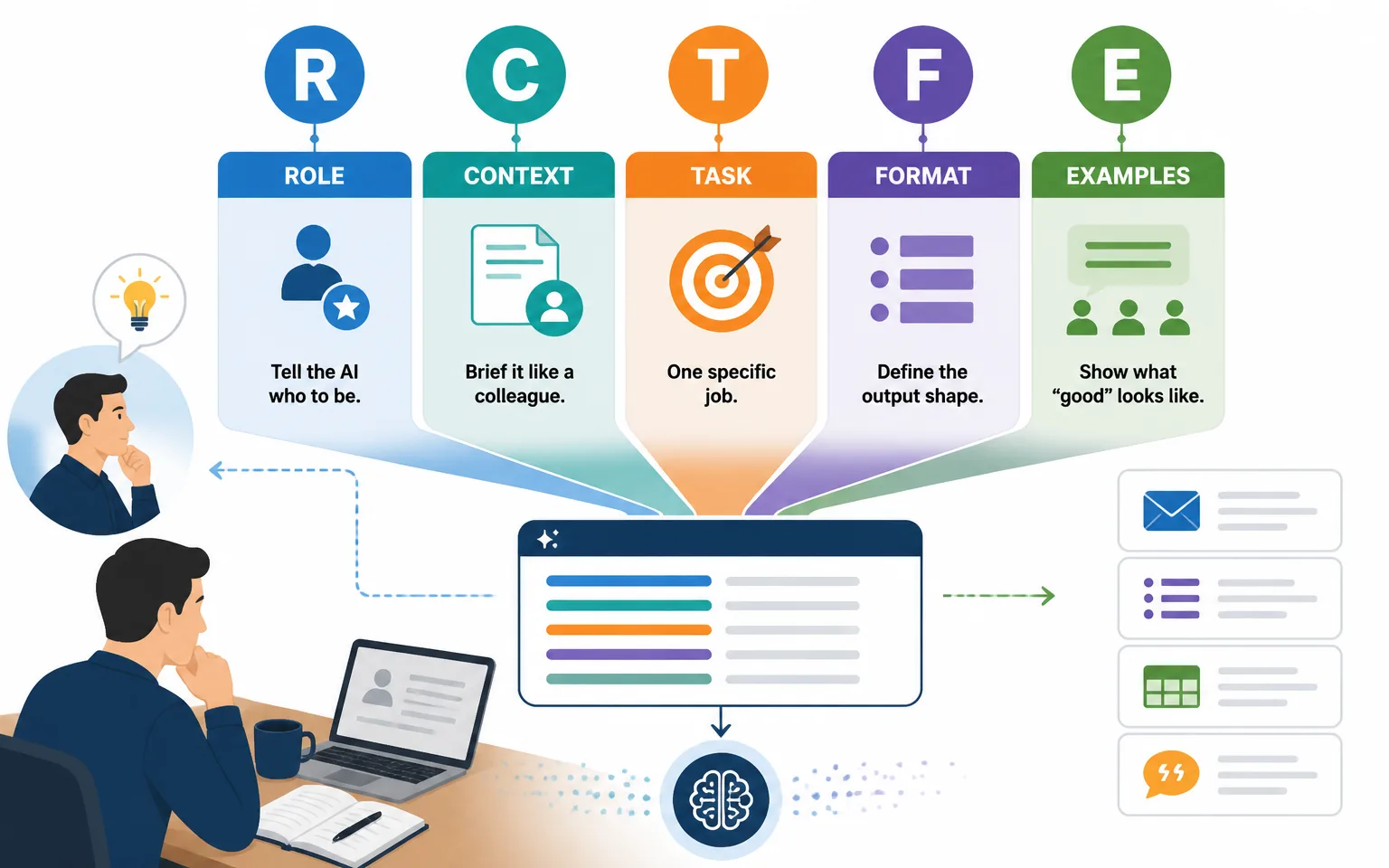
Role: tell the AI who to be
Start with “You are a direct-response email copywriter who writes in a conversational, first-person style.” Role assignment activates the right patterns in the model. It is the cheapest quality upgrade available.
Context: brief it like a colleague
Paste in your audience description, your product details, your unique angle, and what has worked before. I keep a 200-word “brand context block” saved and paste it at the top of every marketing prompt. Context is where most of the 96% of content marketers now using AI — the highest adoption rate of any marketing function, per Searchlab’s 2026 AI marketing statistics — still underinvest.
Task: one specific job
“Write five subject lines under 45 characters that create curiosity without clickbait” beats “help me with my email.” One prompt, one job. Chain prompts for multi-step work.
Format: define the output shape
Word count, structure, markdown or plain text, number of variants, reading level. If you want a table, ask for a table. The model will happily comply — it just will not guess.
Examples: show, don’t describe
Paste one or two examples of copy you love (yours or a competitor’s) and say “match this voice and rhythm.” This technique, called few-shot prompting, is the single biggest quality lever I know. It is also why generic AI content is so easy to spot: nobody gave the model a voice to imitate.
My Five Go-To Prompt Frameworks for Marketing
Frameworks keep you from reinventing the wheel at 11 p.m. before a launch. These five cover most of my marketing work, and they compound: the economics are stunning when you get them right. Structured prompt workflows cut content creation costs by 60–80% for teams that adopt them, based on the WifiTalents data I referenced earlier.
The Persona Ladder
Ask the AI to first write out your target reader’s top three pains, top three desires, and top three objections — then write the copy addressing them in order. Separating the empathy step from the writing step produces noticeably sharper copy.
The Critique Loop
Generate a draft, then follow up with: “Now act as a skeptical reader who almost clicked away. What is weak, unclear, or unconvincing? Rewrite fixing only those issues.” Two passes, dramatically better output.
The Variant Matrix
Request the same message in five emotional registers — curiosity, urgency, proof, story, contrarian — and A/B test the top two. This is how I test angles without burning days on production.
The Extraction Prompt
Feed the AI a long asset (webinar transcript, blog post, case study) and ask for the ten strongest hooks, quotes, and stats. I covered the full workflow for this in my guide to building an AI content repurposing workflow, and it remains the fastest way to turn one asset into a month of emails.
The Compliance Pass
A final prompt that checks copy against a checklist: claims substantiated, no spam-trigger words, disclosure included where needed, CTA present. Boring, and it has saved me repeatedly.
Prompt Engineering for Email Marketing
Email is where prompt skill pays fastest, because email still prints money: the channel returns roughly $36–$42 for every dollar spent in 2026, far ahead of paid search and social ads, according to Digital Applied’s email marketing statistics. Small copy improvements multiply across every send.
Subject lines are the obvious starting point. Organizations using AI to generate and optimize subject lines see about a 26% increase in open rates versus manually written ones, per the same Digital Applied research, and layering AI send-time optimization on top adds a further 14% lift. My subject line prompt is simple: role (email copywriter), context block, the email’s core promise, then “ten subject lines under 45 characters: three curiosity, three benefit-led, two urgency, two contrarian. No clickbait, no emoji.”
For full sequences, I draft the strategy first — “map a five-email launch sequence with the job of each email” — approve the map, then generate one email per prompt with the map pasted in as context. Sequence coherence collapses when you ask for all five emails in one go. Pair this with behavioral targeting (I walk through the setup in my post on AI email segmentation and automation) and you are executing at a level most solo marketers never reach. You will also be ahead of the curve: by late 2026, an estimated 61% of enterprise email programs will use AI in at least one element of campaign creation. Solo operators with good prompts can match them.
Prompt Engineering for Affiliate Content
Affiliate writing has a specific failure mode with AI: hallucinated product details. My rule is that the AI never generates facts — it only shapes facts I provide. I paste in verified specs, pricing, my genuine pros and cons from testing, then prompt: “Using only the information provided, write a comparison section. If information is missing, insert [VERIFY] rather than guessing.”
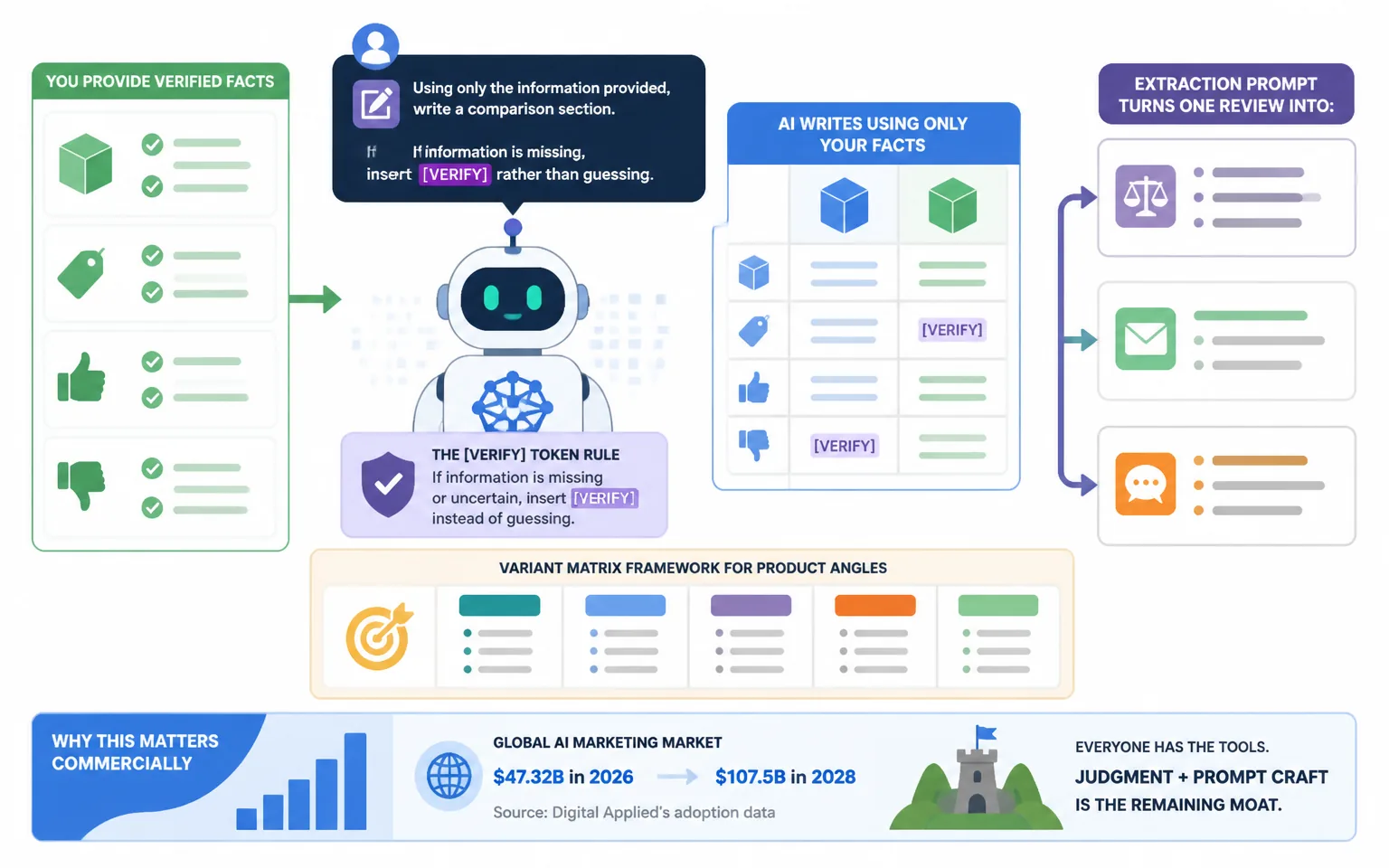
The “[VERIFY] token” trick alone will save your credibility. From there, the Variant Matrix framework works beautifully for product angles, and the Extraction Prompt turns one in-depth review into comparison posts, email promos, and FAQ snippets. I go deeper on the full system in my playbook on how to use AI to scale affiliate marketing.
This matters commercially because the field is crowding fast. The global AI marketing market reached $47.32 billion in 2026 and is projected to hit $107.5 billion by 2028, per Digital Applied’s adoption data — everyone has the tools now. Judgment plus prompt craft is the remaining moat.
Build a Prompt Library (Your Compounding Asset)
Every prompt that produces a winner goes into a simple document with four fields: name, use case, the full prompt, and a note on results. Mine lives in a plain Notion table and currently holds about forty battle-tested prompts. When a campaign works, I do not just save the copy — I save the prompt that produced it.
Version your prompts like software. When I tweak a subject-line prompt, I duplicate it as v2 and note what changed. Over months, you learn what your audience responds to at the instruction level, which is knowledge no competitor can copy. Given that 88% of marketers now report using AI tools daily, per AI Business Weekly’s adoption roundup, the marketers who systematize this daily usage are the ones compounding while everyone else starts from a blank chat window every morning.
Common Prompt Engineering Mistakes to Avoid
A few traps I see constantly. First, one-shot perfectionism: expecting the first output to be final. Plan for two to three refinement turns; that is the workflow, not a failure of it. Second, over-stuffed prompts: cramming five tasks into one instruction confuses priority — chain instead. Third, no human pass: AI drafts, you finish. Your stories, your opinions, your specifics are what make content rank and convert in an era of sameness. Fourth, ignoring the model’s questions: ending prompts with “ask me up to three clarifying questions before writing” routinely surfaces gaps I did not know I had left.
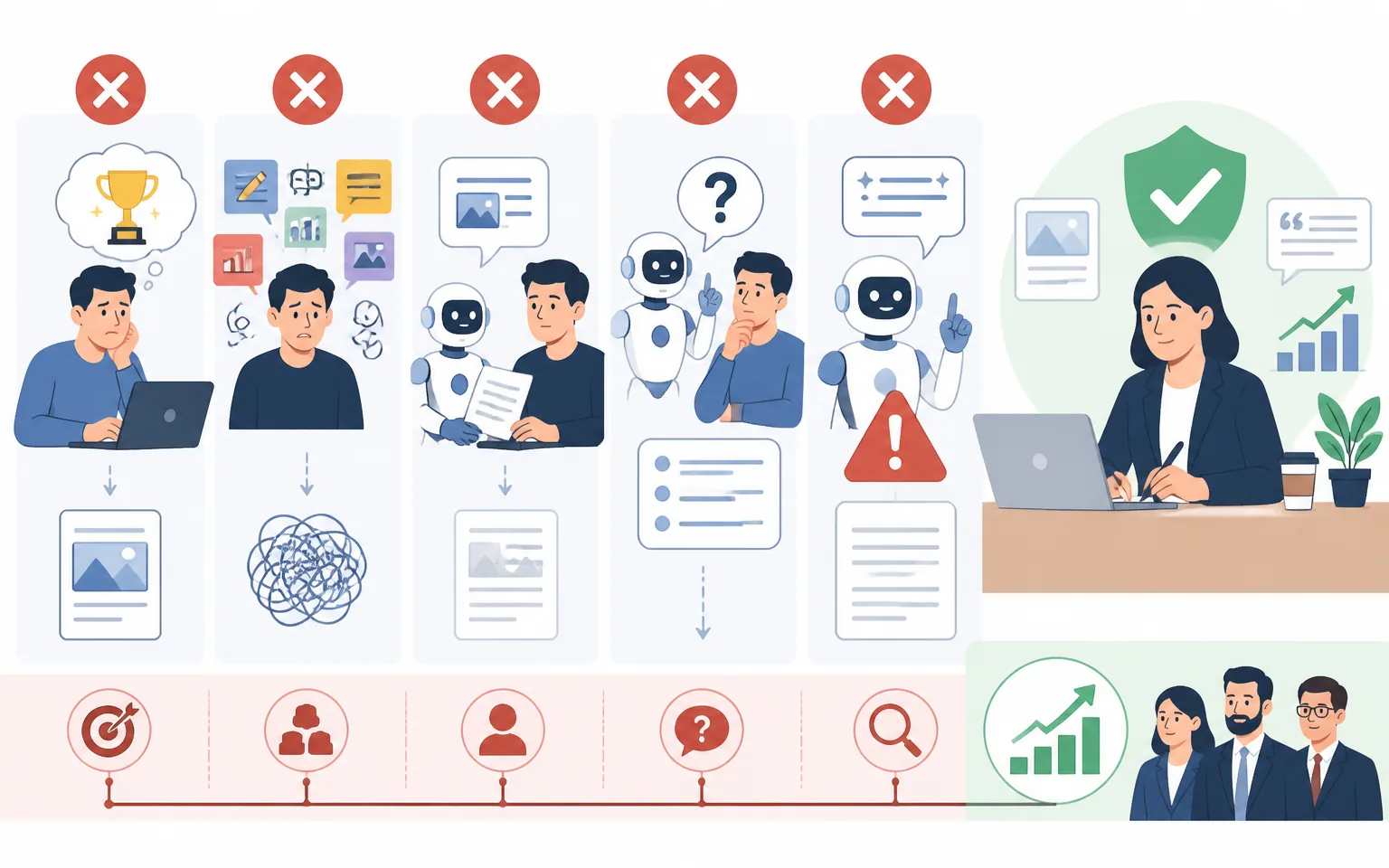
Finally, do not confuse fluency with accuracy. AI writes confidently whether it is right or wrong. Verify every stat, every feature claim, every price before publishing — the same discipline I preach in my guide to using ChatGPT for marketing. The executives are already convinced of the upside — 93% of CMOs say generative AI is delivering clear ROI, per BizIQ’s AI marketing statistics — but ROI accrues to teams with quality control, not just enthusiasm.
Frequently Asked Questions
Do I need technical skills to learn prompt engineering?
No. Marketing prompt engineering is closer to writing a great creative brief than to coding. If you can clearly describe your audience, offer, and desired outcome, you have the raw material. The frameworks in this guide are entirely plain-language.
Which AI model is best for marketing prompts?
The frameworks matter more than the model. I use Claude for long-form drafts and voice matching, ChatGPT for ideation and quick variants, and Gemini when I need current-events grounding. A well-engineered prompt outperforms a lazy prompt on any model, every time.
How long should a marketing prompt be?
As long as a good freelancer brief: usually 150–400 words including your context block and examples. Under 50 words, you are gambling. The exception is follow-up refinements, which can be one line.
Will AI-generated content hurt my SEO?
Google’s guidance targets unhelpful content, not AI-assisted content. Content that demonstrates first-hand experience, cites verifiable sources, and answers real questions performs fine regardless of drafting method. Thin, unedited AI output is what gets penalized — another reason the human editing pass is non-negotiable.
Is prompt engineering still worth learning, or will AI just get smarter?
Models improve, but the core skill — clearly specifying audience, intent, constraints, and quality bar — becomes more valuable as AI gets more capable, not less. Better engines reward better drivers.
Final Thoughts
Prompt engineering is not about magic words. It is about transferring what you already know about your audience and your offer into instructions an AI can execute. Start with the R-C-T-F-E structure on your very next email, save what works into a library, and iterate weekly. Within a month you will produce more, better, and faster than you thought possible — and unlike an ad budget, this skill compounds for free. If you try just one thing today, make it the Critique Loop. That second pass is where good copy becomes copy that sells.