Welcome Email Sequence: The Complete Guide to Converting New Subscribers in 2026

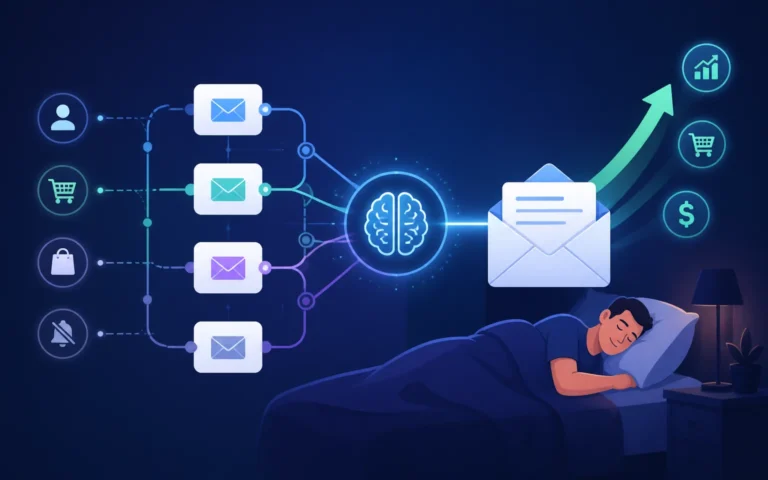
Here is a number that changed how I think about email marketing: automated emails make up roughly 2% of total email volume, yet they drive about 37% of all email-generated sales, per Omnisend’s analysis of 150,000+ brands, according to Omnisend’s 2026 benchmark data. And sitting at the very top of that automation pyramid is one flow almost every business either skips or half-builds — the welcome email sequence.
I have audited dozens of email programs over the years, and the pattern is depressingly consistent. Someone signs up, gets a single “Thanks for subscribing!” email (or worse, nothing at all), and then hears nothing until the next promotional blast. That is like a store clerk greeting a new customer at the door, handing them a receipt, and walking away.
In this guide, I will show you exactly how I build welcome sequences that convert — the structure, the timing, the copy angles, and how I use AI to personalize the whole thing without adding hours of work. By the end, you will have a complete blueprint you can implement this week.
Why the Welcome Sequence Is Your Highest-Leverage Email Asset
Let me start with the case for why this matters more than almost anything else on your email to-do list.
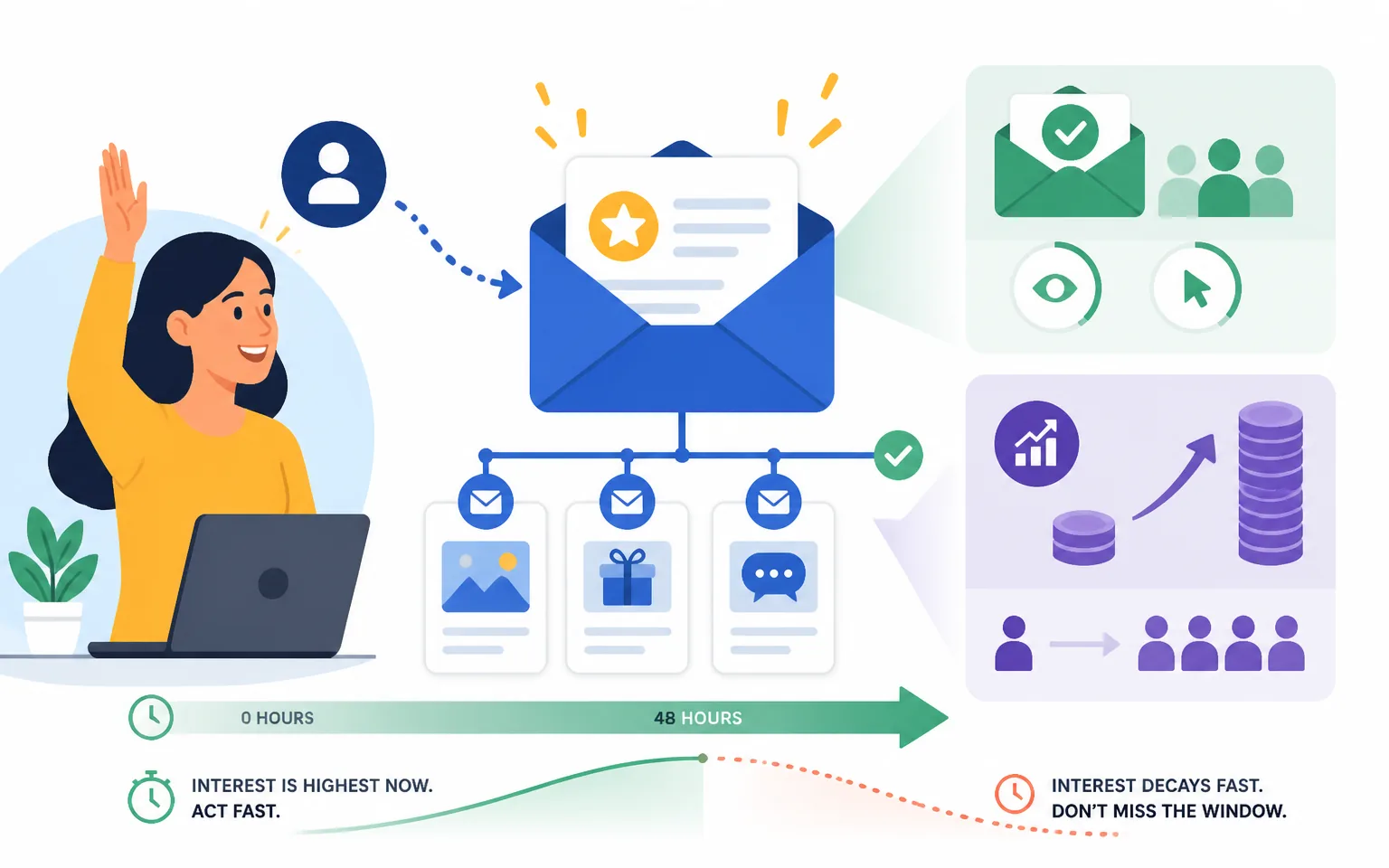
Welcome emails achieve an average open rate of 83.6% with a 16.6% click-through rate, according to Mailmend’s 2026 analysis of welcome email performance — making them the single highest-performing automated email type in existence. Compare that to your typical campaign, where a 35% open rate counts as a good day.
The reason is simple: timing. A new subscriber just raised their hand. They are more curious about you in the first 48 hours than they will ever be again. Interest decays fast, and the welcome sequence is how you convert that peak attention into a relationship — and revenue.
The revenue side is just as dramatic. Across 183,000+ Klaviyo stores, the 2026 median revenue per recipient is $0.11 for campaigns but $1.94 for automated flows, per Geysera’s analysis of Klaviyo benchmark data — and the welcome series specifically reaches around $2.65 per recipient because it captures customers at peak engagement. In plain terms: the same email address is worth roughly 20x more inside a well-built automation than inside your weekly newsletter.
If you are still growing your list, pair this guide with my post on using AI lead magnets to grow your email list — the welcome sequence is the engine, but you still need fuel.
The 5-Email Welcome Sequence Framework I Use
There is no single “correct” number of emails, but after testing short and long variants, I keep coming back to a five-email structure spread over 10 to 14 days. Here is each email, what it does, and why the order matters.
Email 1: Deliver and Delight (Immediately)
This email goes out within minutes of signup. It has three jobs: deliver whatever you promised (lead magnet, discount code, resource), set expectations for what comes next, and ask for one tiny action — usually replying to a question or moving you to the primary inbox.
That reply request is not a gimmick. Replies are one of the strongest positive engagement signals mailbox providers track, and they materially improve your inbox placement for every future email. I ask something easy: “What is the one thing you are trying to fix with your email marketing right now?” The answers also become a goldmine for content ideas.
Email 2: Your Story and Your Angle (Day 2)
People buy from people. Email 2 is where I tell subscribers who I am, why I do this, and — critically — what I believe that others in my space do not. A point of view is more memorable than a resume. Keep it under 400 words and end with a soft pointer to your best free content.
Email 3: The Quick Win (Day 4)
Give the subscriber a result they can achieve in under 15 minutes. For my audience, that might be a three-line subject line formula or a segmentation tweak. When someone gets a tangible win from your free emails, the mental math on your paid offer changes completely. Omnisend’s 2026 email benchmarks put average welcome automation conversion at 2.11% — but the sequences that front-load a genuine quick win are the ones that beat that number.
Email 4: Proof and Objection Handling (Day 7)
This is the social proof email: a case study, a customer story, or a before-and-after. Structure it around the single biggest objection your buyers have. If your product seems complicated, show someone non-technical succeeding. If it seems expensive, show the ROI math. Welcome emails generate roughly 320% more revenue per email than standard promotional sends, according to CodeCrew’s 2026 email statistics roundup — and this proof email is usually where that revenue actually lands.
Email 5: The Direct Offer (Day 10)
Now — and only now — you make a clear, unapologetic offer. A deadline or expiring incentive helps: honest urgency (a genuinely expiring welcome discount) outperforms fake countdown timers, which subscribers can smell instantly. If they do not buy, they simply roll into your regular newsletter list. No hard feelings, and the relationship you built keeps paying off in campaign engagement for months.
Timing and Cadence: What the Data Says
Two timing rules I never break. First, Email 1 must be instant. Every hour of delay costs you engagement, because that post-signup curiosity spike decays fast. Second, never let more than four days pass between welcome emails — gaps are where subscribers forget who you are, and forgotten senders become spam complaints.
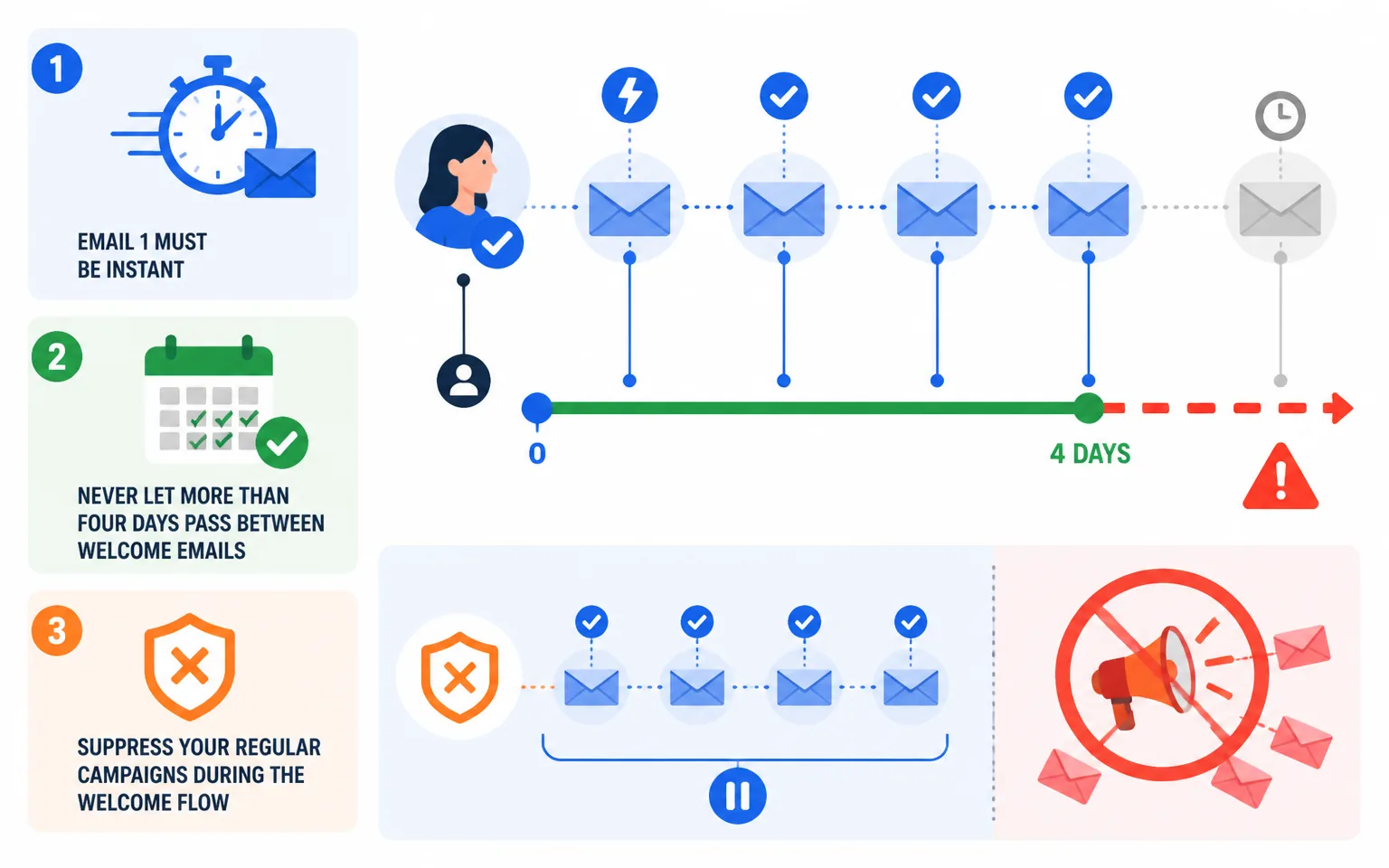
One more structural decision: suppress your regular campaigns while someone is in the welcome flow. Mixing a day-3 welcome email with a same-day promo blast is the fastest way to confuse a new subscriber and inflate unsubscribes.
How I Use AI to Personalize the Welcome Flow
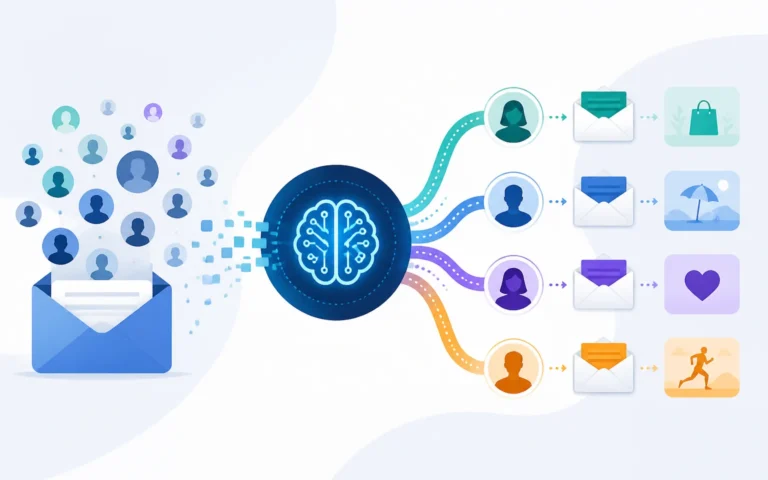
Here is where 2026 gets interesting. The classic welcome sequence is one-size-fits-all. AI lets a solo operator run the kind of branching personalization that used to require an enterprise lifecycle team.
Three practical applications I use today:
Signup-source branching. Someone who joined from a blog post about affiliate marketing should get different examples in Emails 3 and 4 than someone who came from a lead magnet about AI tools. I use AI to generate variant copy blocks for each source, which turns one sequence into five tailored ones in an afternoon.
Reply mining. Remember that question in Email 1? I feed the replies into an AI assistant weekly to cluster the answers into themes. Those themes decide which pain point Email 4’s case study addresses. My segmentation approach is covered in depth in my guide to AI email segmentation and automation.
Subject line iteration. Welcome emails already open well, but the difference between a 70% and an 85% open rate on Email 1 compounds across the whole sequence. I batch-generate and test variants using the process from my AI email subject lines guide.
The payoff for getting personalization right is real: behavior-triggered marketing emails generate about 10 times greater revenue than generic marketing sends, per Klaviyo’s 2026 benchmark research. A welcome sequence that adapts to who the subscriber actually is sits squarely in that category.
Deliverability: The Unsexy Foundation
None of this matters if your emails land in spam. Before launching a welcome sequence, verify three things: your domain authentication (SPF, DKIM, and DMARC) is set up correctly, your signup forms use confirmed opt-in or at least a bot honeypot, and your Email 1 avoids the classic spam triggers — excessive images, link-heavy footers, and ALL-CAPS urgency.
Welcome flows actually help deliverability over time. Because they generate opens, clicks, and replies at rates far above normal campaigns, they teach Gmail and Outlook that your domain sends wanted mail. A strong welcome sequence is effectively a warm-up machine for your sender reputation.
The Metrics That Actually Matter
Skip vanity dashboards. I track four numbers for every welcome sequence: sequence completion rate (what percentage of subscribers receive all five emails without unsubscribing — aim above 90%), reply rate on Email 1 (my health check for list quality), conversion rate on Email 5 (Omnisend’s 2026 data pegs the ecommerce average at 2.11%, with B2B technology welcome flows reaching around 3.0%), and revenue per recipient across the whole flow.
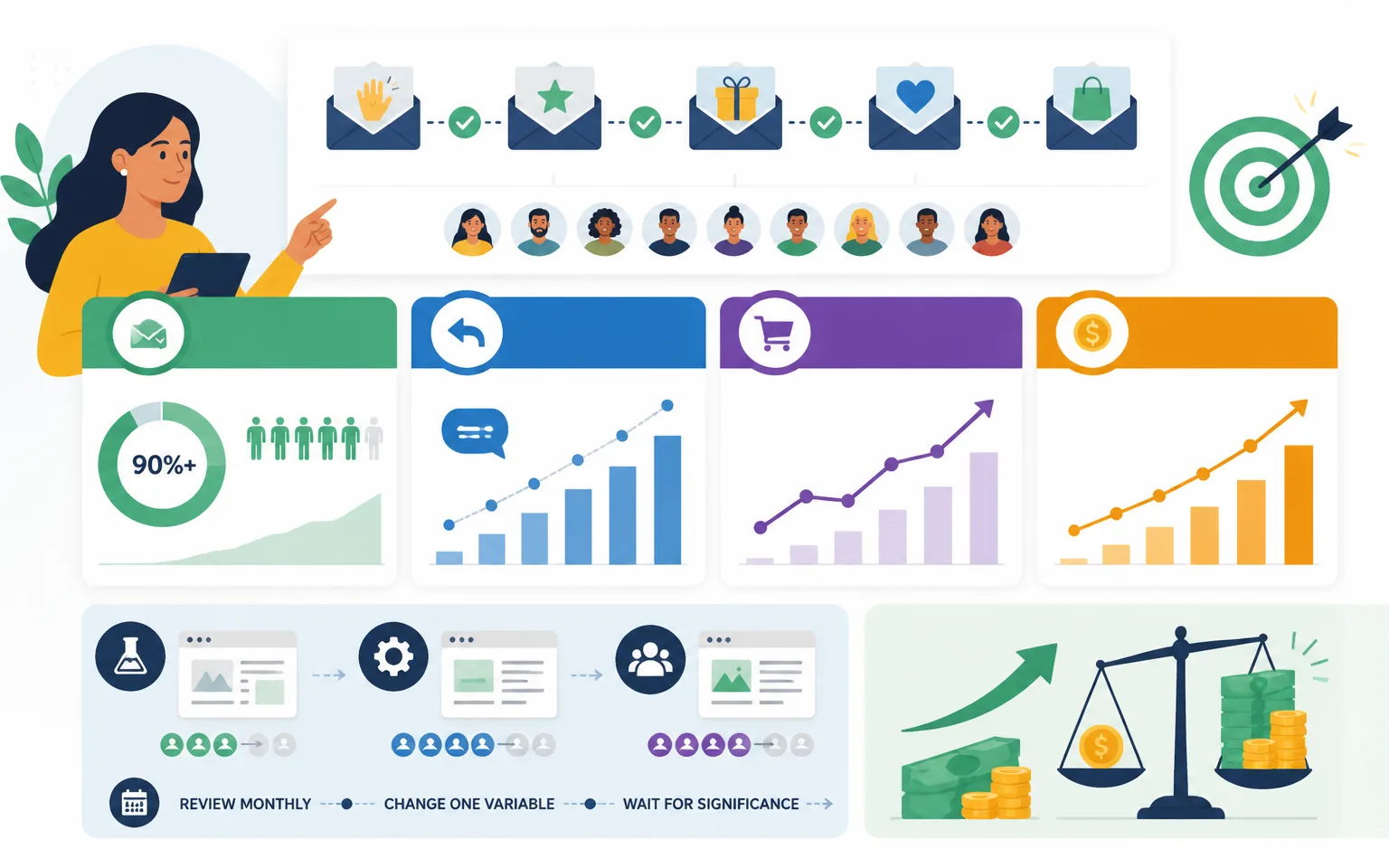
Review these monthly, change one variable at a time, and give each change at least a few hundred subscribers before judging it. The broader context is friendly: with email marketing returning an average of $36 to $42 for every $1 spent in 2026 according to industry ROI benchmarks compiled by Marketful, even modest improvements to your highest-converting flow move real money.
Common Welcome Sequence Mistakes I See Constantly
A few failure patterns worth naming so you can avoid them.
Selling in Email 1. The subscriber asked for a resource, not a pitch. Lead with generosity; the offer lands harder in Email 5 because you earned it.
One email and done. A single welcome email captures the open but wastes the relationship. The revenue is in the sequence, not the greeting.
No expiration on the flow. Subscribers who finish the sequence without buying should move to your regular list — and eventually into a re-engagement track. I covered that end of the lifecycle in my post on win-back email campaigns.
Writing it once and never touching it. Your welcome sequence talks to every new subscriber you will ever get. It deserves a quarterly review more than any other asset in your email program.
Which Platform Should You Build This In?
The honest answer: the one you already use, as long as it supports multi-step automation with delays and exit conditions. Every mainstream platform — Klaviyo, Omnisend, MailerLite, ConvertKit, ActiveCampaign, Brevo — can run the five-email framework in this guide. The framework matters far more than the tool.
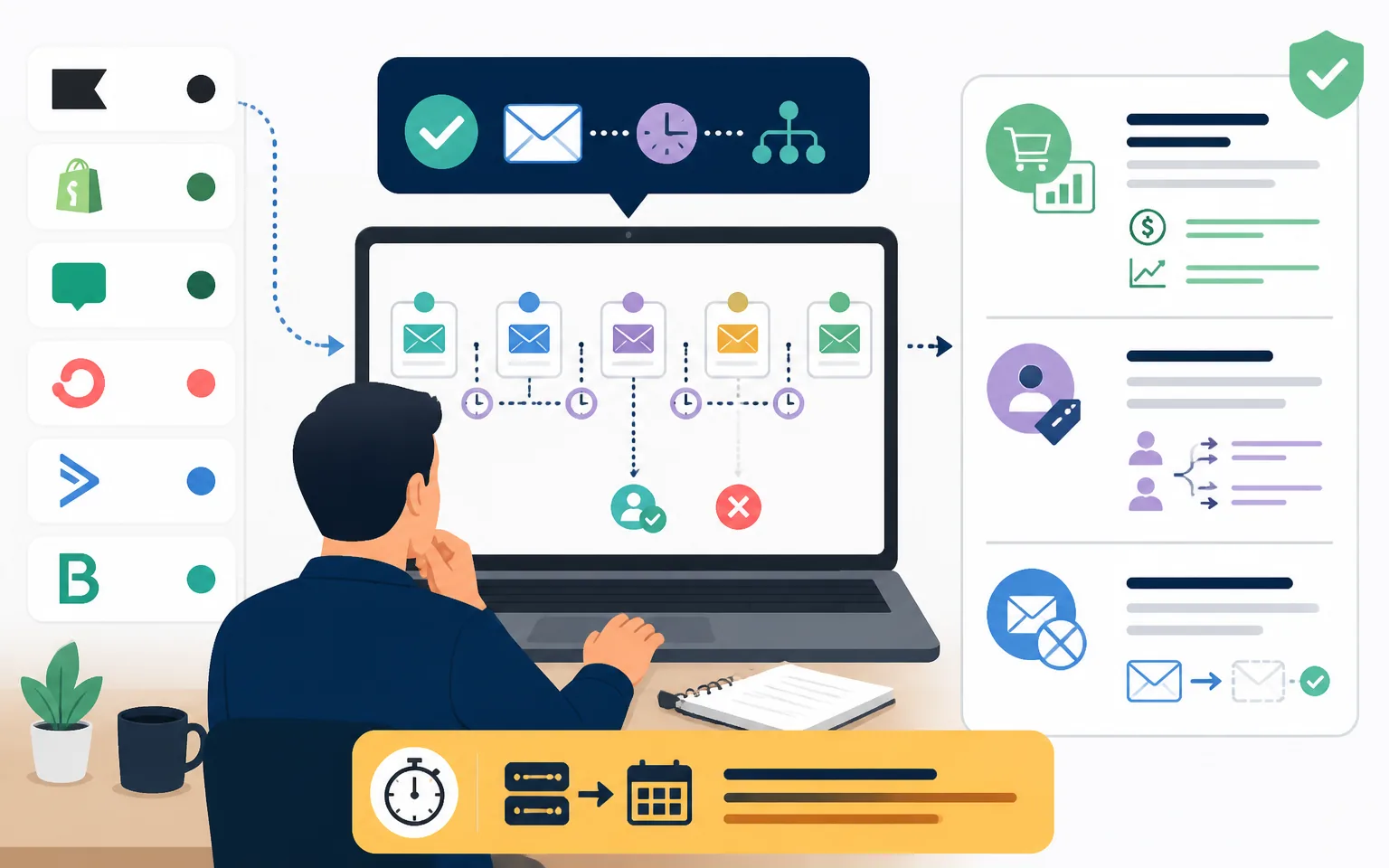
That said, a few selection criteria if you are choosing fresh. If you run an ecommerce store, pick a platform with native revenue attribution per flow email, because you cannot optimize what you cannot measure — this is exactly where the $1.94 flow versus $0.11 campaign revenue-per-recipient gap shows up in your own dashboard. If you are a creator or service business, prioritize easy tagging by signup source, since that is what powers the personalization branching from earlier. And whatever you choose, confirm it can suppress campaign sends for subscribers currently inside the welcome flow; platforms that cannot do this force you into the exact overlap problem I warned about in the timing section.
Do not switch platforms just to build a welcome sequence. Migration costs weeks; this flow costs an afternoon.
Frequently Asked Questions
How many emails should a welcome sequence have?
Three to six emails works for most businesses. I recommend five over 10–14 days: delivery, story, quick win, proof, and offer. Fewer than three wastes the engagement window; more than seven risks fatigue before your first real campaign.
Should the first welcome email include a discount?
If you promised one at signup, yes — deliver it instantly. If not, I prefer saving the incentive for Email 5, where it creates a natural deadline. Leading with an unrequested discount trains subscribers to wait for deals.
How soon should the first email be sent?
Immediately — within minutes of signup. Welcome emails open at roughly 83.6% on average per Mailmend’s 2026 data precisely because they arrive while interest is at its peak. Every hour of delay erodes that advantage.
Do welcome sequences work for B2B and service businesses?
Yes — often better. B2B technology welcome flows convert at around 3.0%, above the ecommerce average, because the quick-win and proof emails map naturally onto a considered purchase. Swap the discount in Email 5 for a call booking or trial.
Can AI write my entire welcome sequence?
AI can draft it, but the story email and your point of view have to be genuinely yours — subscribers can tell. My workflow: I outline the sequence, use AI for variants and personalization branches, then rewrite every email in my own voice before it ships.
Final Thoughts
The welcome email sequence is the rare marketing asset that you build once and that then greets every single subscriber you will ever acquire, at the exact moment they care most. The data backs this up from every angle — 83.6% open rates, $2.65 revenue per recipient, 320% more revenue per email than promotional sends — but the deeper truth is simpler: first impressions compound.
Block out one afternoon this week. Write the five emails using the framework above, wire up the automation in whatever platform you use, and let it run for 30 days before judging it. Then tell me how it went — I read every reply.