AI Email Segmentation & Automation Guide

If you only change one thing about your email program this year, make it this: stop sending the same message to everyone. AI-powered segmentation and automated flows are the single biggest lever I know of for turning a flat email list into a revenue engine — segmented campaigns earn a 100.95% higher click-through rate than non-segmented sends, and automated flows pull roughly 18x the revenue per recipient of one-off broadcasts. In this guide I’ll walk you through exactly how I set up AI segmentation, which automated flows actually move the needle, and how to avoid the deliverability traps that quietly kill results.
As you build automated flows, keep them compliant with the FTC’s CAN-SPAM guidance, which applies to automated sequences just as it does to one-off campaigns.
Why Email Segmentation Still Wins in 2026
Email remains the highest-ROI channel in marketing, and it isn’t close. In 2026 email delivers an average return of roughly $36–$42 for every dollar spent, outperforming paid search, social ads, and display advertising (WSI World). But that headline number hides a wide gap between senders who blast their whole list and senders who segment intelligently.
The data is blunt about that gap. According to the DMA, around 25% of email revenue comes from segmented lists, and segmented sends drive about 30% of total revenue despite being a fraction of volume. Marketers who segment consistently report 30% to 50% better performance than those who don’t (Mailmodo). When I migrated my own list from “send to all” to even a handful of basic segments, the difference in engagement was immediate and obvious.
Segmentation is also the tactic marketers themselves rank highest. List segmentation sits at the top of the most-used email tactics at 51%, just ahead of personalization at 50% and triggered emails at 45%. And a striking 90% of email professionals say targeting messages by subscriber segment increases performance. If you’ve been treating segmentation as an advanced, nice-to-have step, the numbers say it’s actually the foundation.
What AI Actually Changes About Segmentation
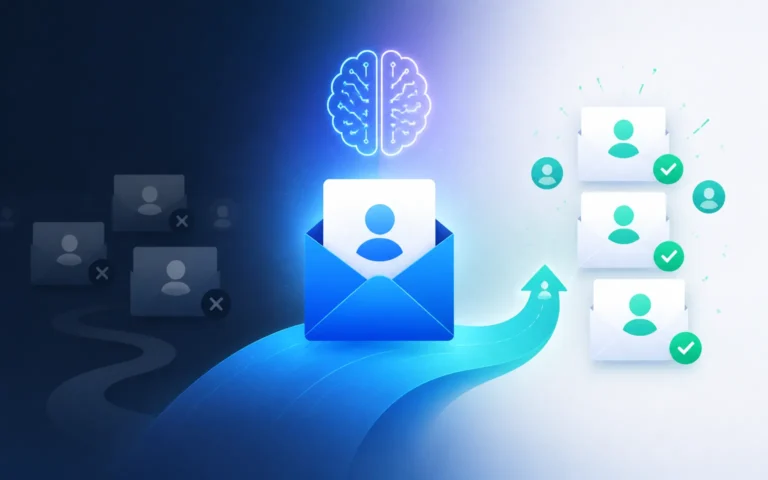
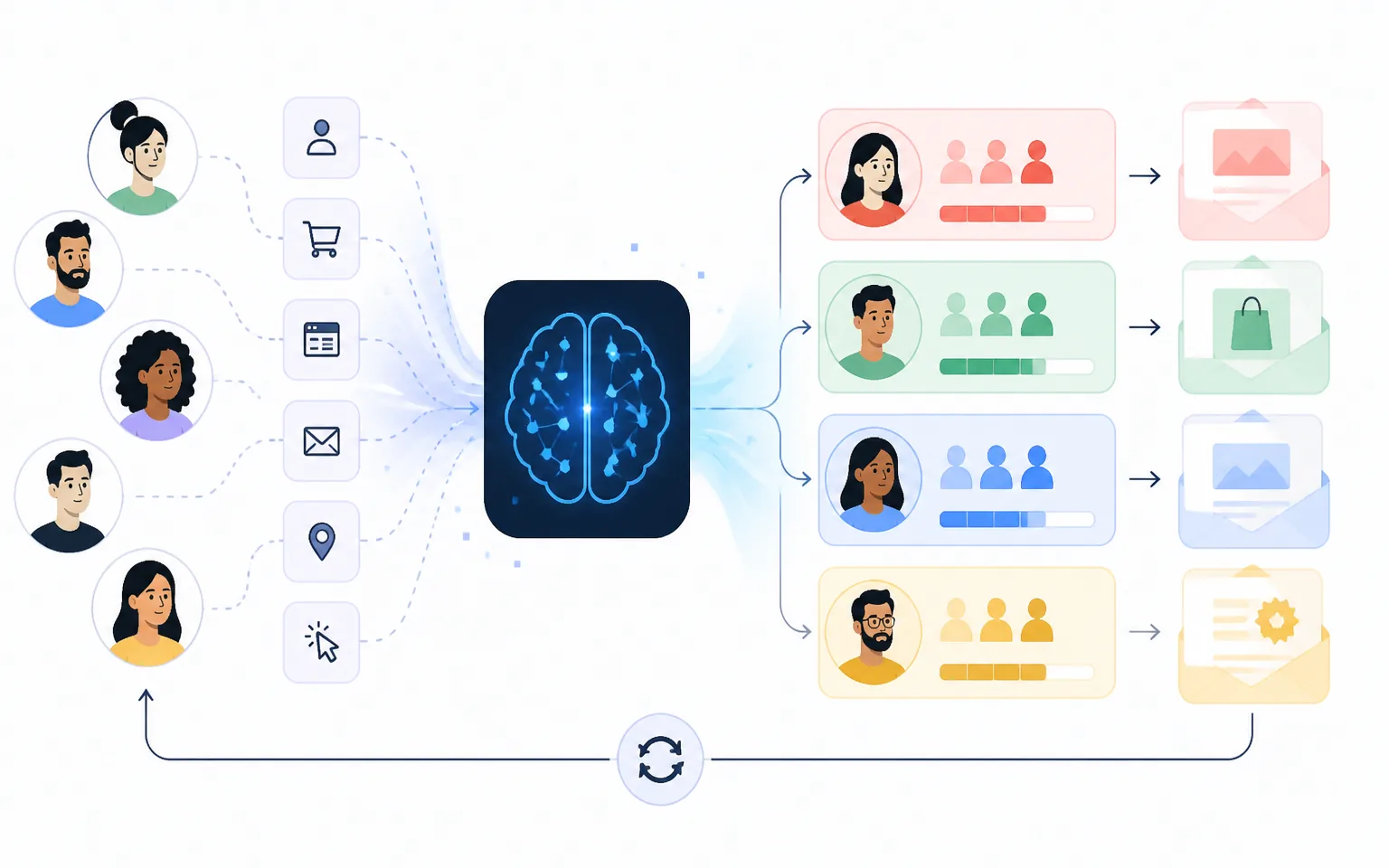
For years, segmentation meant manual rules: tag people by signup source, split by purchase history, maybe a region filter. That still works, but it’s labor-intensive and static. AI changes the game by doing two things humans struggle to do at scale — predicting behavior and continuously re-sorting your audience as that behavior shifts.
The lift is real. Industry research shows AI-powered personalization in email produces a 41% increase in revenue and a 13.44% boost in click-through rates (Digital Applied). Advanced AI adopters are also 75% more likely to clear a 45:1 ROI than teams that haven’t adopted these tools. Adoption is accelerating fast too: 49% of marketers used generative AI to write email copy in 2025, and that figure is projected to reach 80% by 2027.
Predictive Segments
This is where AI earns its keep. Instead of segmenting by what someone did, predictive models segment by what they’re likely to do next — who’s about to churn, who’s primed for a second purchase, who has the highest predicted lifetime value. Platforms like Klaviyo and others now ship these predictive scores out of the box, so even a solo operator can target a “high churn risk” segment without building a data science team.
Engagement-Based Sorting
AI continuously watches opens, clicks, and site behavior, then moves contacts between engaged and unengaged buckets automatically. That matters for more than relevance — it directly protects deliverability, because suppressing chronically unengaged contacts keeps your sender reputation healthy. Personalized, well-targeted emails hit a 20.9% open rate versus just 9.7% for generic blasts (Digital Applied), and that engagement signal compounds in your favor with inbox providers.
AI-Written Subject Lines and Copy
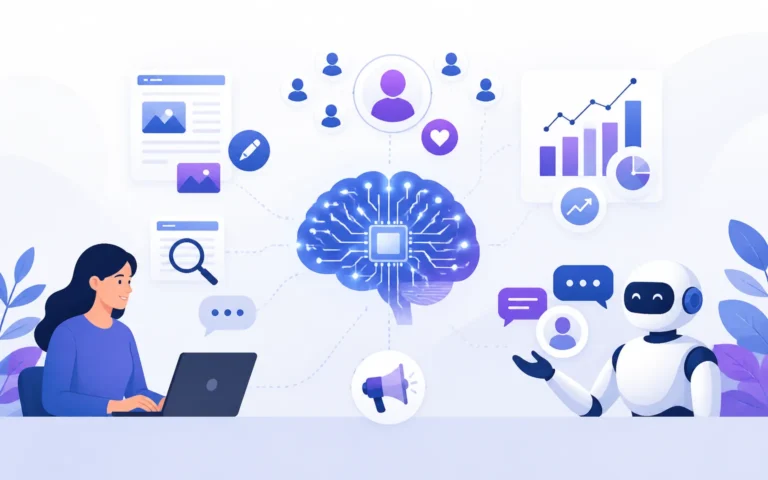
Segmentation tells you who; AI copy tools help with what. Organizations using AI to generate and optimize subject lines see a 26% increase in open rates compared to manually written versions (BuildMVPFast). I lean on AI for first drafts and variant generation, then edit for voice — a workflow I break down further in my guide on how to use ChatGPT for marketing.
The Core Segments I Build First
You don’t need fifty segments. You need a handful that map to real intent. These are the ones I set up before anything else, and they cover the majority of revenue opportunity for most lists.
First, new subscribers: anyone who joined in the last 14–30 days. They’re the warmest audience you’ll ever have, which is why welcome emails outperform promotional sends by 320% and hit an 83.6% open rate — the highest of any automated email type (AI Advantage Agency).
Second, engaged buyers: people who’ve purchased and opened recently. Behavior-based personalization using purchase history boosts click-through by up to 39% (Mailmodo), so this segment deserves your best product recommendations and loyalty offers.
Third, at-risk and lapsed: contacts whose engagement is sliding. Catching them with a win-back sequence before they go fully cold is far cheaper than acquiring a replacement subscriber. Fourth, high-value / VIP: your top spenders by predicted lifetime value, who warrant early access and a more personal tone. Get these four right and you’ve captured most of the upside before you ever build something fancier.
The Automated Flows That Drive Real Revenue
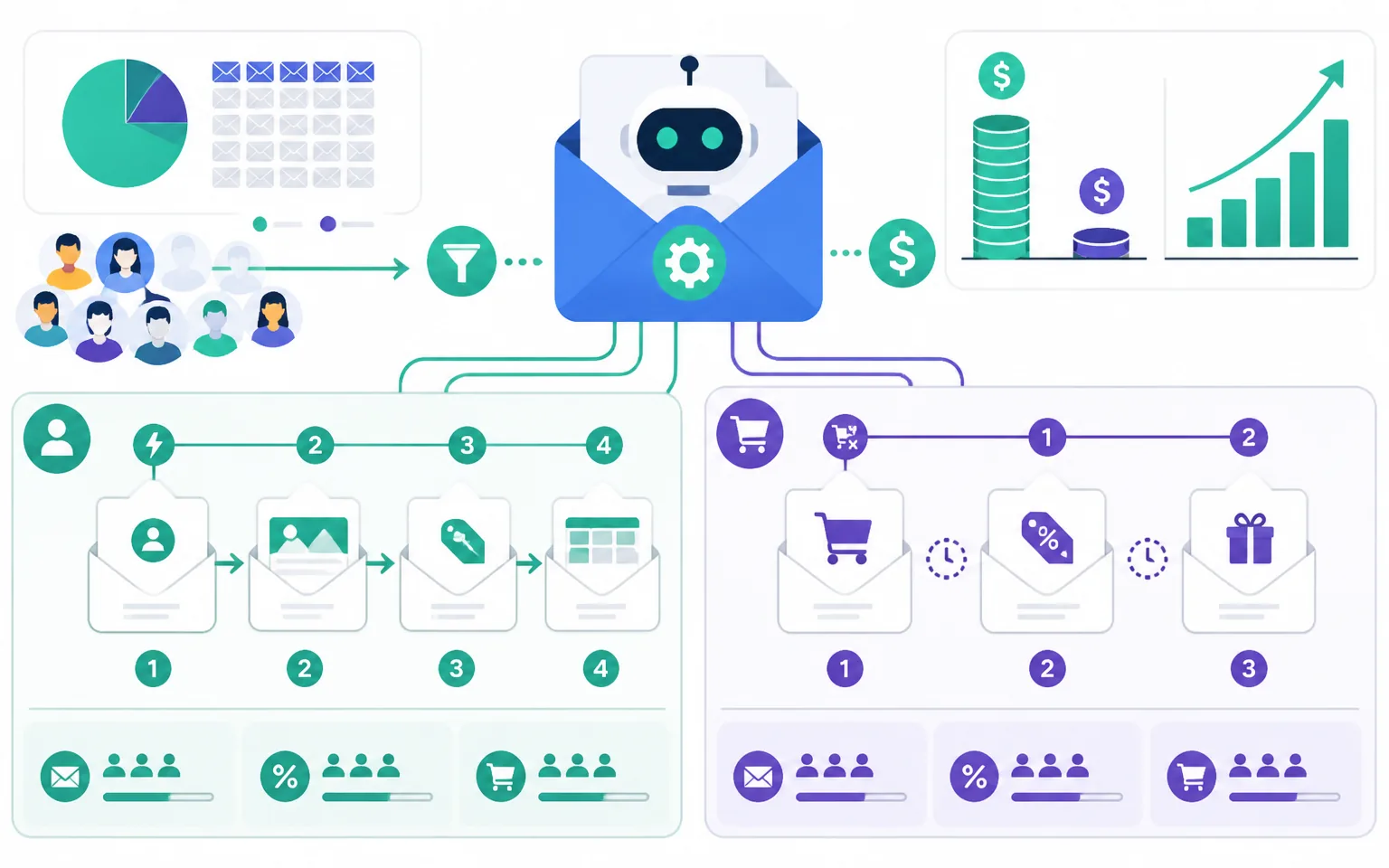
Here’s the statistic that reframes how you should think about email: automated flows drive roughly 41% of email revenue from just 5.3% of total sends (Darkroom / Klaviyo). Per recipient, automated emails earn about $2.87 versus $0.18 for one-off campaigns — roughly a 16x gap (Robly). Flows are the highest-leverage work in email, full stop.
The Welcome Flow
The welcome flow is non-negotiable and the easiest to justify. The average welcome flow generates about $2.65 per recipient, with top performers seeing placed-order rates above 10% (Darkroom). I run a 3–4 email welcome series: an immediate warm intro, a story or proof email, a soft offer, and a “best of” content roundup. Triggered automations like this hit 45.38% open rates versus 40.08% for manual newsletters (Robly), and that early engagement trains the inbox to trust you.
The Abandoned Cart / Browse Flow
For anyone selling products, this is the highest-ROI automation you can build. Abandoned cart emails achieve a 50.5% average open rate, with the top 10% of brands reaching 65.34% (Mailmend). Don’t settle for a single reminder — three-email sequences produced $24.9 million in one analysis versus just $3.8 million from single emails, a 6.5x revenue difference. Top abandoned-cart flows hit $28.89 revenue per recipient against a $3.65 industry average.
Post-Purchase and Win-Back Flows
The sale isn’t the finish line. A post-purchase flow that confirms the order, sets expectations, and cross-sells turns one-time buyers into repeat customers — and retention is where compounding revenue lives. Win-back flows then re-engage lapsed contacts before you have to suppress them. I dig deeper into the platform mechanics in my breakdown of AI-powered email marketing tools, pros and cons.
How to Build an AI Segmentation System Step by Step
Theory is cheap; here’s the actual sequence I follow when setting this up for a list, whether it’s mine or a client’s.
Step one: clean your data. AI segmentation is only as good as the signals feeding it. Remove hard bounces, suppress chronically unengaged contacts, and make sure your events (purchases, page views, clicks) are tracking correctly. Garbage in, garbage out applies brutally here.
Step two: turn on predictive scores. If your platform offers predicted lifetime value, churn risk, or next-order date, enable them. These become the backbone of your smartest segments and require almost no manual upkeep once running.
Step three: build the four core segments described above, then attach a flow to each. Start simple — one flow per segment — and resist the urge to over-engineer before you have data.
Step four: layer in AI copy and subject-line testing. Generate variants, let the platform optimize, and review the winners to learn your audience’s language. Given that AI subject lines lift open rates by 26%, this step pays for itself quickly.
Step five: measure revenue per recipient, not just opens. P90 performers in 2026 see flow revenue per recipient in the $0.25–$0.45 range (Darkroom). That metric tells you whether your segmentation is actually working where it counts. For a broader foundation on tactics and tooling, my guide to the best email marketing practices and tools pairs well with this workflow.
Deliverability: The Quiet Multiplier
None of this matters if your emails land in spam. Segmentation actually helps deliverability because engaged segments generate the opens and clicks that signal trust to inbox providers. The reverse is also true: blasting unengaged contacts drags your reputation down and suppresses your reach across the entire list.
This is where suppression discipline becomes a growth tactic, not just hygiene. By routing unengaged contacts into a win-back flow and then suppressing the non-responders, you concentrate your sends on people who actually want them. Personalized emails were found to be six times more likely to drive conversions and delivered six times the transaction rate of generic ones (Mailmodo) — and a clean, engaged list is what makes that personalization land in the primary inbox. If you want a deeper tactical pass, I cover sender-reputation fundamentals in my post on how to improve your email marketing strategy.
Common Mistakes I See (and How to Avoid Them)
The biggest mistake is over-segmentation: building so many micro-segments that each one is too small to be statistically meaningful or worth maintaining. Start with four, prove they work, then expand. The second mistake is treating AI as set-and-forget — predictive models still need clean inputs and periodic review. The third is optimizing for opens when revenue per recipient is the metric that pays the bills; with automated flows earning up to 30x more per recipient than broadcasts (Mailmend), that’s where your attention belongs.
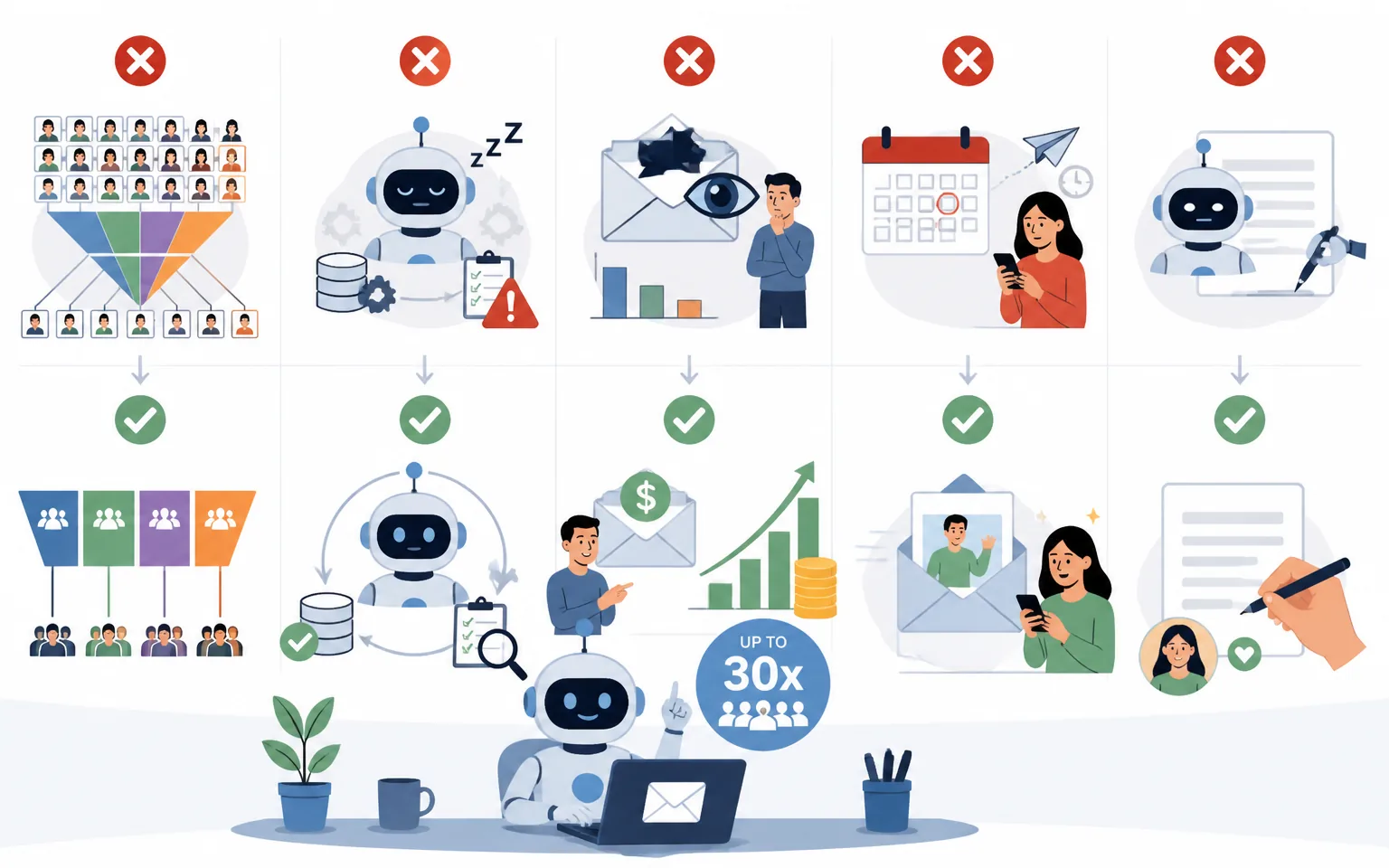
The fourth mistake is ignoring the welcome window. New subscribers are at peak interest, and a delayed or weak welcome flow wastes the most engaged audience you’ll ever have. Finally, don’t let AI flatten your voice — use it for speed and scale, then edit so it still sounds like you.
Frequently Asked Questions
Does email segmentation really increase revenue?
Yes, measurably. Segmented campaigns earn a 100.95% higher click-through rate and a 14.31% higher open rate than non-segmented sends, and the DMA attributes about 25% of email revenue to segmented lists. Most marketers who segment report 30–50% better performance overall.
What’s the difference between a segment and an automated flow?
A segment is a group of contacts defined by shared traits or behavior (new subscribers, VIPs, at-risk). A flow is an automated sequence of emails triggered by an action or condition. You combine them: segments decide who qualifies, flows decide what they receive and when. Flows drive about 41% of email revenue from just 5.3% of sends.
Do I need expensive AI tools to start?
No. Most modern platforms include predictive segments and AI subject-line optimization in standard plans. Start with the built-in features, prove the lift, and only upgrade once revenue per recipient justifies it.
How many segments should a small list have?
Begin with four: new subscribers, engaged buyers, at-risk/lapsed, and high-value VIPs. These cover most of the revenue opportunity. Add more only when each new segment is large enough to matter and maps to a distinct message.
Will AI-written emails hurt my deliverability?
Not inherently. Deliverability depends on engagement and list hygiene, not on whether copy was AI-assisted. AI subject lines actually lift open rates by about 26%, and higher engagement improves your sender reputation. The risk comes from sending to unengaged contacts, not from using AI.
Final Thoughts
AI-powered segmentation and automated flows aren’t a futuristic upgrade — they’re the baseline for a serious email program in 2026. The math is overwhelming: flows that earn 16–30x more per recipient than broadcasts, AI personalization that lifts revenue 41%, and segmentation that doubles your click-through rate. My advice is to start small and concrete: clean your data, switch on predictive segments, build four core flows, and measure revenue per recipient. Do that, and you’ll capture most of the upside long before you ever need anything more complex.