Zero-Click Search Survival Guide: How I Keep Winning Traffic When Google Answers Everything

The Day I Realized Most of My Google Traffic Was Never Coming Back
I still remember opening Google Search Console one morning and staring at a graph that made no sense. My impressions were the highest they had ever been. My rankings were stable. And yet my clicks had quietly slid down month after month. My content was being seen more than ever — and visited less than ever. That was my introduction to the zero-click search era, and if you run a blog or business site in 2026, it is your reality too whether you have noticed it yet or not.
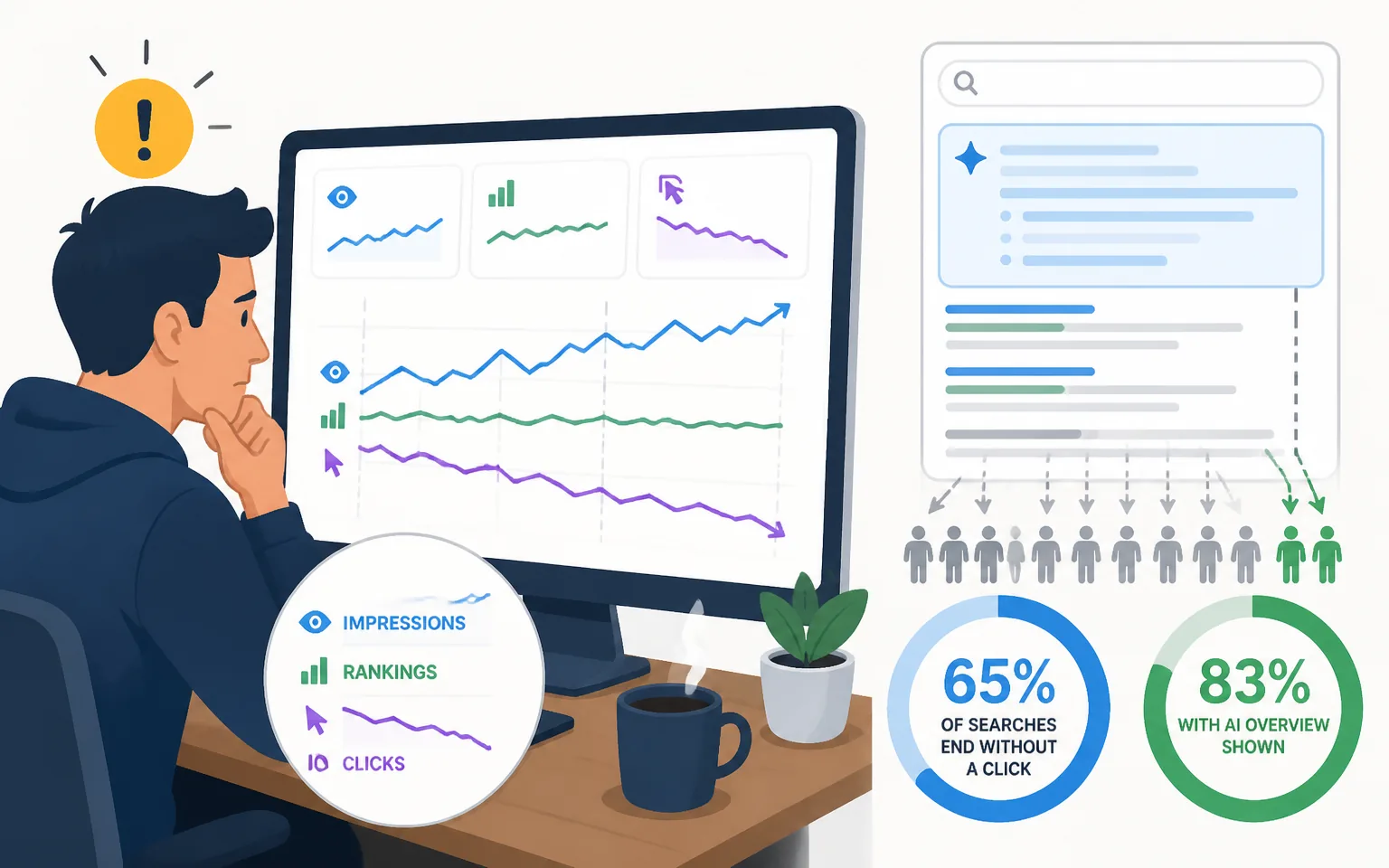
The numbers behind this shift are stark. According to SparkToro’s 2026 clickstream study with Similarweb, roughly 68% of all Google searches now end without a single click to any external website. And when Google shows an AI Overview at the top of the results, that figure climbs to about 83%. In other words, when the AI answer box appears, fewer than two searches in ten send anyone anywhere.
But here is the part most SEO commentary gets wrong: zero-click search is not the death of search traffic. It is a re-pricing of it. Some clicks are gone forever, some are more valuable than ever, and there is a specific playbook for capturing the ones that remain. In this guide I will walk you through exactly how I have adapted my own strategy for byskh.com — what I stopped doing, what I doubled down on, and how I turned “impressions without clicks” from a frustration into an asset.
What Zero-Click Search Actually Means in 2026
A zero-click search is any query that ends on the search results page itself. The searcher gets their answer from an AI Overview, a featured snippet, a knowledge panel, a map pack, or a “People Also Ask” box — and never visits a website. This behavior has existed for years, but AI Overviews poured fuel on it.
As of March 2026, roughly 48% of Google queries trigger an AI Overview, up 58% year over year according to aggregated SERP tracking data. That means nearly half the time your content competes not against ten blue links, but against a machine-written summary of your own material sitting above you.
The click impact is well documented. Seer Interactive analyzed 2.43 billion search impressions across 53 brands and found organic click-through rates dropped 61% on queries where AI Overviews appear. The Pew Research Center’s controlled study of nearly 69,000 real queries found a 46.7% relative decline in clicks when an AI Overview is present. Different methodologies, same conclusion: informational queries that used to feed blogs are being answered on the SERP.
Which Queries Lost the Most
Not all traffic evaporated equally. From my own analytics and the industry data, the losses cluster in three areas: definitions and simple factual questions (“what is a drip campaign”), quick how-to steps that fit in a paragraph, and comparison summaries. Meanwhile, clicks have held up remarkably well for transactional queries, tool comparisons where readers want real screenshots and pricing, personal experience content, and anything requiring trust before money changes hands.
That pattern is your map. The strategies below all flow from one principle: stop fighting for clicks Google no longer gives away, and dominate the clicks — and the visibility — that remain.
Strategy One: Treat Impressions as a Branding Channel, Not a Failure
The first mental shift I had to make was accepting that being cited without being clicked still has value — if your brand is visible in the citation. When an AI Overview quotes your site, your domain appears as a source. When you own a featured snippet, your brand name sits at position zero. Searchers may not click today, but repeated exposure builds the recognition that drives branded searches later.
This is measurable. In my Search Console data, branded queries for my site grew steadily in the months after my content started appearing in AI Overviews, even as generic informational clicks fell. Industry surveys back this up: marketers increasingly report brand impressions replacing clicks as their primary SERP metric, because the brands users repeatedly see in snippets and AI citations win the direct visit later.
Practically, this means two things. First, write in a way that forces attribution — original data, named frameworks, first-person experience that a summary cannot fully strip out. Second, track impressions and branded search volume as seriously as you track clicks. If both are rising while generic clicks fall, your strategy is working, not failing.
Strategy Two: Go Deeper Than the AI Overview Can
AI Overviews are good at surface answers and bad at depth. They cannot share your test results, your screenshots, your failures, or your specific numbers. So the content that still earns clicks in 2026 is content that makes the searcher think, “the summary is not enough — I need the full picture.”
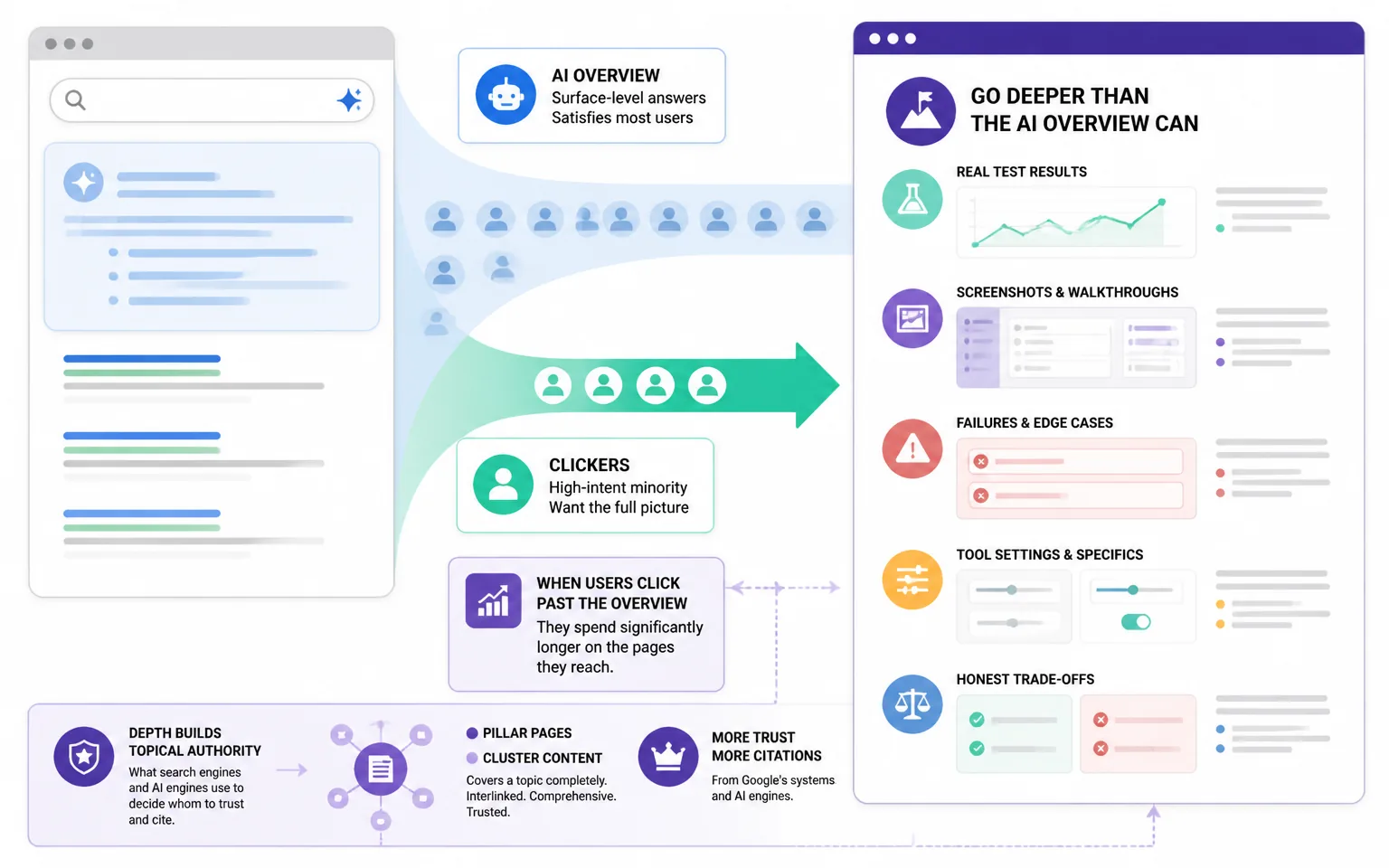
Here is how I structure posts now: the opening answers the core question quickly (which helps me get cited), and then the body goes places no AI summary can follow — real campaign data, step-by-step walkthroughs with edge cases, tool settings, and honest trade-offs. Pew’s research found that when users do click past an AI Overview, they spend significantly longer on the pages they reach, because the clickers are the high-intent minority. Fewer visitors, better visitors.
Depth also feeds topical authority, which is what both Google’s ranking systems and AI engines use to decide whom to trust and cite. If you want the full framework for building that kind of authority with pillar pages and cluster content, I broke down my entire system in my topical authority pillar and cluster playbook.
Strategy Three: Optimize to Be the Cited Source
If half of searches show an AI Overview, then appearing inside that Overview is the new position one. This discipline — often called GEO (generative engine optimization) or AEO (answer engine optimization) — rewards a specific set of habits:
Structure Your Answers for Extraction
AI systems and featured snippet algorithms both favor content that answers a question in a clean, self-contained block: a 40-60 word direct answer immediately after a question-style heading, followed by supporting detail. I now write every H2 and H3 as a question or clear promise, and open each section with the answer before elaborating. It feels formulaic while writing, but it dramatically increases how often my content is pulled into snippets and Overviews.
Use Schema Markup Aggressively
Structured data is the machine-readable layer that tells search engines exactly what your content is. FAQ schema, HowTo schema, Article schema, and Product schema all raise the odds of appearing in rich results and AI citations. Multiple 2026 studies of AI Overview citations note that pages with well-implemented schema are disproportionately represented among cited sources. It costs almost nothing to add with modern SEO plugins, and it compounds.
Feed the Machines Fresh, Factual, Attributable Content
AI engines prefer citing sources with current data and clear expertise signals. Update your key posts regularly, date your claims, and include statistics with named sources — exactly the habit that also serves human readers. I covered the full optimization approach for AI search engines in my guide to GEO and AEO: optimizing for AI search, which pairs naturally with everything in this article.
Strategy Four: Convert Harder on Every Visit You Do Get
This is the strategy that changed my business more than any other. When Seer Interactive’s data shows organic CTR down 61% on AI Overview queries, the math is brutal: if you get half the visitors, each visitor is worth twice as much. You can no longer afford a visit that ends with a bounce and a shrug.
Every important post on my site now has one job beyond informing: capture the reader into a channel I own. That means a relevant lead magnet, a content upgrade, or a newsletter pitch matched to the post’s topic — not a generic “subscribe” box. Email is the ultimate zero-click hedge, because once someone is on your list, no algorithm sits between you and them. Email marketing continues to return roughly $36 for every $1 spent according to widely cited Litmus research, which makes it the single best destination for your shrinking-but-higher-intent organic traffic.
If you have never built systematic capture into your content, start with my walkthrough of using AI to create lead magnets that grow your email list — it is the exact process I use to turn one blog post into a topic-matched opt-in offer in under an hour.
Strategy Five: Rebalance Your Content Portfolio
Zero-click reality should change not just how you write, but what you write. I now sort every planned post into three buckets before I write a word:
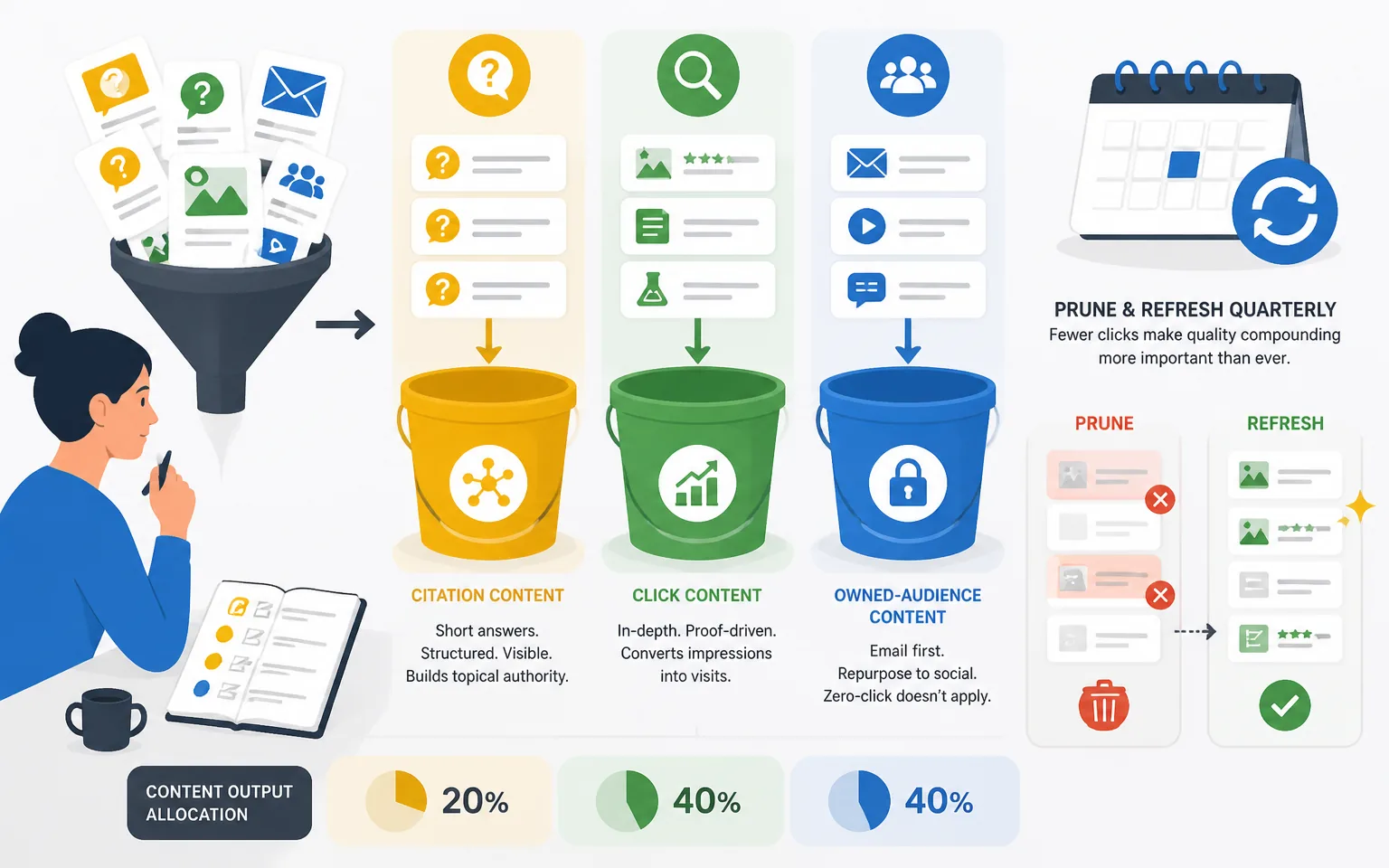
Citation Content
Short-answer informational topics that will mostly be consumed inside AI Overviews and snippets. I still write these, but leaner, heavily structured, and primarily for visibility and citations rather than traffic. They build the topical map that makes engines trust the rest of my site.
Click Content
Topics where searchers need the page itself: tool reviews with real testing, templates and swipe files, detailed tutorials, personal case studies with numbers. These get my deepest effort because they still convert impressions into visits at healthy rates. Transactional and commercial-investigation keywords live here.
Owned-Audience Content
Content designed for my email list and repurposed to social — where zero-click dynamics do not apply at all. The publishing effort shifts: perhaps 40% of my output now serves channels I control, up from maybe 10% three years ago.
One more portfolio habit matters: pruning and refreshing. With fewer total clicks available, decaying content costs you more than it used to. I run a quarterly refresh cycle on my highest-value pages using the process from my content decay and refresh guide, and those refreshes consistently recover rankings and citations faster than new posts earn them.
Strategy Six: Diversify Beyond Google Entirely
Google still dominates search, but the searcher’s journey has splintered. People now start research in ChatGPT, Perplexity, YouTube, TikTok, Reddit, and Pinterest. Datos panel data through 2025-2026 shows AI chat interfaces handling a small but rapidly growing share of information queries — and those platforms cite and link sources too. The sites winning citations in ChatGPT and Perplexity today are building tomorrow’s referral channel while their competitors argue about lost Google clicks.
My diversification is deliberately boring: one primary owned channel (email), one discovery channel beyond Google search that fits my niche, and consistent optimization for AI engine citations everywhere. You do not need to be everywhere. You need to be un-killable in two or three places.
The Metrics That Matter Now
Old scoreboard: rankings and organic sessions. New scoreboard, the one I actually review monthly: impressions and impression trends in Search Console, branded search volume, AI Overview and snippet citations for target queries, email subscribers captured per thousand visits, and revenue per visitor. Judge your SEO by the old scoreboard and 2026 looks like decline. Judge it by the new one and you can see exactly where you are winning.
On my own site, sessions are down from their 2024 peak — I will not pretend otherwise. But subscribers per visit have tripled, branded search keeps climbing, and revenue per visitor is the highest it has ever been. That is what adaptation looks like in practice.
Frequently Asked Questions
What percentage of Google searches are zero-click in 2026?
Roughly 65% of Google searches end without a click to any external website, per SparkToro/Datos 2026 clickstream data. When an AI Overview appears on the results page, the zero-click rate rises to about 83%.
Should I stop targeting informational keywords?
No — but change your expectations for them. Informational content now earns citations, visibility, and topical authority more than direct traffic. Write it leaner and more structured, and reserve your deepest effort for commercial, experiential, and tutorial content where clicks survive.
Do featured snippets still matter with AI Overviews everywhere?
Yes. Featured snippets still appear on a large share of queries, often below or alongside AI Overviews, and snippet-optimized formatting is also the formatting AI systems prefer to cite. Optimizing for one improves your odds in the other.
How do I know if AI Overviews are stealing my clicks?
Look for the signature pattern in Search Console: stable or rising impressions with falling CTR on informational queries, while your average position holds steady. Compare query-level CTR year over year — queries that gained an AI Overview typically show CTR declines of 40-60%, consistent with Seer Interactive’s and Pew’s findings.
What is the single best defense against zero-click search?
An email list. It is the one audience channel no search engine or algorithm can dilute. Pair aggressive on-site capture with content structured to win AI citations, and zero-click search becomes a visibility engine feeding an owned audience instead of a traffic leak.
My Bottom Line
Zero-click search is not a temporary storm to wait out — it is the new climate. The 65% zero-click rate will likely climb, AI Overviews will cover more queries, and the open-web click will keep getting scarcer and more precious. The bloggers and businesses that thrive will be the ones who stopped measuring success in raw sessions and started building brand visibility, extraction-friendly content, and owned audiences.
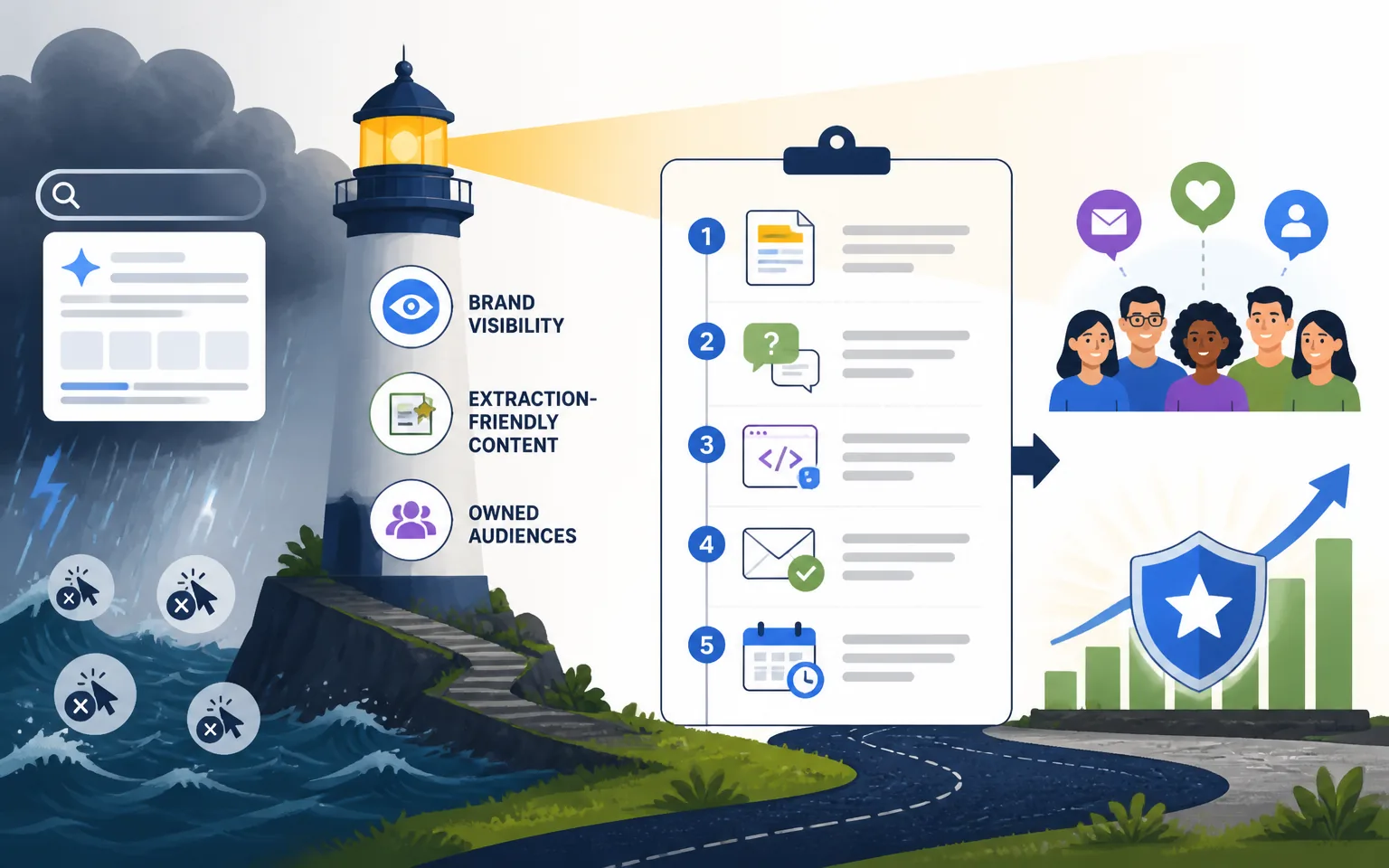
Start this week: pick your five most valuable posts, restructure their openings for citation, add FAQ schema, attach a topic-matched email opt-in to each, and set a calendar reminder to refresh them quarterly. That is 80% of the playbook, and almost none of your competitors will bother. In a zero-click world, that is exactly the edge you want.