Win-Back Email Campaigns: How I Re-Engage Inactive Subscribers With AI in 2026

Every email list I have ever managed has the same dirty secret: a huge chunk of it is dead weight. Subscribers who opened everything for three months, then went silent. Customers who bought once and vanished. If your list is more than a year old, I’d bet real money that 30 to 50 percent of it hasn’t touched an email from you in months. Most marketers respond by either ignoring the problem or quietly deleting those contacts. Both are mistakes. Research compiled by Mailmend shows that 45% of inactive subscribers can still be reactivated with targeted messaging — nearly half of the people you were about to give up on are still winnable. In this guide, I’ll walk you through the exact win-back email campaign system I use, how I layer AI on top of it, and the numbers that convinced me this is one of the highest-ROI projects in email marketing.
Key Takeaways on Win-Back Email Campaigns
- Reactivating a lapsed customer costs roughly 5 to 10 times less than acquiring a new one, which is why win-back is the highest-leverage flow most lists never build.
- Realistic reactivation sits around 14% on average, climbing past 21% for well-segmented automated campaigns. Anything between 10% and 30% is healthy.
- Define “inactive” by behaviour, not by a round number. For ecommerce the window is 60 to 90 days post-purchase; for content lists, 90 days without an open or click.
- Win-back earns the least revenue per recipient of any flow (about $0.84 at a $100–200 average order value), and that is fine. Its job is list health, not headline revenue.
- Do not lead with a discount. Offering one to people who would have returned anyway is margin burned for nothing.
What a Win-Back Email Campaign Actually Is (And Why It Beats Acquisition)
A win-back campaign (sometimes called a re-engagement or reactivation campaign) is a short, automated email sequence sent specifically to subscribers or customers who have stopped engaging. The goal is simple: get them to open, click, or buy again — or, failing that, cleanly remove them from your active list.
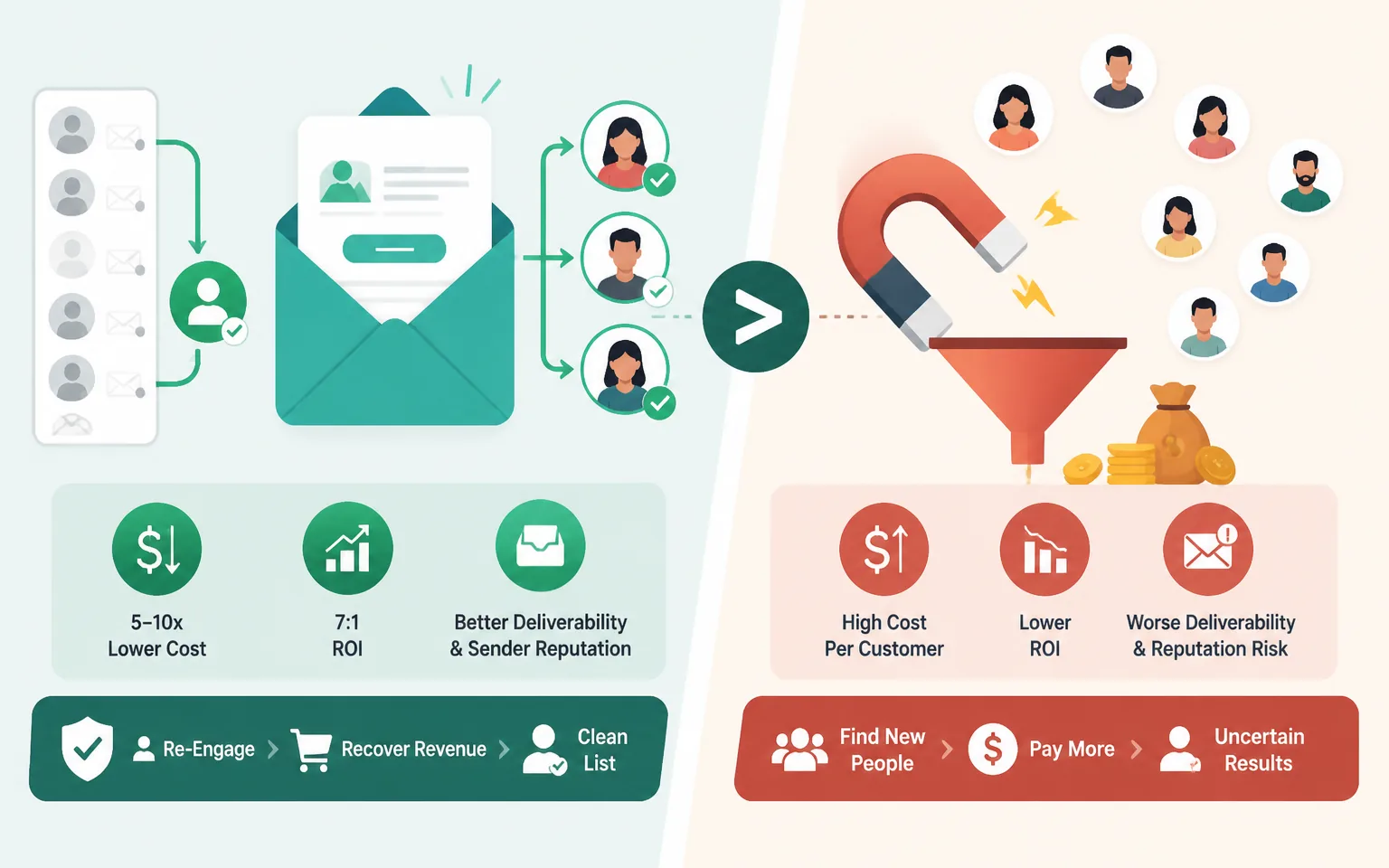
The economics here are what hooked me. Reactivating a lapsed customer costs roughly 5 to 10 times less than acquiring a brand-new one, according to Opensend’s 2026 win-back research. And reactivated email addresses deliver about a 7:1 return on investment in conversions and purchases, per Mailmend’s re-engagement statistics. Compare that with what you’re paying for cold traffic right now and the math makes itself.
There’s a second, less obvious benefit: deliverability. Gmail, Yahoo, and Microsoft judge your sender reputation heavily on engagement rates. A list full of ghosts drags down opens across the board, which means even your engaged subscribers start landing in spam. Running win-back campaigns — and pruning whoever doesn’t respond — is list hygiene and revenue recovery in one move. If deliverability is already a sore spot for you, my guide on common email delivery issues and how to fix them pairs well with this one.
The Numbers: What Win-Back Campaigns Realistically Achieve
Let me set honest expectations, because I’ve seen wildly inflated claims in this space. Here is what the current benchmark data actually says.
Re-engagement campaigns win back an average of 14% of inactive subscribers and generate around a 29% open rate, according to Mailmend’s 2026 compilation. That may sound modest, but remember: these are people who ignored everything else you sent. Automation raises the ceiling considerably — automated win-back emails achieve open rates of 42.51%, dramatically outperforming standard one-off campaigns.
The trend line is moving in the right direction too. Reactivation campaign benchmarks have climbed from 17% in 2023 to a projected 21.4% in 2026, per Searchlab’s email marketing benchmark report. For small and mid-sized businesses specifically, win-back campaigns typically see 15–25% re-engagement rates, which matches what I’ve experienced on my own lists and client lists.
One caveat worth knowing: on a revenue-per-recipient basis, win-back is the lowest-earning automated flow — roughly $0.84 per recipient for brands with a $100–200 average order value, based on Klaviyo ecommerce benchmark data analyzed by Darkroom. That’s fine. Win-back isn’t your welcome series. Its job is to recover revenue that would otherwise be zero, protect your sender reputation, and tell you definitively who to remove.
If you want to sanity-check any of these figures against a primary source, Klaviyo publishes its ecommerce email benchmark report openly, broken out by flow type and industry. I re-check my own numbers against it every quarter.
Step One: Define “Inactive” Before You Do Anything Else
Most win-back campaigns fail before the first email is written because “inactive” was never defined properly. A subscriber who ignores your emails for 30 days is very different from one who’s been silent for a year.
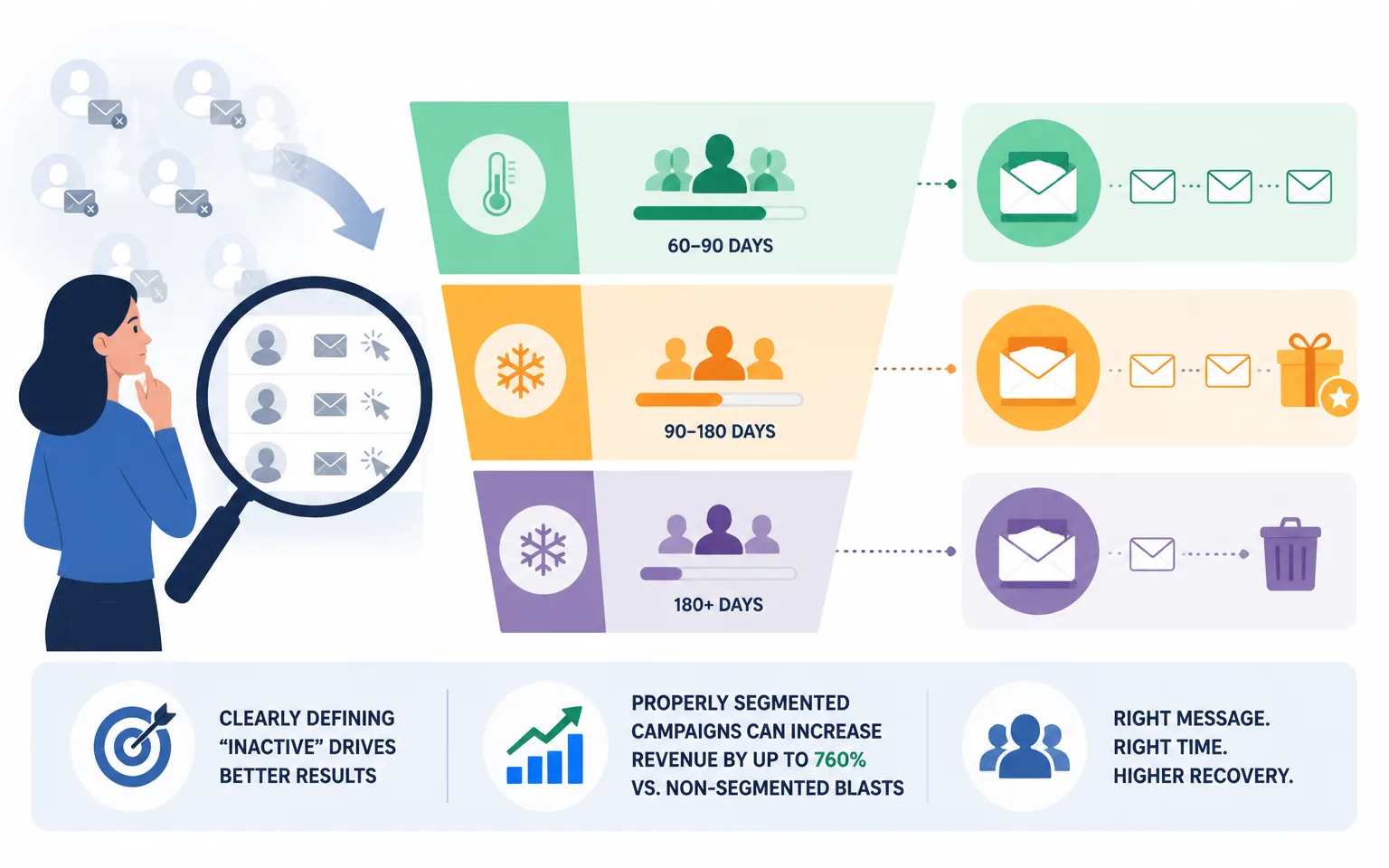
Here’s how I segment. For content and affiliate lists, I treat anyone with no opens or clicks in 90 days as cooling, and no engagement in 180 days as cold. For ecommerce, I go by purchase behavior: the data consistently shows the best win-back window is 60–90 days after the last purchase, according to Eightx’s DTC reactivation benchmarks. Wait longer than that and reactivation rates fall off a cliff; act sooner and you’re emailing people who were never really gone.
I build three tiers in my email platform:
- Slipping (60–90 days inactive): highest recovery potential, gets the full sequence.
- Cold (90–180 days): gets a shorter, more direct sequence with a stronger incentive.
- Frozen (180+ days): gets one final “should we say goodbye?” email, then removal.
This tiering matters more than any subject line trick. Properly segmented campaigns have been linked to revenue increases of up to 760% compared with non-segmented blasts, a widely cited figure from Campaign Monitor’s segmentation research. If you want to go deeper on building these segments with AI doing the heavy lifting, I wrote a full walkthrough in my AI email segmentation and automation guide.
Step Two: Where AI Changes the Win-Back Game
I’ve run win-back campaigns the manual way for years. Adding AI to the workflow improved my results in three specific places — and I want to be precise about this, because “use AI” is useless advice on its own.
Predictive Timing Instead of Fixed Rules
The old way: pick an arbitrary inactivity threshold and fire the sequence. The AI way: platforms like Klaviyo, ActiveCampaign, and Omnisend now score each contact’s churn probability based on their individual engagement rhythm. A subscriber who normally opens weekly and goes quiet for three weeks is flagged sooner than a monthly opener showing the same gap. This means I catch people while they’re slipping rather than after they’re gone — and as the benchmarks above show, earlier means dramatically higher recovery rates.
Personalized Copy at Scale
Generic “We miss you!” emails are the participation trophies of email marketing. AI lets me generate variants that reference what the subscriber actually engaged with: the category they browsed, the lead magnet they downloaded, the last article they clicked. The impact is measurable — Omnisend’s 2026 data found that personalized subject lines lift reactivation open rates from 18% to 31%, a 72% improvement from changing a single variable. I’ve covered my exact prompting workflow for this in my post on writing AI email subject lines people actually click.
Incentive Selection
Not everyone needs a discount to come back, and offering one to people who would have returned anyway is margin burned for nothing. AI-driven testing helps identify which incentive each segment responds to. One counterintuitive finding from Omnisend’s 2026 research: free shipping offers drive 8% higher open rates and 12% higher conversions than percentage discounts in re-engagement campaigns. I’d been defaulting to “15% off” for years. The data said I was leaving money on the table.
Step Three: My Four-Email Win-Back Sequence
Here is the exact structure I deploy. Four emails, spaced over about three weeks. Each has one job.
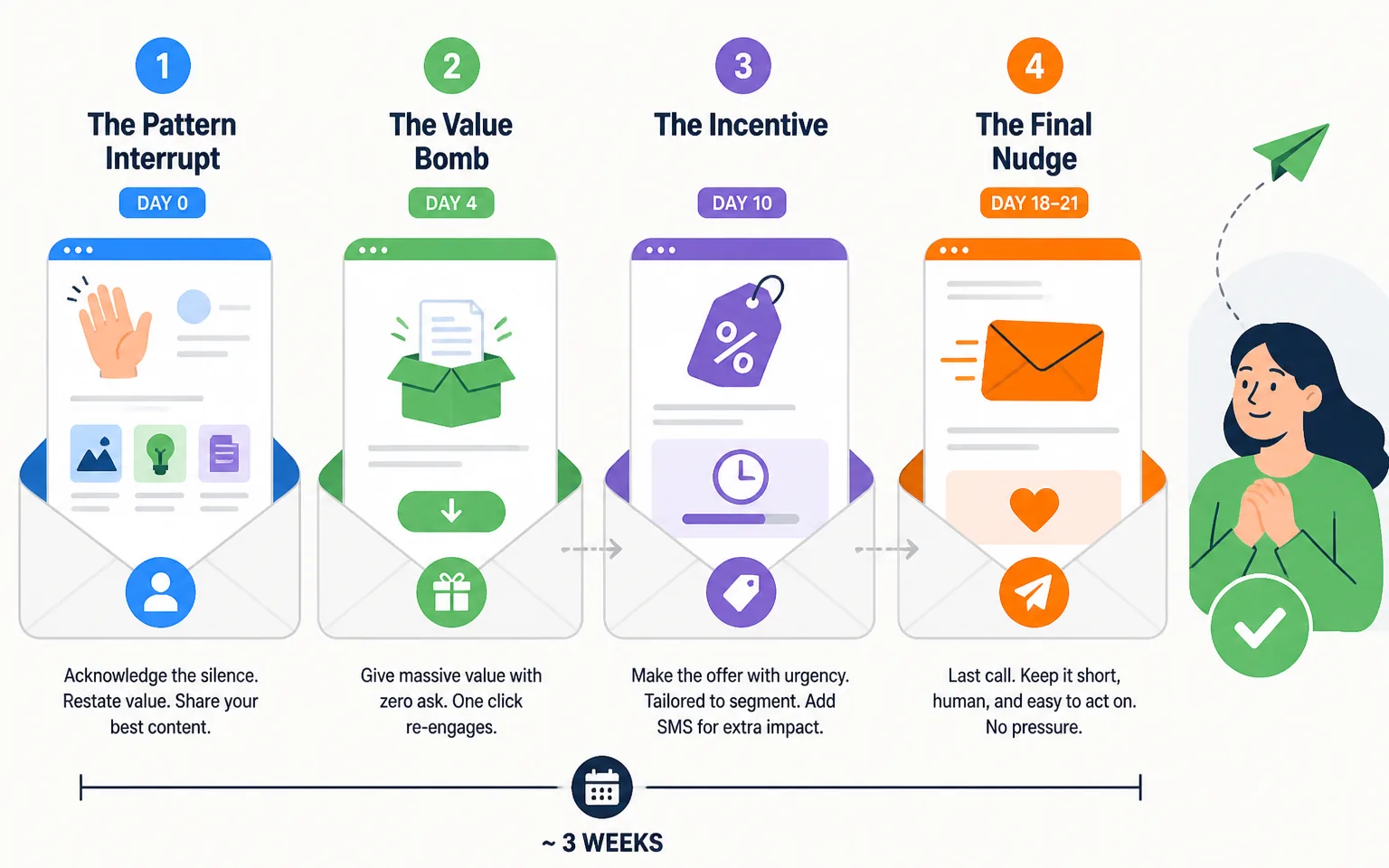
Email 1: The Pattern Interrupt (Day 0)
No discount, no guilt trip. Just a short, human email that acknowledges the silence and re-states value. Something like: “I noticed you haven’t opened my emails lately — either my content slipped, or your inbox got busier. Here are the three most useful things I’ve published since you’ve been away.” Curiosity-driven subject lines outperform desperate ones here. This email alone typically recovers the largest share of the “slipping” tier.
Email 2: The Value Bomb (Day 4)
Give something away with zero ask: your best guide, a free template, a tool. The goal is a single click, because one click tells every mailbox provider this address is live again. For my list, this is usually my most comprehensive free resource for that segment’s topic.
Email 3: The Incentive (Day 10)
Now the offer — matched to the segment, per the AI testing above. For ecommerce: free shipping or a discount with a real deadline. For content/affiliate lists: an exclusive resource or bonus. If you sell via SMS as well, this is where to add it: combining SMS with email produces roughly a 54% conversion lift versus email alone in win-back flows, per Opensend’s 2026 statistics.
Email 4: The Goodbye (Day 18–21)
The breakup email: “Still want to hear from me? Click here, or I’ll take you off the list.” This email consistently surprises people with how well it performs — loss aversion is real. Whoever doesn’t click gets suppressed or deleted. No exceptions. Keeping them hurts every future send.
Across this full sequence, a realistic aggregate outcome based on the 2026 benchmarks is a 10–30% reactivation rate depending on list age and how aggressively you tiered your segments — Opensend puts that range as the realistic expectation for most structured ecommerce campaigns.
Step Four: Measure, Prune, Repeat
A win-back campaign is not a one-time cleanup; it’s an always-on automation. Once the sequence is built, every subscriber who crosses your inactivity threshold enters it automatically. Here’s what I track:
Reactivation rate — the percentage of entrants who open or click during the sequence. Benchmark against the 14–21% figures above. Revenue per recipient — remember $0.84 is the ecommerce baseline; content lists should track click-through to monetized pages instead. List reduction rate — I aim to remove 100% of non-responders after email 4. Painful, but every one of them was actively hurting deliverability. Downstream deliverability — watch your overall open rate in the 60 days after a big prune. Mine has jumped as much as 8 points after removing frozen subscribers.
One more thing: win-back is only one leg of a retention system. If you’re serious about keeping the customers you reactivate, my post on retention marketing strategies that actually work covers the other side of that equation.
Common Win-Back Mistakes I See Constantly
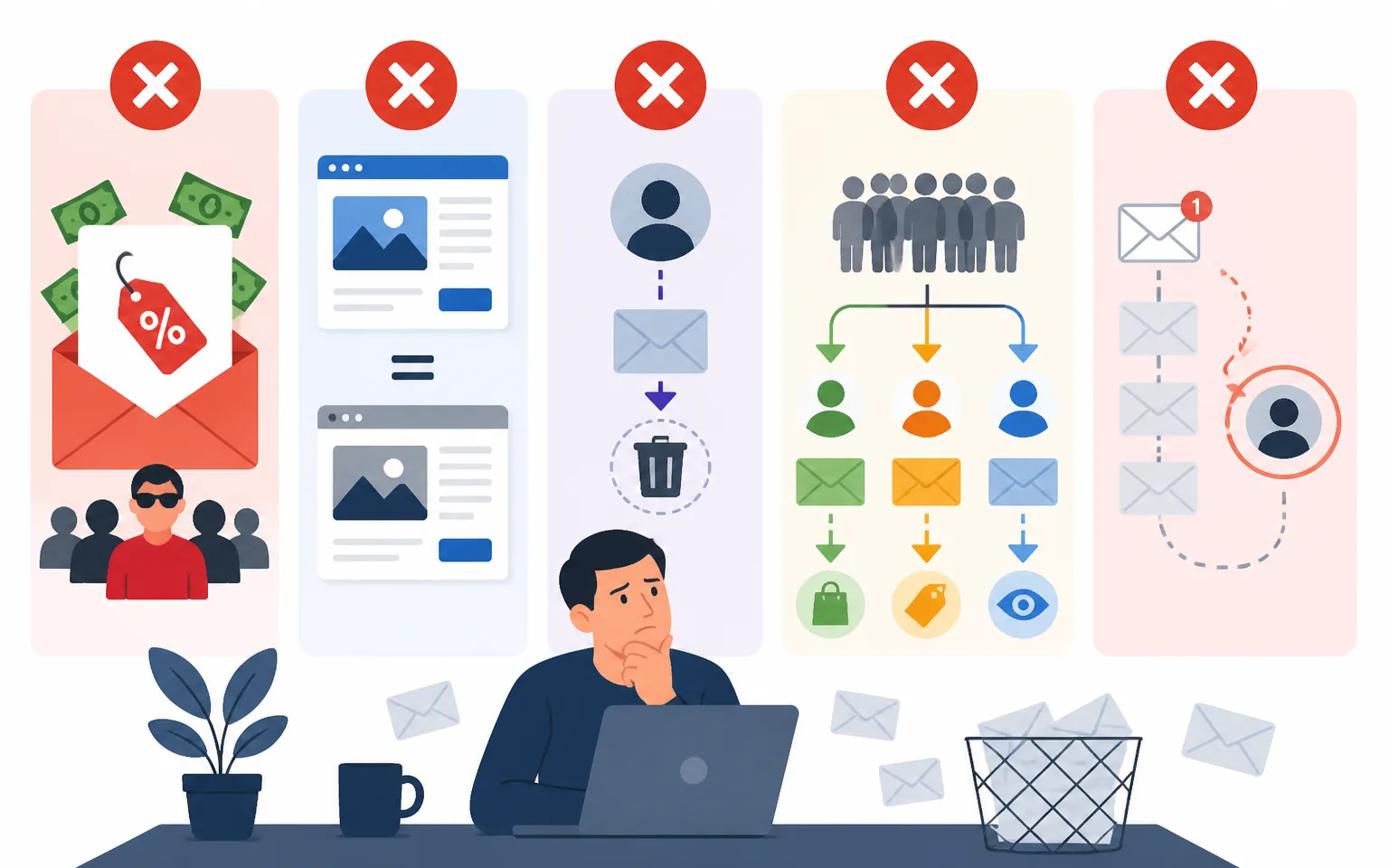
First: leading with a discount. It trains subscribers to go dormant on purpose and attracts deal-hunters back for exactly one purchase. Value first, incentive third. Second: sending win-back emails from the same template as your regular newsletter — the whole point is a pattern interrupt, so make it look and feel different. Third: never removing non-responders. A win-back campaign that doesn’t end in a prune is just extra email volume to dead addresses. Fourth: writing one generic sequence for your whole list instead of tiering by inactivity depth and past behavior. And fifth: giving up after one attempt — subscribers reactivated once are prime candidates for churn again, which is why the automation must be evergreen, not a quarterly cleanup project.
Summary
Win-back campaigns are the cheapest audience you will ever buy, because you already paid for it once. The work is not clever copywriting; it is defining inactivity properly, tiering by how cold each segment is, and sending a sequence rather than a single sad “we miss you”.
Set expectations honestly. A 14% average reactivation rate will not transform a quarter, but on a list where 40% of names are dead weight it meaningfully changes who you are talking to.
Run the four-email sequence, measure reactivation rate and revenue per recipient separately, and be willing to let the genuinely gone go. A smaller engaged list outperforms a large silent one on every metric that matters, including deliverability.
Frequently Asked Questions
How many emails should a win-back sequence have?
Three to five. My standard is four: pattern interrupt, value, incentive, goodbye. Fewer than three doesn’t give mailbox providers enough engagement signals; more than five annoys people who were already disengaged.
When should I trigger a win-back campaign?
For ecommerce, 60–90 days after the last purchase is the sweet spot supported by DTC benchmark data. For content lists, 90 days without an open or click is my trigger. Earlier beats later in every dataset I’ve seen.
What’s a good reactivation rate?
The 2026 benchmark average is around 14%, with well-segmented, automated campaigns reaching 21% or higher. If you’re between 10% and 30%, you’re in the healthy range. Below 10%, revisit your segmentation and your first email’s subject line.
Should I delete subscribers who don’t respond?
Yes — suppress or delete them after the final email. Inactive addresses depress your engagement metrics, which harms inbox placement for your entire list. The subscribers you keep become more valuable when the ghosts are gone.
Do win-back campaigns work for small lists?
Arguably better. On a 2,000-person list where 800 are inactive, reactivating even 14% brings back over 100 engaged readers — a meaningful audience shift for a small operation, at essentially zero cost.
Can AI fully automate my win-back campaign?
The triggering, segmentation, send-time optimization, and copy variants — yes. The strategy, offer economics, and brand voice — that’s still on you. I use AI as the engine, not the driver.
Final Thoughts: Your List Is Worth More Than You Think
The subscribers who went quiet already told you they wanted what you offer — that’s why they signed up. A win-back campaign is simply the discipline of asking them again, intelligently, before you let them go. Between the 7:1 ROI on reactivated addresses, the deliverability gains from pruning, and the fact that AI now automates the hardest parts of timing and personalization, there is no good reason to let a third of your list sit cold. Build the four-email sequence this week, set the automation live, and let it quietly recover revenue in the background. Your future sender reputation will thank you.