AI Content Repurposing Workflow (2026 Guide)

Why Content Repurposing Became the Highest-Leverage Skill in Marketing
If you only do one thing with AI this year, build a content repurposing workflow. Turning a single “pillar” asset into ten or more platform-native pieces is now the fastest, cheapest way to multiply your reach — and AI has collapsed the time it takes from days to minutes. That is the short answer. The longer answer, which I’ll walk you through below, is a repeatable system I use to turn one idea into a week’s worth of content without burning out or hiring a team.
Before you scale repurposing, it helps to ground the approach in Google’s people-first content guidance, which stresses that reworked content still has to deliver genuine, original value to the reader.
I’m Sk Hasan, and I’ve been publishing on byskh.com long enough to watch “post once, pray for reach” quietly stop working. The math behind repurposing is hard to argue with: one pillar piece of content, strategically repurposed, generates roughly 10–15x the output, 5–10x the reach, and 3–5x the ROI compared to traditional, linear content creation, according to Shno’s 2026 content repurposing data. That is not a rounding-error improvement. That is the difference between a blog nobody finds and a brand that shows up everywhere your audience already is.
And the adoption curve confirms it’s no longer optional. 87% of marketers now use generative AI in at least one workflow in 2026, up from 51% in 2024, per Averi’s State of AI in Marketing report. Content marketers lead internal adoption at 96%. If you’re not building these systems, you’re competing against people who are.
What Content Repurposing Actually Means in 2026
Content repurposing is taking one substantial piece of content — a blog post, a podcast episode, a webinar, a long video — and reshaping its ideas into formats native to other platforms. It is not copy-pasting the same paragraph onto five networks. The teams that win tailor each derivative to the platform it lives on.
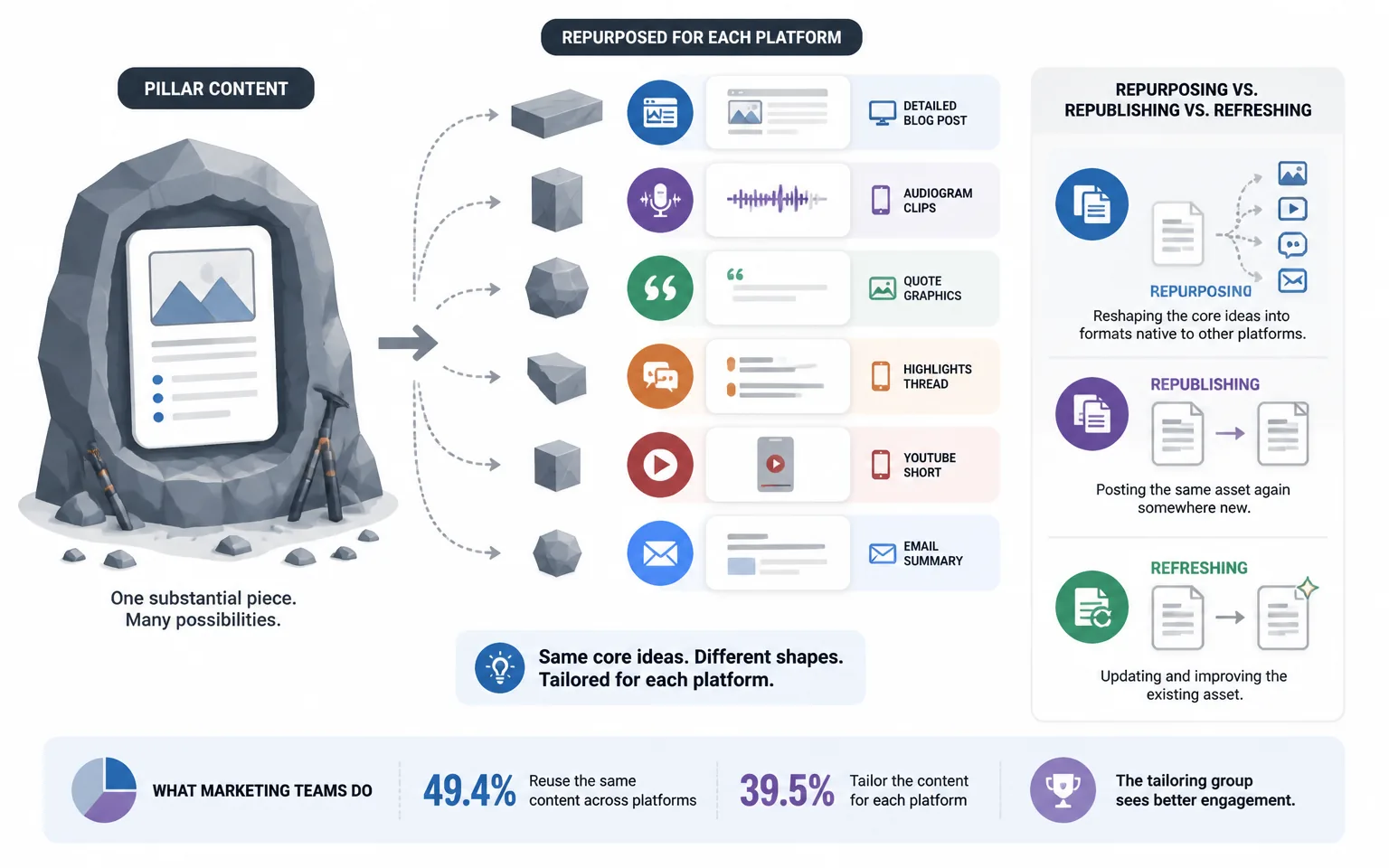
The data backs the distinction. Of marketing teams, 49.4% reuse the same content across platforms, while 39.5% tailor the content for each platform, according to Shno’s research. The tailoring group consistently sees better engagement, because a LinkedIn carousel, a YouTube Short, and an email newsletter each reward different shapes of the same idea.
Here’s the mental model I use: every pillar asset is a quarry. You’re not making one statue from it — you’re cutting dozens of stones, each sized for a specific spot. A 45-minute podcast episode can become a detailed blog post, vertical audiogram clips, quote graphics, a highlights thread, and an email summary, all without creating any net-new ideas.
Repurposing vs. Republishing vs. Refreshing
Three terms get muddled, so let me separate them. Republishing is posting the same asset again somewhere new. Refreshing is updating an existing asset with current facts — and it’s powerful on its own: bloggers who update old posts are 2.5 times more likely to report strong results than those who never refresh existing content, per Shno’s 2026 figures. Repurposing, the focus of this guide, is transformation: same core idea, new format, new platform, new audience.
The Business Case: What the Numbers Say
Let me put the ROI argument on the table before we get tactical, because this is what convinces stakeholders and, frankly, what kept me committed when the work felt tedious.
Reach is the headline. Systematic content repurposing boosts content reach by roughly 300%, with Buffer reporting a 400% reach increase across new platforms after implementing a structured program, according to Shno’s compiled data. Distribution reach typically multiplies 3–5x once you stop relying on a single channel.
Output scales without headcount. Teams implementing structured repurposing strategies typically report 3–5x increases in content output without increasing headcount and 40–60% reductions in content production cost per asset, per the same 2026 dataset. Teams that standardize repurposing into templates publish up to 3.4 times more derivative assets per primary asset within 30 days while holding production hours roughly flat.
AI is the accelerant on top of all of this. AI-powered repurposing workflows reduce adaptation time by an estimated 65% per asset, and AI overall enables companies to publish 42% more content monthly — a median of 17 articles versus 12 without AI, according to Averi’s benchmarks. And it pays: 68% of businesses see an increase in content marketing ROI from using AI tools, with repurposing and optimization named as the two primary applications driving that improvement.
My Five-Step AI Content Repurposing Workflow
This is the system I actually run. It’s deliberately simple, because complexity is where workflows go to die. You can apply it whether your pillar asset is a blog post, a video, or a podcast.
Step 1: Choose a Pillar Asset Worth Multiplying
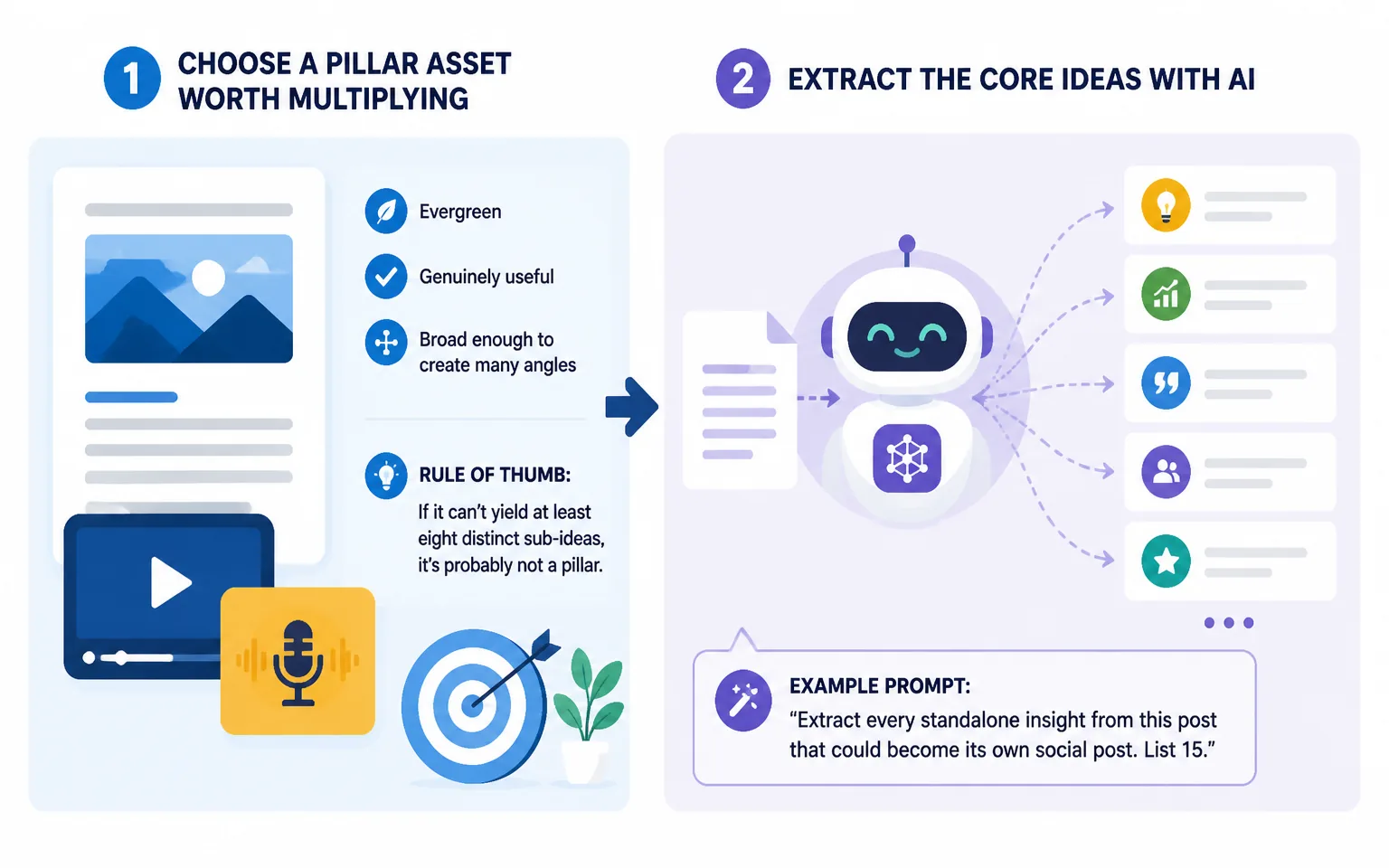
Not every piece deserves repurposing. I pick pillars that are evergreen, genuinely useful, and broad enough to fragment into many angles. A 2,000-word guide, a recorded webinar, or a meaty podcast episode all qualify. A time-sensitive announcement usually doesn’t. The rule of thumb: if it can’t yield at least eight distinct sub-ideas, it’s probably not a pillar.
This is also where strategy beats volume. As I cover in my AI marketing strategy guide for small business, picking the right few assets to amplify beats spraying mediocre content across every channel.
Step 2: Extract the Core Ideas with AI
Feed the pillar to your AI assistant and ask it to pull out the discrete, standalone ideas — the claims, frameworks, statistics, and stories that can each live on their own. I literally prompt: “Extract every standalone insight from this post that could become its own social post. List 15.” This is the unlock, because the bottleneck in repurposing was never writing — it was the cognitive load of re-seeing your own content from fresh angles.
If you’re new to prompting for marketing tasks, my walkthrough on how to use ChatGPT for marketing covers the exact prompt patterns I lean on here. The cleaner your extraction, the less editing you do downstream.
Step 3: Reshape Each Idea for Its Destination Platform
Now you transform. Each extracted idea gets reshaped for where it’ll live: a LinkedIn post wants a hook and a takeaway, a YouTube Short wants a 30-second script, an email wants a conversational tone and a single CTA. I give the AI the idea plus the platform’s constraints and let it draft, then I edit for voice. This tailoring step is what separates the 39.5% of teams who customize from the 49.4% who just recycle — and it’s where the engagement lift lives, per Shno’s platform-distribution data.
For longer derivatives like secondary blog posts or lead magnets, my guide on how to write content using AI details the drafting-and-editing loop that keeps quality high while moving fast.
Step 4: Add Human Voice and Verify Facts
AI drafts; you own. I never publish a raw generation. I add a personal anecdote, sharpen the hook, and — critically — verify any statistic or claim against the source. This matters more than ever because the governance gap is real: only 29% of teams have a formalized AI governance policy, with nearly half still building one, according to Averi’s 2026 report. Your fact-checking habit is your brand’s insurance policy.
Step 5: Schedule, Distribute, and Measure
The final step is getting the pieces out and tracking what works. I batch-schedule a week of derivatives in one sitting, then watch which formats earn the most engagement and double down. The compounding effect is the whole point: one pillar feeds weeks of distribution, and the derivatives drive traffic back to the original — repurposing gated content into a series of posts increases total asset reach by an estimated 3–5x while feeding organic search back to the source, per Shno’s data.
The AI Tools I Reach For
You don’t need a sprawling stack. You need one strong text model, one video-clipping tool, and one distribution automator. Here’s the lean setup, with current pricing so you can budget realistically.
For Text Repurposing
A general-purpose assistant (ChatGPT, Claude, or Gemini) handles extraction, reshaping, and drafting. Free tiers go a long way; paid tiers (around $20/month) unlock longer context and better reasoning. This is the workhorse of the whole workflow, and it’s where most of your 65% time savings come from. For a broader survey of what’s worth paying for, see my roundup of top AI marketing tools to grow your business.
For Video and Audio Repurposing
Opus Clip analyzes long-form video, finds the most engaging moments, and auto-formats vertical clips with captions and a “Virality Score” that predicts performance — it’s the most widely cited option at around $15/month, per Postiv AI’s 2026 tested roundup. If your strength is distribution rather than clipping, Repurpose.io automates publishing video and audio across platforms with rules-based reformatting and scheduling, starting at $32/month for its Content Marketer tier. Mid-range options like Castmagic ($23/month) and ContentStudio ($25/month) sit between the two, according to the same source.
How to Choose
The deciding question is whether your bottleneck is creation or distribution. Opus Clip solves “I can’t make enough clips fast enough.” Repurpose.io solves “I make clips but publishing everywhere is a chore.” Pricing across the category runs from free to about $99 per seat per month, per Postiv AI’s pricing comparison, so start cheap and scale only when a tool clearly removes a bottleneck.
Common Mistakes That Quietly Kill Repurposing Programs
I’ve made most of these, so learn from my scar tissue. The first is lazy duplication — pasting identical copy everywhere and wondering why engagement is flat. Tailor or don’t bother. The second is skipping the human pass; AI output without your voice reads generic and audiences can smell it. The third is never measuring, which leaves you guessing instead of doubling down on what works.
The fourth, and most expensive, is ignoring your back catalog. Refreshing and repurposing old posts is some of the highest-ROI work available, since updated content makes you 2.5x more likely to report strong results, per Shno’s 2026 data. Most marketers chase new pillars while a goldmine sits unmined in their archives.
A Realistic Week of Repurposing
To make this concrete, here’s what one pillar can become. Take a 2,000-word guide published Monday. By Friday, with AI doing the heavy lifting, it has spun off five LinkedIn posts, three short-form video scripts, one email newsletter, a quote-graphic series, a Q&A thread, and a downloadable checklist. That’s roughly a dozen assets from one source — squarely in the 10–15x output range the data describes, and accomplished in a few focused hours rather than a few full days.
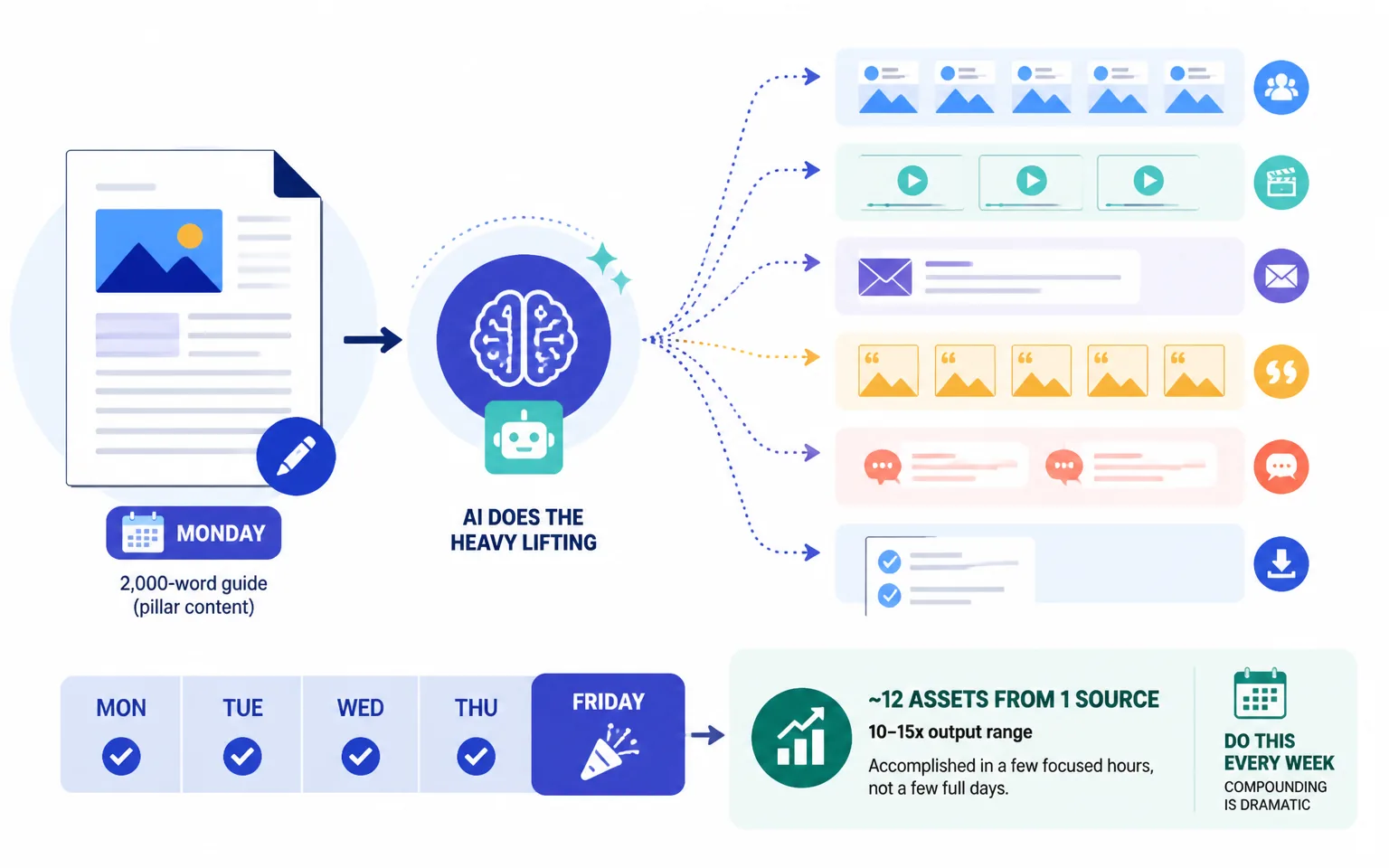
Do that every week and the compounding is dramatic. Within six months of AI implementation, content output volume increases 77%, according to Averi’s benchmarks — and that’s the trajectory I’ve watched play out firsthand.
Frequently Asked Questions
What is the best AI tool for content repurposing?
There’s no single best — it depends on your bottleneck. For text, a general assistant like ChatGPT or Claude handles extraction and reshaping. For video, Opus Clip (around $15/month) leads for AI clipping, while Repurpose.io ($32/month) leads for automated cross-platform distribution, per Postiv AI’s tested roundup. Start with the free tiers and only pay once a tool clearly removes friction.
How many pieces can I make from one piece of content?
Realistically, ten to fifteen distinct derivatives from a strong pillar. One pillar piece, strategically repurposed, generates roughly 10–15x the output and 5–10x the reach of linear content creation, according to Shno’s 2026 statistics. The exact number depends on how rich the source is and how many platforms you publish to.
Does repurposing hurt SEO with duplicate content?
Not when done properly. Repurposing transforms ideas into new formats rather than copying text verbatim, and the derivatives typically link back to the pillar, feeding organic search traffic to it. Tailored, platform-native pieces avoid duplicate-content issues entirely while expanding total reach 3–5x, per Shno’s data.
How much time does AI actually save on repurposing?
AI-powered repurposing workflows cut adaptation time by an estimated 65% per asset, according to Averi’s State of AI in Marketing report. In practice, a week of derivative content that once took days now takes a few focused hours.
Do I still need a human in the loop if AI does the work?
Absolutely. AI drafts; you verify facts, add voice, and approve. With only 29% of teams having a formal AI governance policy, per Averi’s report, the human review step is both a quality safeguard and a brand-safety necessity.
Final Thoughts
Content repurposing used to be a discipline that rewarded large teams with time to spare. AI flipped that. Now a solo creator or a small business can credibly show up everywhere their audience is, from one good idea a week, at a fraction of the old cost. The numbers — 3–5x reach, 3.4x more derivative assets, 65% less adaptation time — aren’t hype; they’re what happens when you stop creating content linearly and start treating every pillar as a quarry.
My advice: don’t try to automate everything on day one. Pick one pillar this week, run it through the five steps, and ship a dozen pieces. Once you feel the leverage, the habit builds itself. That’s how I built byskh.com’s output, and it’s the single change I’d recommend to any marketer who feels like they’re always behind on content.