Internal Linking for SEO: Complete Strategy

Internal linking is the single most underused SEO lever I see on small blogs and business sites in 2026, and the data backs that up: roughly 25% of pages on the average website have zero internal links pointing to them, according to large-site log analysis summarized by Digital Applied. That means a quarter of your hard-won content may be invisible to Google’s crawler and to AI search engines alike.
The fundamentals here line up with Google’s documentation on making links crawlable — descriptive anchor text and standard crawlable links are what let both search engines and AI systems follow your site structure.
I’m Sk Hasan, and I’ve spent years building and ranking content sites. In my experience, a deliberate internal linking strategy is the fastest, cheapest ranking win most site owners are ignoring.
This guide walks you through exactly how internal linking works, how many links to use, the architecture that wins in the AI-search era, and the anchor-text rules that move the needle. Let’s get into it.
Key Takeaways on Internal Linking Strategy for SEO
- Pages with 40–44 internal links earn roughly 4× more Google traffic than pages with fewer than 5, per Zyppy’s study of 23 million internal links.
- About 25% of pages on the average site have zero internal links — they’re orphaned and barely crawled.
- A solid internal linking strategy can improve crawl efficiency by 40% to 70%, based on large-site case studies.
- Pages within three clicks of the homepage get up to 9× more SEO traffic than deeper pages.
- In the AI era, a page with no internal links is effectively invisible to AI agents — internal links are now a citation factor, not just a ranking one.
- Consistency in descriptive anchor text often beats heavy variation; one exact-match anchor correlates with ~5× more traffic.
What Is Internal Linking and Why It Matters for SEO
An internal link is simply a hyperlink from one page on your site to another page on the same site. That’s it. But the strategic weight of those links is enormous.
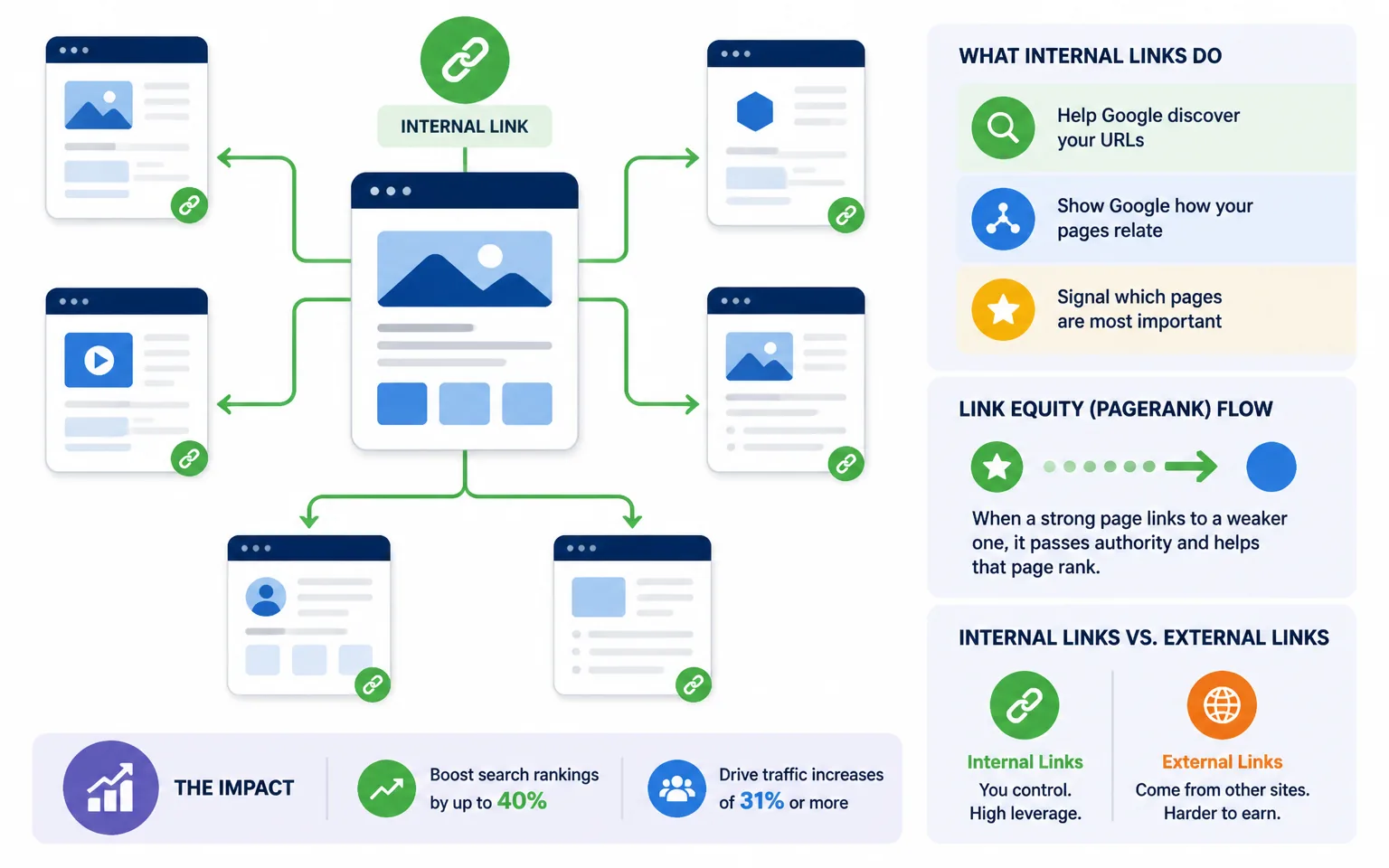
Internal links do three jobs at once. They help Google discover your URLs, they show Google how your pages relate to one another, and they signal which pages you consider most important.
Here’s the part most people miss. Internal links distribute “link equity” (often called PageRank) around your site. When a strong page links to a weaker one, it passes authority and helps that page rank.
The numbers are striking. According to a synthesis of 2026 ranking data from Rankability, smart internal linking can boost search rankings by up to 40% and drive traffic increases of 31% or more within a few months.
If you’re still building your foundation, pair this with my guide on how to rank higher on Google, which covers the broader on-page and technical signals internal links amplify.
Internal Links vs. External Links
External (or “backbound”) links come from other websites and are harder to earn. Internal links you control completely — that’s what makes them such a high-leverage tactic.
You decide which pages get linked, how often, and with what anchor text. No outreach, no waiting, no cost. In a world where link building gets more expensive every year, your own site is the one place you have total authority over equity flow.
How Internal Links Affect Crawling and Indexing
Direct answer: internal links are how Googlebot finds and prioritizes your pages, so weak internal linking means weak crawling and slow indexing.
Crawl depth is the key concept here. Crawl depth is the number of clicks it takes to reach a page from your homepage. A page four clicks deep has a crawl depth of four.
The deeper a page sits, the less often Google crawls it. For sites over 1,000 pages, pages that are 4+ clicks from the homepage see roughly 70% less crawl frequency, according to Digital Applied’s 2026 analysis.
This is why “three clicks from home” remains the gold standard. A My Ranking Metrics study found that pages at depths 1–3 generate nine times more SEO traffic than pages buried deeper.
The crawl gains from fixing internal links are real and measurable. In a JetOctopus large-site case study, Googlebot crawl coverage jumped from 40% to 70% after a revised internal linking strategy — about a 30-percentage-point improvement with no new content.
If a fresh post isn’t getting picked up, internal links are usually the fix. I cover the full discovery process in my piece on getting indexed by Google fast.
The Orphan Page Problem
An orphan page is a page with no internal links pointing to it. To Google, it barely exists; to AI search engines, it’s invisible.
This isn’t a rare edge case. Roughly a quarter of pages on the average site are orphaned or under-linked, and fewer than half of large-site pages receive enough internal links, per the same large-site log analysis.
The first audit I run on any site is a hunt for orphans. Tools like Screaming Frog, Ahrefs, or Google Search Console’s crawl stats will surface pages with zero inbound internal links so you can fix them fast.
How Many Internal Links Should a Page Have?
Direct answer: aim for 2–5 contextual links per 1,000 words, scaling up to 5–10 for long-form content, while keeping total page links (including navigation and footer) under 150.
The most cited data here comes from Zyppy’s analysis of 23 million internal links across roughly 1,800 websites and 520,000 URLs. The finding is counterintuitive but important.
Pages with 0–4 internal links pointing to them received only about 2 clicks on average from Google. Pages with 40–44 internal links pointing in received 4× more — roughly 8 clicks on average.
But more isn’t infinitely better. After about 45–50 inbound internal links, the traffic benefit reversed in Zyppy’s data. There’s a sweet spot, and overstuffing a page with links dilutes their value.
Note the distinction: that 40–44 figure is about links pointing to a page from across your site, not links you cram into a single article. Within one article, a handful of genuinely relevant contextual links is plenty.
Quality Over Quantity
Every internal link should make sense to a human reader. If a link doesn’t help the reader go somewhere useful, it shouldn’t be there.
Google’s systems increasingly evaluate links in context — the surrounding sentences, the relevance of the target, and whether the link looks editorial or manipulative. A relevant link inside a helpful paragraph is worth far more than ten links stuffed in a footer block.
The Best Internal Linking Architecture in 2026: Pillar and Cluster
Direct answer: the winning structure for content sites in 2026 is the pillar-and-cluster (hub-and-spoke) model, where a broad pillar page links down to focused cluster pages and each cluster links back up.
This bi-directional pattern concentrates topical authority on the pillar and tells Google the cluster is one coherent body of work. It also keeps your priority pages within those crucial three clicks of the homepage.
Here’s how I set it up. The pillar page targets a broad head term (say, “email marketing”). Each cluster page targets a specific long-tail subtopic (like “email subject line testing”), and every cluster links back to the pillar with descriptive anchor text.
The model is more relevant than ever for AI search. As Memorable Design notes, hub-and-spoke linking builds the topical authority and E-E-A-T signals that AI systems use to decide which sources to cite.
I’ve written a full walkthrough of this in my pillar-and-cluster playbook for building topical authority — internal linking is the connective tissue that makes that whole system work.
Mapping Your Clusters Before You Link
You can’t link strategically if you don’t know your topic map. Before building links, group your existing posts into topic clusters around the head terms you want to own.
This is where keyword research pays off twice. The same research that finds your topics also reveals the semantic relationships that should become internal links — I break down that process in my guide on keyword research for SEO.
Once your clusters are mapped, the linking almost writes itself: pillar to clusters, clusters to pillar, and clusters to closely related siblings where it genuinely helps the reader.
Internal Linking Anchor Text Best Practices
Direct answer: use descriptive, keyword-relevant anchor text that reads naturally, and favor consistency over wild variation.
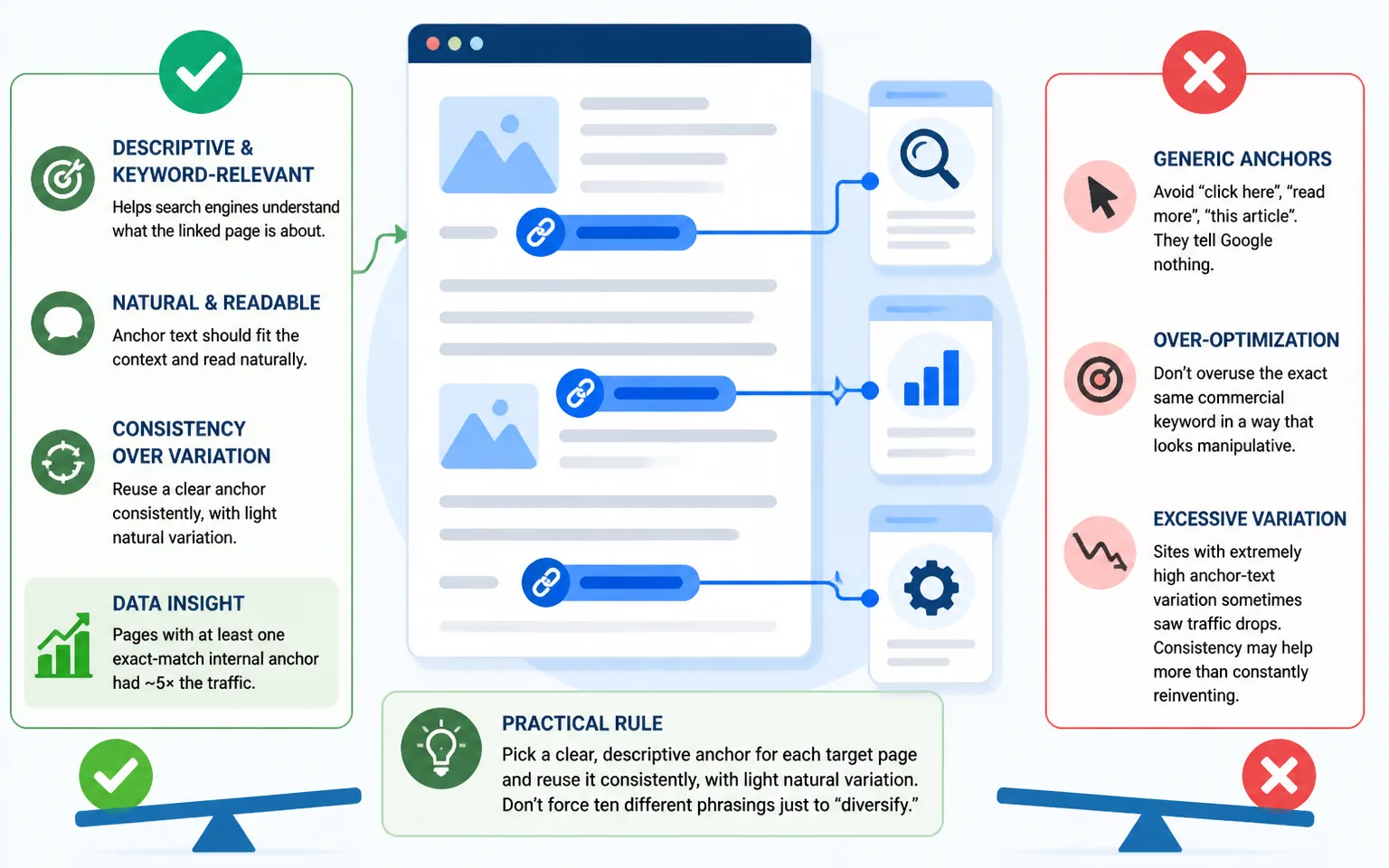
Anchor text tells Google what the linked page is about. “Click here” tells it nothing; “keyword research for SEO” tells it everything.
Zyppy’s data is illuminating here. Pages with at least one exact-match internal anchor had roughly 5× the traffic of pages without one — though the authors rightly flag this as correlation, not proven causation.
Here’s the surprise. The same study found that sites with extremely high anchor-text variation sometimes saw traffic drops, suggesting consistency may help more than constantly reinventing your anchors.
My practical rule: pick a clear, descriptive anchor for each target page and reuse it consistently, with light natural variation. Don’t force ten different phrasings just to “diversify.”
Anchor Text Mistakes to Avoid
Avoid generic anchors like “read more” and “this article” for your important pages. They waste the relevance signal entirely.
Also avoid over-optimizing with the exact same commercial keyword in a way that looks manipulative. Natural language that happens to include your keyword is the goal — not robotic repetition that screams “SEO link.”
Internal Linking for AI Search and AI Overviews
Direct answer: in 2026, internal links don’t just help you rank — they determine whether AI engines can find and cite your content at all.
The shift is dramatic. A large Ahrefs study of 863,000 keywords found that only 38% of pages cited in Google AI Overviews also rank in the top 10 for that query — down from 76% just seven months earlier.
Translation: AI engines now pull from pages well outside the top 10, and clean internal linking is one of the strongest signals helping them surface and trust those deeper pages.
The opportunity is growing fast. Conductor’s analysis found that 25.11% of searches triggered an AI Overview in Q1 2026, up from 13.14% in March 2025 — nearly double in a single year.
And visibility there is valuable: getting cited inside an AI Overview earns roughly 35% more clicks than a traditional ranking alone, according to the same 2026 reporting.
A page with no internal links is invisible to AI agents, full stop. Even a flawless AI-Overview-worthy article gets ignored if nothing on your site links to it — orphan pages don’t get cited.
For the full picture of optimizing for generative and answer engines, see my deep dive on GEO and AEO for AI search, where internal linking plays a starring role.
Why Short, Linkable Passages Win
AI systems lift short, self-contained passages most easily. Internal links that point to clearly structured, well-organized pages make it easier for those systems to extract and cite your content.
That’s a big reason 88% of Google AI Overviews now cite three or more sources — they reward sites that connect related ideas clearly. A tight internal linking structure literally helps the machine understand your expertise.
A Step-by-Step Internal Linking Audit
Direct answer: audit your internal links by mapping clusters, finding orphans, strengthening priority pages, and fixing broken links — in that order.
Step one: crawl your site with Screaming Frog or a similar tool and export every page with its inbound internal link count. Flag anything with zero or very few links.
Step two: identify your money pages — the posts you most want to rank. Add contextual links to them from relevant, higher-authority pages on your site.
Step three: fix orphans. Every published page should have at least a few relevant internal links pointing to it from related content.
Step four: check for broken internal links and redirect chains. Broken internal links waste crawl budget and frustrate users — and with crawl efficiency improvable by 40% to 70% through better linking, this housekeeping pays off.
Step five: review anchor text. Make sure your important pages are getting descriptive, consistent anchors rather than generic “click here” filler.
How Often to Re-Audit
I run a light internal linking pass every time I publish — linking the new post into its cluster and linking relevant older posts to it. Then I do a full audit quarterly.
This rhythm keeps fresh content from becoming orphaned and ensures equity keeps flowing to your priority pages as the site grows.
Common Internal Linking Mistakes
The biggest mistake is publishing and forgetting — new posts go up with no links pointing to them and immediately become orphans. With about 25% of pages already orphaned on the average site, this compounds fast.
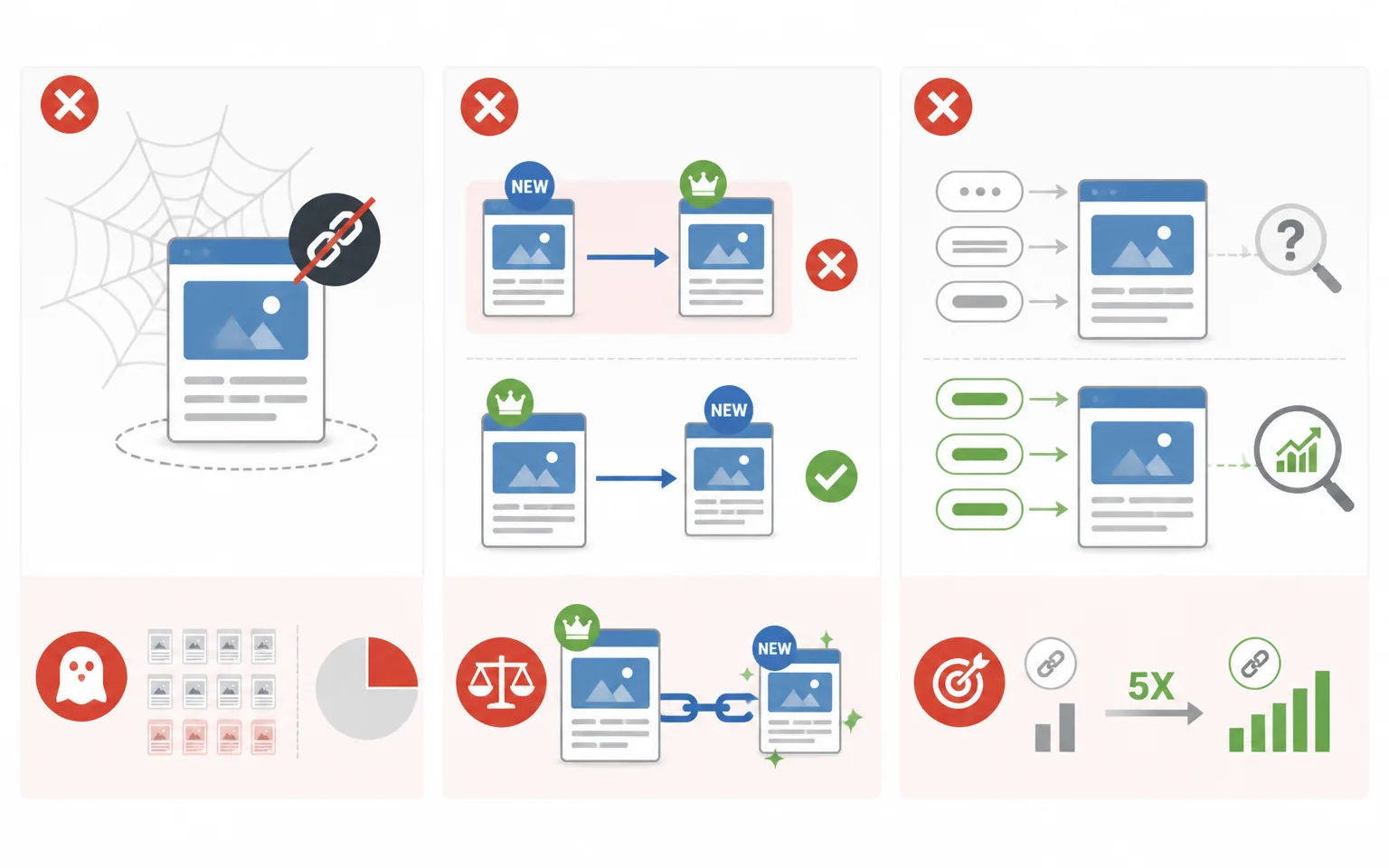
Another common error is linking only from new posts to old ones, never the reverse. Your established, higher-authority pages should pass equity down to new content to help it rank.
Finally, many site owners ignore anchor text entirely, linking with vague phrases that give Google no topical signal. Given that exact-match anchors correlate with roughly 5× more traffic, that’s a costly oversight.
Summary
Internal linking is the highest-leverage SEO tactic you fully control, and in 2026 it does double duty — helping you rank in Google and helping AI engines find and cite your content. The data is consistent: pages with 40–44 inbound internal links earn around 4× the traffic of orphaned pages, and better linking can lift crawl efficiency by 40% to 70%.
The winning structure is pillar-and-cluster: a broad hub page linking down to focused spokes, each linking back up, with everything kept within three clicks of the homepage. Use descriptive, consistent anchor text, and fix your orphans first.
Do a light linking pass on every new post and a full audit quarterly. That simple habit will keep your equity flowing, your pages crawled, and your best content visible to both Google and AI search.
Frequently Asked Questions
How many internal links should I have on a single blog post?
For a typical post, aim for 2–5 contextual internal links per 1,000 words, scaling toward 5–10 for long-form articles around 2,000 words. Keep total links on the page (including menus and footer) under 150, and make sure every link is genuinely relevant to the reader rather than added just to hit a number.
Do internal links actually improve Google rankings?
Yes. Internal links help Google discover, crawl, and prioritize your pages, and they pass link equity between pages. Synthesized 2026 data suggests smart internal linking can boost rankings by up to 40% and traffic by 31% or more within a few months, though results depend on overall content quality and site authority.
What is an orphan page and why is it bad?
An orphan page is a page with no internal links pointing to it. Google rarely crawls it, it struggles to rank, and AI search engines effectively can’t see it. Since roughly 25% of pages on the average site are orphaned, fixing them is usually one of the fastest SEO wins available.
What is the best internal linking structure for SEO?
The pillar-and-cluster (hub-and-spoke) model is the 2026 standard. A broad pillar page links down to focused cluster pages, and each cluster links back to the pillar. This concentrates topical authority, keeps priority pages within three clicks of the homepage, and strengthens the signals AI engines use to cite sources.
Does internal linking help with AI Overviews and AI search?
Increasingly, yes. Only about 38% of pages cited in Google AI Overviews now also rank in the top 10, so AI engines pull from deeper pages — and clean internal linking helps them find and trust that content. A page with no internal links is essentially invisible to AI agents, so orphaned content rarely gets cited.
What anchor text should I use for internal links?
Use descriptive, keyword-relevant anchor text that reads naturally, and favor consistency over heavy variation. Pages with at least one exact-match internal anchor showed roughly 5× the traffic of pages without one in Zyppy’s study, while extreme anchor variation sometimes correlated with traffic drops — so pick a clear anchor per target and reuse it.
Conclusion
If you do one SEO thing this month, audit your internal links. It costs nothing, it’s entirely in your control, and the upside — better rankings, faster indexing, and AI citations — is too large to leave on the table.
Start by finding your orphans, build out a pillar-and-cluster structure, and link with intent. Your future traffic will thank you.