E-E-A-T for SEO: How to Build Trust Signals That Win Rankings and AI Citations in 2026

What E-E-A-T Really Means for SEO in 2026
If you only optimize one thing this year, make it trust. E-E-A-T — Experience, Expertise, Authoritativeness, and Trust — is the framework Google’s quality systems use to decide which pages deserve to rank and, increasingly, which sources get pulled into AI answers. It is not a single score you can game; it is the sum of signals that prove a real, credible human stands behind your content. I have watched it move from a “nice to have” to the deciding factor in whether a page survives a core update, and the data backs that up: every respondent in a 2026 industry survey agreed that trust and credibility signals are becoming more important as AI systems decide which sources to surface, according to GoodFirms’ AI SEO research.
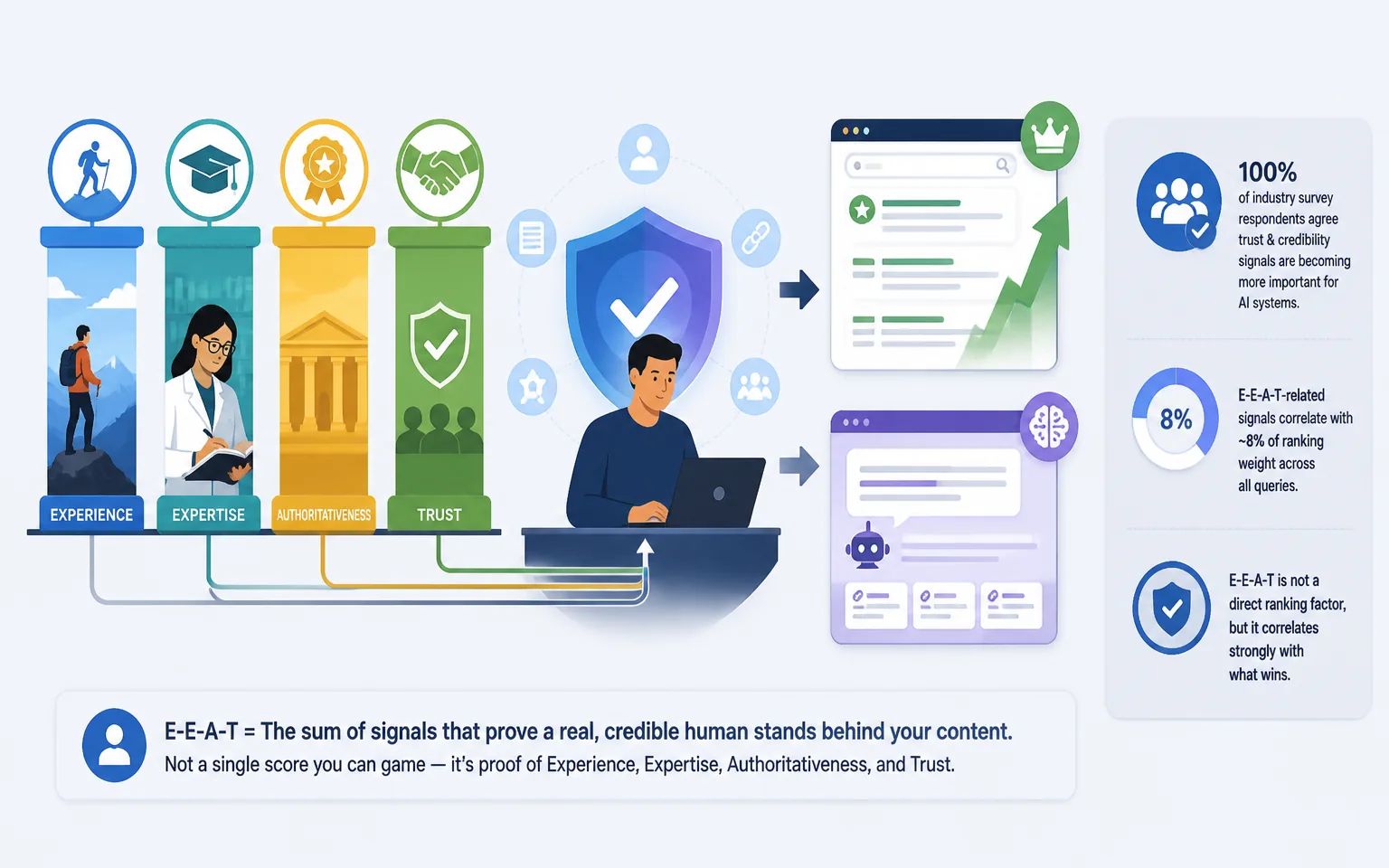
Here is the direct answer most people want up front: E-E-A-T is not a direct ranking factor, but it correlates strongly with what wins. A 2025 correlation study by DollarPocket analyzing 10 million search results found E-E-A-T-related signals correlate with roughly 8% of ranking weight across all queries — small on paper, but decisive in competitive niches where everything else is equal.
The Extra “E”: Why Experience Now Outweighs Credentials
Google added the second “E” — Experience — to the original E-A-T for a reason, and the December 2025 core update finally gave it teeth. That update significantly raised the weight of demonstrable, lived experience, and websites without it systematically lost ground. As one post-update analysis put it, Google’s systems have gotten uncomfortably good at distinguishing between performing expertise and actually demonstrating it.
What does that look like in practice? Language patterns that signal first-hand use — “in my testing,” “when I tried this,” “our data showed” — plus specificity markers like exact measurements, proprietary numbers, and unique details. Original photos, screenshots, and charts count too. The old playbook of a keyword-stuffed author box and an About page that reads like a résumé no longer guarantees anything. John Mueller said it plainly in 2025: you cannot simply “sprinkle some experiences on your web pages.” Experience has to be real, and it has to be visible on the page.
The winners and losers made the shift obvious. Post-update coverage noted that generalist sites covering everything shallowly took the hardest hits, while focused, niche sites with genuine subject depth often gained visibility — a pattern that rewards the same topical focus I describe in my topical authority pillar-cluster playbook.
How E-E-A-T Drives AI Overviews and ChatGPT Citations
Trust is no longer just a ranking input — it is the admission ticket to AI search. Analysis by Wellows of 2,400 AI Overview citations found that pages with strong E-E-A-T signals are 2.3x more likely to be cited, and that 96% of AI Overview citations come from sources exhibiting strong trust signals. When a generative engine has to choose which handful of sources to quote, it leans on the same credibility cues quality raters look for.
This matters because classic ranking is no longer a guaranteed on-ramp. Independent research shows the top-10 citation rate for AI answers has fallen sharply, and roughly 47% of AI Overview content is now drawn from pages ranking below position five. In other words, you can be cited by an AI answer without sitting at the top of the blue links — if your trust signals are strong enough. Being cited also pays: Seer Interactive’s late-2025 study found pages cited in AI Overviews saw a +35% lift in organic click-through rate versus pages that ranked but were not cited.
If you want the mechanics of formatting content for these engines, I go deep on that in my guide to GEO and AEO for AI search. E-E-A-T is the credibility layer that sits underneath all of it.
The Trust Signals Google Actually Measures
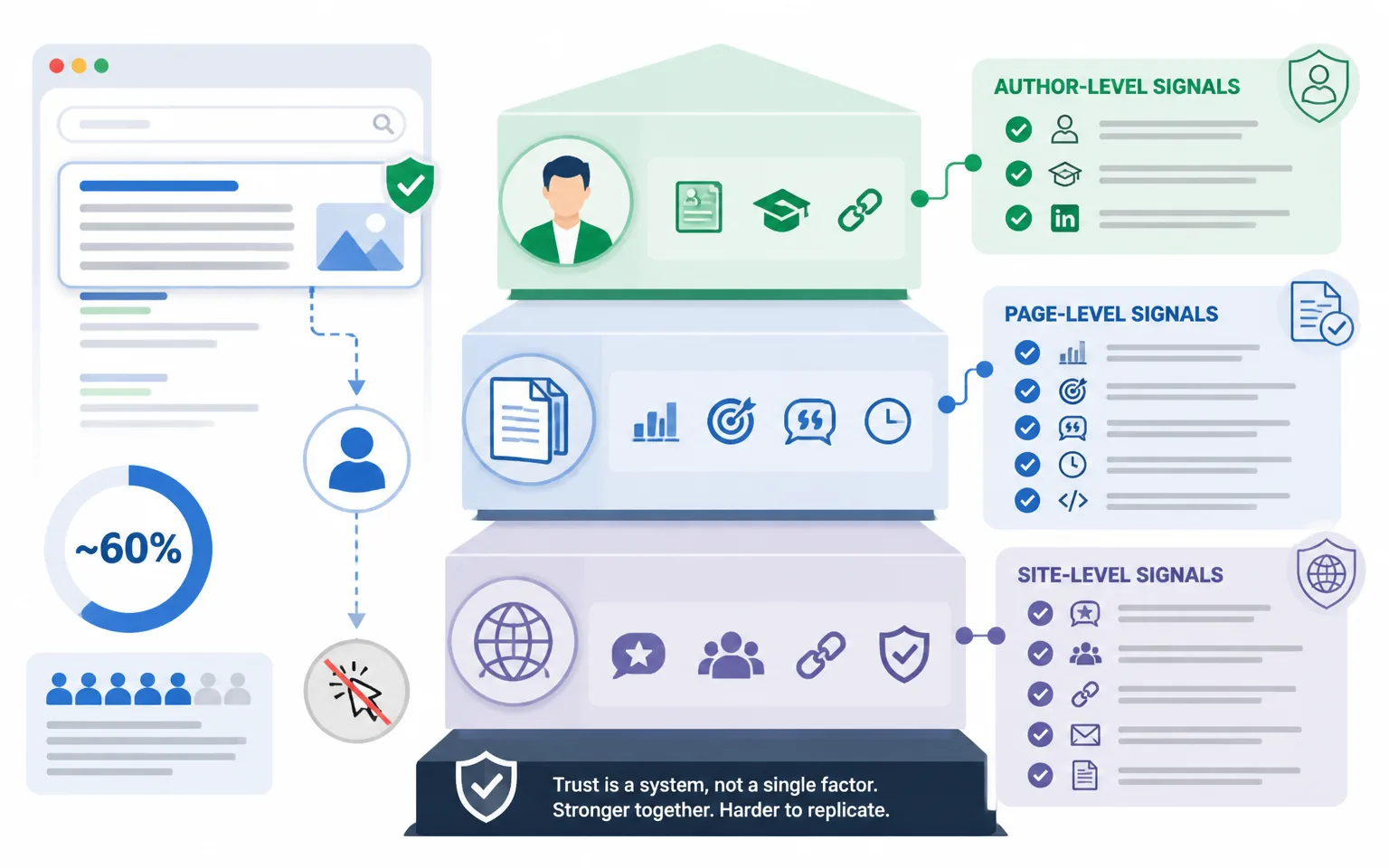
E-E-A-T shows up across three layers. Treating them together is how you build a page that both ranks and gets quoted. Zero-click behavior underscores the stakes: nearly 60% of Google searches now end without a click, so the impression your snippet and citation leave often is the visit.
Author-level signals
Real, named authors with completed bios, verifiable credentials, and links to their LinkedIn or professional profiles. Google increasingly wants to connect content to a person who has a reputation to protect. A byline that leads nowhere is a missed trust signal.
Page-level signals
Depth, accuracy, original data, clear sourcing, and content freshness. Outdated pages bleed trust; refreshing them restores it, which is exactly why I treat updates as an ongoing discipline in my content decay and refresh guide. Structured data reinforces these signals for machines, too.
Site-level signals
Reputation across the wider web — reviews, mentions, quality backlinks, transparent contact and policy pages, and a consistent editorial standard. Traditional ranking correlation has actually loosened (one study put it at r=0.18, down from 0.23 in 2024), which tells me single factors matter less and the holistic trust picture matters more.
A Practical E-E-A-T Playbook You Can Start Today
Frameworks are useless without execution. Here is the sequence I follow on my own projects, ordered from highest to lowest leverage.
Demonstrate first-hand experience on the page
Add what only someone who actually did the work could write: screenshots from your own dashboard, a photo of the product in your hands, the number you measured, the mistake you made and fixed. These specificity markers were flagged as decisive after the December 2025 update. If a competitor could copy your paragraph word for word without having done anything, it is not experience — it is filler.
Build real author authority
Give every article a genuine author with a complete bio, a photo, credentials, and outbound links to their profiles and personal site. Help your writers build their own public brand; a recognized expert lends their reputation to every page they sign. This is slow work, but it compounds — and it is precisely what the algorithm now rewards over a keyword-optimized author box.
Strengthen site-wide trust
Publish clear About, Contact, and editorial-policy pages. Cite primary sources. Earn mentions from reputable sites in your niche. Add structured data so search engines can parse who wrote what and what your page is about — my schema markup guide walks through the exact types that reinforce authorship and organization trust. With AI Overviews now appearing in the vast majority of brand searches, a coherent trust footprint across your whole site is what gets you surfaced consistently.
Common E-E-A-T Mistakes That Quietly Sink Rankings
The most expensive mistakes are the ones that look harmless. Faceless “admin” or “staff” bylines throw away author trust. Thin, me-too content that summarizes what everyone already said adds no experience. Fake or inflated credentials now backfire because Google is better than ever at spotting performed expertise. And letting flagship pages go stale invites content decay — a real risk when 65% of marketers already name AI-driven search change as their single biggest challenge, per industry surveys. You do not want self-inflicted trust problems on top of that.
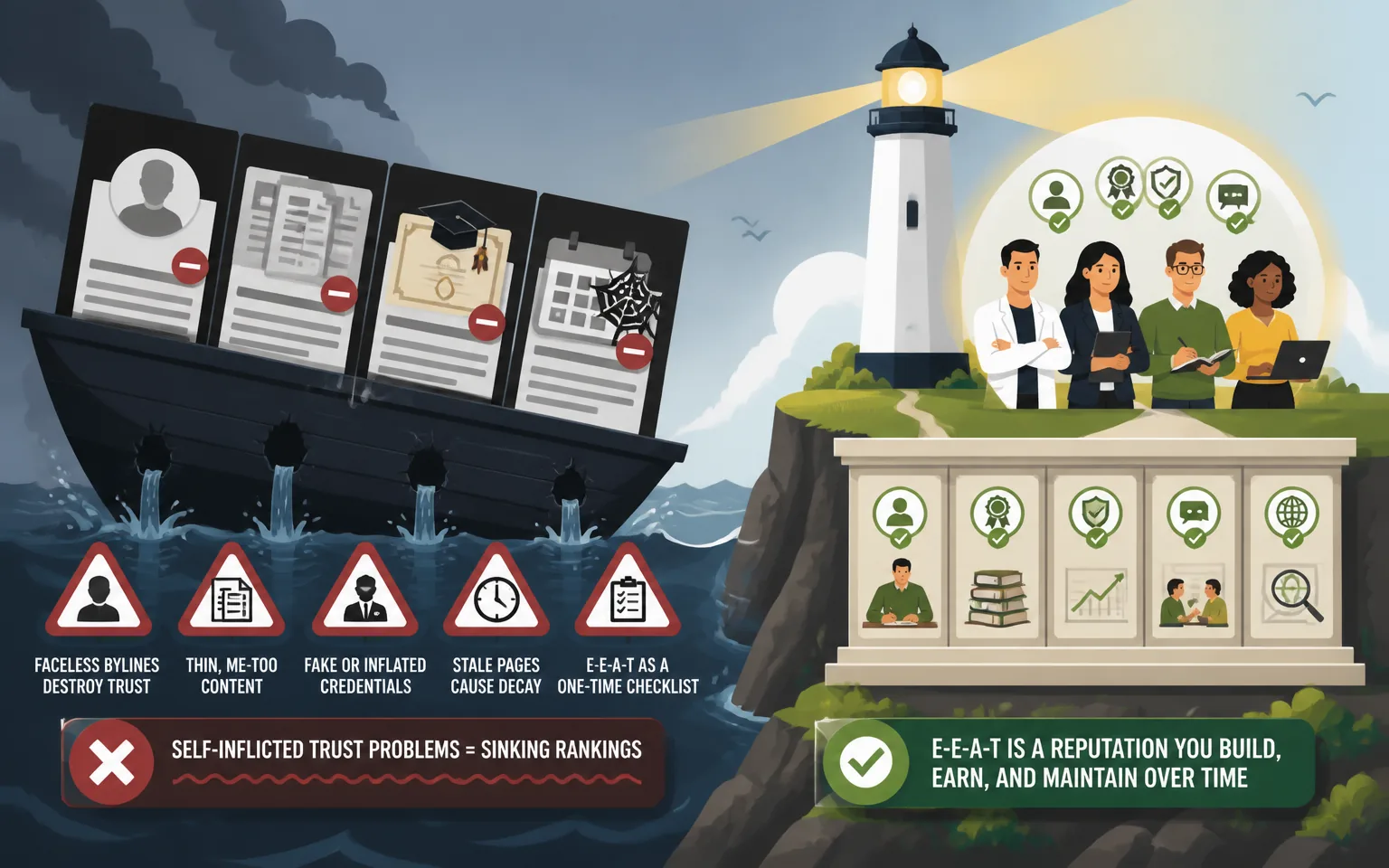
Another silent killer: treating E-E-A-T as a checklist to complete once. It is not a badge; it is a reputation you maintain. Every new page either adds to or subtracts from the trust your domain has accumulated.
How to Measure Whether Your E-E-A-T Is Working
You cannot see an “E-E-A-T score,” but you can track proxies. Watch your citation rate in AI Overviews and chatbots for your target queries — being quoted is the clearest signal that engines trust you. Monitor rankings through core updates; trusted sites tend to hold or gain while thin sites drop. Track branded search volume and direct traffic, which both rise as your authority grows. And keep an eye on referring domains from reputable sources. With 89% of brand searches now showing an AI Overview, your presence (or absence) inside those answers is a fast, honest read on where your trust stands. Run this review quarterly and after every confirmed core update.
Frequently Asked Questions
Is E-E-A-T a direct Google ranking factor?
No. Google and John Mueller have both confirmed there is no single E-E-A-T score in the algorithm. It is a framework describing qualities Google’s systems are built to reward, and its signals correlate with roughly 8% of ranking weight in one 10-million-result study — enough to be decisive in close races.
What is the difference between the two E’s — Experience and Expertise?
Expertise is formal knowledge or skill in a subject; Experience is having personally done or used the thing you are writing about. A doctor has expertise on a medication; a patient who took it has experience with it. The December 2025 core update raised the weight of that lived experience specifically.
Does E-E-A-T matter for getting cited in AI Overviews?
Yes — arguably more than for classic rankings. Research on 2,400 citations found strong-E-E-A-T pages are 2.3x more likely to be cited, and 96% of AI Overview citations come from high-trust sources. Trust has become the primary filter for AI inclusion.
How long does it take to improve E-E-A-T?
Page-level fixes like adding author bios, first-hand detail, and sources can show impact within a core update cycle. Site-level reputation — backlinks, mentions, author brand — takes months to compound. Treat it as an ongoing practice, not a one-time project.
Can AI-generated content have good E-E-A-T?
Only if a real expert shapes, verifies, and adds genuine first-hand experience to it. Pure machine output with no lived input struggles on the “Experience” dimension, which is exactly where the latest updates apply the most pressure.
Why E-E-A-T Matters Most for YMYL Topics
Not every page is judged with equal severity. Google reserves its harshest scrutiny for “Your Money or Your Life” (YMYL) content — health, finance, legal, and safety topics where bad information can genuinely harm someone. On these pages, weak E-E-A-T is not a minor drag; it is a hard ceiling. If you publish financial advice without demonstrable credentials, transparent sourcing, and author accountability, you will struggle to rank no matter how well-written the piece is. Some analysts now argue E-E-A-T became the single most important quality signal after the December 2025 core update, precisely because so much money-and-health content leaned on thin, AI-spun text, as post-update reporting detailed. If you operate in a YMYL niche, treat expert authorship and citations as non-negotiable, not optional polish.
Even outside YMYL, the direction of travel is the same. Google’s raters are instructed to weigh the “total user experience,” and that holistic lens is bleeding into every category. The gap between a page that merely mentions a topic and one that proves lived competence is widening across the board.
Turning Your Authors Into Recognized Entities
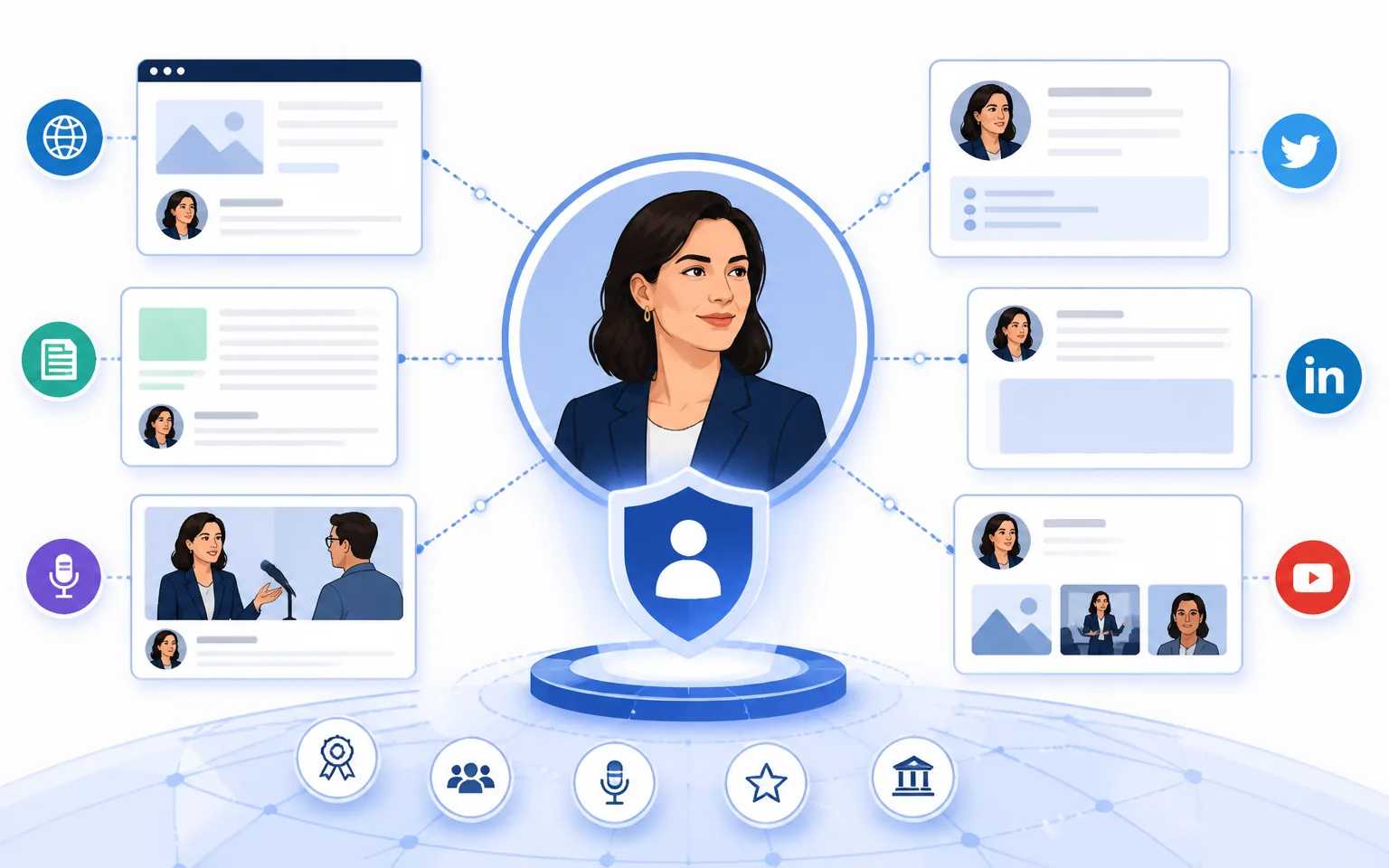
The most durable E-E-A-T advantage is an author whom search engines recognize as a distinct, trusted entity. That means the same author name, bio, and photo appearing consistently across your site, guest posts, interviews, and social profiles — a web of corroborating signals Google can connect. When an engine can map a byline to a real reputation, every page that person signs inherits that credibility. This is why building author brands pays off long after any single post is published, and why the strongest sites invest in a handful of visible, quotable experts rather than an anonymous content mill. In a landscape where trust is the primary filter for AI inclusion, a recognized author is one of the few moats that is genuinely hard to copy. Start by picking one or two people on your team, giving them real bylines, and letting them build a public track record around your core topics.
Final Thoughts
E-E-A-T is not a trick, and that is the point. In a search landscape where nearly 60% of queries end without a click and AI answers decide who gets seen, the sites that win are the ones that are demonstrably worth trusting. Show your work, put a real name and face on it, cite honestly, and keep it current. Do that consistently and you are not just satisfying an algorithm — you are building the kind of reputation that survives every update Google ships next. Start with your most important page today: add the first-hand detail only you could write, and give it a real author. That single change is the highest-leverage SEO move most sites are still ignoring.