Programmatic SEO With AI: Scale Content Safely

What Programmatic SEO Actually Means in 2026
Programmatic SEO is the practice of generating many web pages at once from a single template and a structured dataset, so that each page targets a distinct, specific search query. If you have ever searched “flights from Boston to Austin” or “best CRM for dental clinics” and landed on a page that felt purpose-built for exactly that phrase, you have met programmatic SEO. In 2026, the difference between a programmatic strategy that scales revenue and one that gets your whole domain flattened comes down to one thing: whether each page answers a question that no other page — yours or anyone else’s — already answers well.
The single most important guardrail is Google’s spam policy on scaled content abuse — publishing large volumes of AI content mainly to manipulate rankings is exactly what triggers penalties.
I have been running content operations for long enough to remember when you could spin up 5,000 thin pages and watch traffic climb for a quarter before the inevitable correction. That era is over. Google’s March 2026 core update explicitly named “scaled content abuse” as a primary target, and sites that published hundreds or thousands of AI-generated pages without editorial oversight saw traffic drops of 50 to 80 percent, according to analysis from Digital Applied. So this guide is not about gaming the system. It is about using AI to scale the parts of content production that genuinely deserve to scale, while keeping the human judgment that keeps you safe.

Why the Stakes Are Higher Than They Have Ever Been
Search behavior itself has shifted, which changes what “ranking” even buys you. As of January 2026, AI Overviews appear in roughly 25.8 percent of all US searches and reach approximately two billion users monthly, per data compiled by Stackmatix. That means a meaningful slice of your would-be clicks are now absorbed into an AI-generated answer box before anyone reaches a blue link.

The pull toward AI-first search is accelerating fast. Google’s AI Mode reportedly reached 75 million daily active users and more than 100 million monthly users, a roughly fourfold increase since its May 2025 launch, as reported in Search Engine Land’s 2026 outlook. Informational queries — the bread and butter of most programmatic strategies — trigger an AI Overview 39.4 percent of the time, according to Position Digital’s 2026 statistics roundup. Programmatic pages that exist only to restate what an AI Overview already summarizes are, functionally, invisible.
The lesson I take from these numbers is not “give up on programmatic.” It is that the bar for a page earning its place has risen sharply. If AI can generate your page’s content on the fly from public data, AI will — and it will not send the click to you.
The Line Between Legitimate Scale and Scaled Abuse
Google’s own documentation is refreshingly direct about where the line sits. Creating separate content for every possible variation of how people might search, primarily to manipulate rankings or generative AI responses, violates the scaled content abuse spam policy. But best practices still apply because, as Google explains in its guide to optimizing for generative AI features, those features are rooted in the same core ranking and quality systems that have always governed Search.
So what survives? The pattern across every post-March-2026 recovery study I have read is identical: pages built on unique, structured data continue to rank. Local business directories with verified listings, comparison tools with live pricing, and travel guides with real inventory data all held up, because each page carries information a language model cannot fabricate. The failures were just as consistent. Niche information sites with 500 or more AI pages published in 2025 lost 60 to 80 percent of their traffic, and template-generated location pages that differed only by city name lost 30 to 60 percent, per Digital Applied’s survival analysis. The common thread in every casualty was thin depth, identical structure, and no first-hand expertise.
How I Build a Programmatic SEO System That Lasts
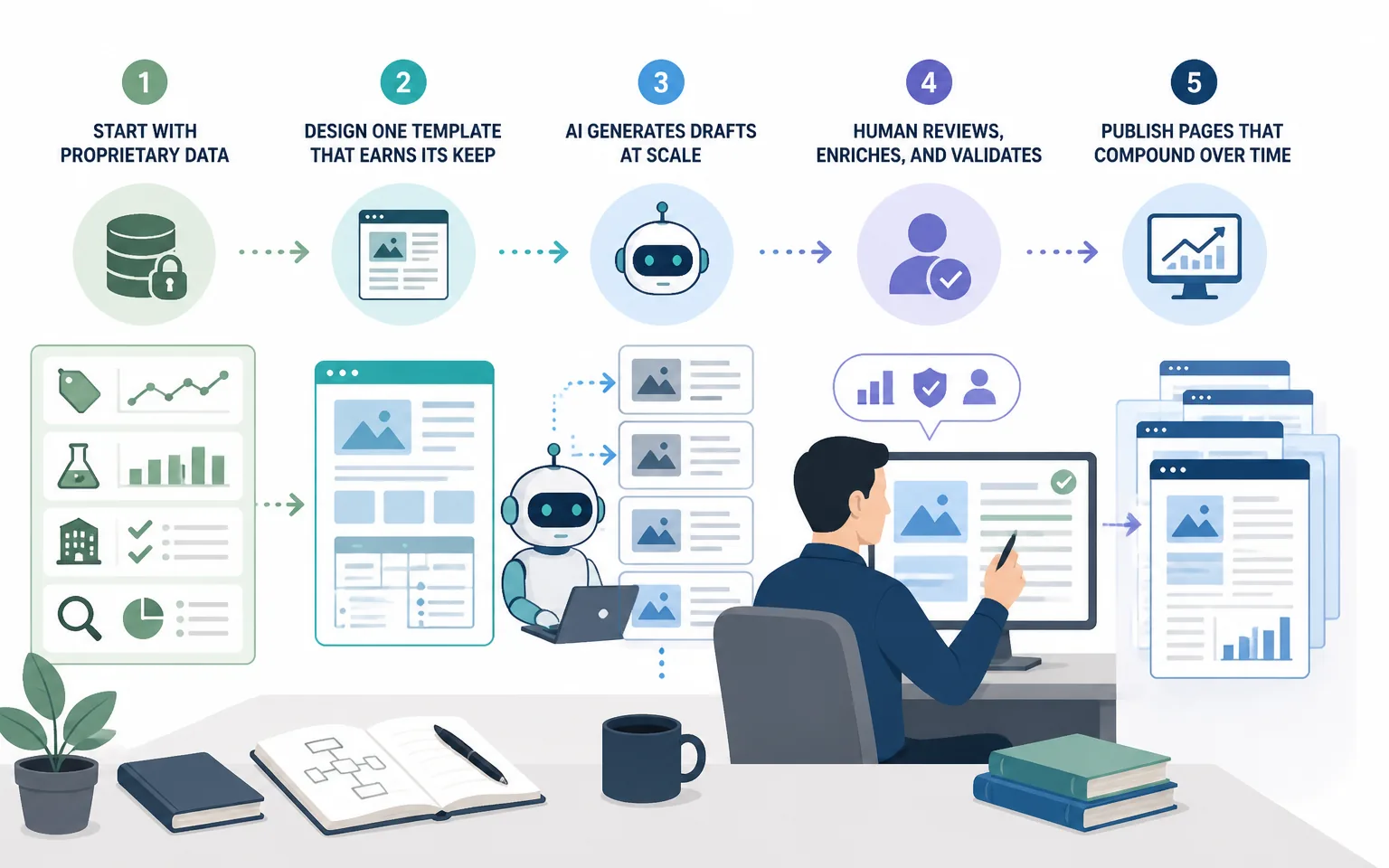
My workflow has five stages, and AI touches every one of them — but never as the sole author of a published page. I think of AI as an extremely fast junior analyst, not as the editor-in-chief.
Stage One: Start With Proprietary Data, Not Keywords
The single biggest predictor of whether a programmatic project survives is whether it is built on data you own or have uniquely assembled. Before I write a line of template copy, I ask what dataset makes each page genuinely different: pricing I have collected, test results I have measured, a directory I have verified, or an analysis that requires access the reader lacks. Google’s March 2026 update specifically rewards original research, proprietary data, and first-hand testing, according to Evertune’s core-update breakdown. If I cannot name the unique data behind a page, that page should not exist.
Stage Two: Design One Template That Earns Its Keep
A programmatic template is a promise: every page will deliver a consistent, useful structure. I design mine so the data does the heavy lifting and the AI-generated prose merely connects the dots between data points. This is also where solid on-page fundamentals matter most, since you are stamping the same structural decisions across every page. I lean on the same principles I outline in my on-page SEO checklist — clean headings, descriptive titles, internal links, and schema — because a structural mistake in the template multiplies across thousands of URLs.
Stage Three: Use AI for Variation, Not Fabrication
Here is where discipline pays off. I use large language models to generate the connective narrative — the sentence that interprets a data point, the summary that frames a comparison — while every factual claim on the page traces back to my dataset. This matters because Google does not actually penalize AI-generated content for being AI-generated; a 2026 study by Rankability found no ranking penalty tied to AI authorship itself. What gets penalized is unhelpful, unoriginal, duplicative content regardless of who or what wrote it. That distinction is the whole game.
Stage Four: Add a Human Editorial Gate
The most damaging pattern in the March 2026 wave was sites publishing 50 to 500 AI articles per day with no human review. I cap publishing velocity deliberately and route every batch through a human who checks factual accuracy, readability, and whether the page actually says something the dataset supports. This is slower. It is also the difference between compounding traffic and a manual action. Quality control at scale is non-negotiable, and modern programmatic tools now include automated checks for duplication and readability, as covered in TopicalMap’s 2026 programmatic guide — but automated checks supplement human judgment, they do not replace it.
Stage Five: Prune Relentlessly
Programmatic SEO is not “publish and forget.” I review page-level performance quarterly and cut or consolidate any page that fails to earn impressions or answers a query another page handles better. Ruthless pruning keeps your average page quality high, which is exactly the signal Google’s quality systems reward.
Connecting Programmatic Pages to the Rest of Your Site
Isolated programmatic pages rarely perform. They need to sit inside a coherent site architecture that signals topical depth. I treat every programmatic cluster as a spoke that connects back to a strong pillar page, following the same logic I describe in my topical authority playbook. When 800 comparison pages all link up to a single authoritative guide, each page borrows credibility from the whole, and Google reads the cluster as genuine subject-matter coverage rather than a pile of disconnected templates.
The broader shift toward AI-mediated search reinforces this. As I have written about how AI is changing SEO strategies, the winners are increasingly sites that demonstrate experience and authority a machine cannot synthesize. Programmatic scale and genuine authority are not opposites — the best operators use scale to cover breadth while investing human expertise to establish depth.
Common Mistakes That Still Sink Programmatic Projects
The first mistake is chasing volume as a vanity metric. Ten thousand pages is not a strategy; it is a liability if 9,000 of them are thin. The second is generating pages for query variations that are functionally identical — “best CRM for dentists” and “top CRM for dental practices” do not need separate pages, and creating both looks like manipulation. The third, and most common, is skipping the data layer entirely and asking AI to invent facts. Affiliate review sites that generated product comparisons with no first-hand testing lost 40 to 70 percent of their traffic in March 2026, per the Digital Applied analysis cited earlier, precisely because their content was indistinguishable from manufacturer specifications. If you would not stake your reputation on a page’s accuracy, do not publish it.
Frequently Asked Questions
Is programmatic SEO dead after Google’s 2026 updates?
No. Programmatic SEO built on unique, structured data continues to rank well. What died is low-effort scaled content — thousands of near-identical AI pages with no original data or expertise. If each of your pages answers a distinct query using information a language model cannot fabricate, the approach remains viable and effective.
Will Google penalize me for using AI to write programmatic pages?
Not for the AI itself. Independent 2026 research found no penalty tied to AI authorship. Google penalizes unhelpful, unoriginal, or duplicative content regardless of whether a human or a machine produced it. Use AI to interpret and connect your proprietary data, keep a human editorial gate, and you stay on the right side of the policy.
How many programmatic pages is too many?
There is no fixed number — the real test is whether each page answers a unique user query that no other page on your site already handles. A site with 50,000 genuinely distinct, data-backed pages can thrive, while a site with 300 near-duplicate pages can get penalized. Focus on distinctness and depth, not raw count.
What kind of data works best for programmatic SEO?
Proprietary or uniquely assembled data: your own pricing, verified directories, first-hand test results, live inventory, or original analysis. The more your dataset resists being reproduced by an AI from public sources, the more durable your pages will be as AI Overviews absorb generic informational queries.
How do I keep quality high when publishing at scale?
Cap your publishing velocity, run automated checks for duplication and readability, and — most importantly — route every batch through a human reviewer who verifies factual accuracy against your data. The March 2026 casualties were overwhelmingly sites publishing dozens to hundreds of unreviewed pages per day.
How to Measure Whether Your Programmatic Pages Are Working
Scale without measurement is just guessing at volume. Once a programmatic project is live, I watch a small set of signals that tell me quickly whether the system is compounding value or quietly accumulating dead weight. The first is the share of pages earning impressions: if a large fraction of your URLs never surface in search at all, that is Google telling you those pages are redundant. The second is average engagement per page — pages that attract clicks but see immediate bounces signal a mismatch between the query and what the template delivers.

I also track how my pages fare against AI Overviews specifically, because that is where a growing share of informational demand now resolves. With AI Mode already serving tens of millions of daily users and AI Overviews touching roughly a quarter of US searches, a programmatic page that cannot offer something beyond a generative summary will bleed clicks even while technically ranking. The healthiest programmatic sites I audit treat every page as a hypothesis: this data, in this format, answers this query better than anything else. When the metrics disprove the hypothesis, I consolidate or cut. That feedback loop — publish, measure, prune, repeat — is what separates a durable content asset from a slow-motion penalty waiting for the next core update.
Final Thoughts
Programmatic SEO in 2026 is not about how many pages you can generate; it is about how many pages you can justify. Every URL you publish should be able to answer the question, “What does this page offer that an AI Overview cannot?” If the honest answer is “nothing,” you are building liability, not equity. But if you start with data you own, template it thoughtfully, use AI to scale interpretation rather than fabrication, and keep a human hand on the editorial gate, programmatic SEO remains one of the most powerful levers in the discipline. The tools have gotten dramatically better. The standards have gotten dramatically higher. Build for the standards, and the scale takes care of itself. If you want to go deeper on the fundamentals that make any programmatic project work, start with getting your keyword research right — because even the smartest template fails if it targets queries nobody searches.