Affiliate Email Marketing: How I Turn Subscribers Into Steady Affiliate Income in 2026

I still remember the first affiliate commission I ever earned from an email. It was $23.50, it landed on a Tuesday morning, and it came from a message I had written weeks earlier that went out automatically while I was asleep. That one small payment changed how I think about affiliate marketing forever. Traffic from Google can vanish with an algorithm update. Social reach can dry up overnight. But an email list is an asset I own, and in 2026 it remains the single most reliable channel I have for turning recommendations into revenue.
In this guide I’m going to walk you through exactly how I do affiliate email marketing today — how I build a list of people who actually want product recommendations, how I structure automated sequences that sell without being pushy, how I use AI to personalize at a scale I could never manage by hand, and how I stay on the right side of disclosure rules. This is the system I wish someone had handed me years ago.
Key Takeaways on Affiliate Email Marketing
- Email returns roughly $36 to $42 per $1 spent, which is why it beats every other channel for affiliate promotion.
- You own the list. No algorithm sits between you and the reader, so the same offer can be promoted repeatedly in different contexts.
- Automated flows produce nearly 41% of email-driven revenue from just 5.3% of sends. Build the welcome sequence before you build anything else.
- Segment by behaviour, not by guesswork. Tag on lead magnet, clicks, and topic engagement, then send the offer only to the segment that earned it.
- Disclose clearly in every email containing affiliate links. The FTC requires it, and trust is the actual asset you are compounding.
Why Email Is Still the Best Channel for Affiliate Offers
Let’s start with the numbers, because they tell the story better than I can. Email marketing delivers an average return of roughly $36–$42 for every $1 spent, according to industry benchmarks compiled by Litmus and the DMA and echoed in HubSpot’s marketing statistics — outperforming paid search, social ads, and display advertising by a wide margin. No other channel I use comes close.
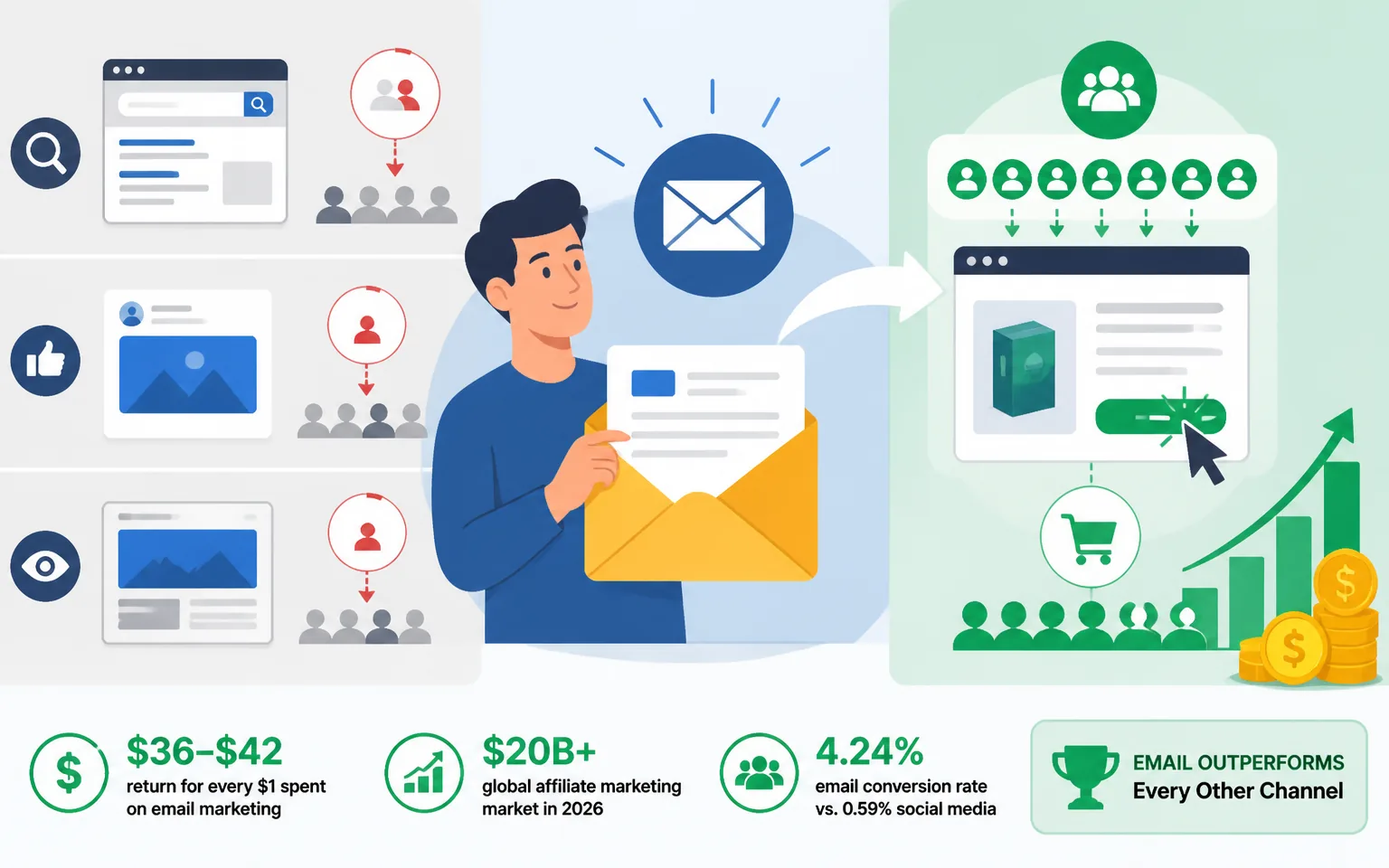
Meanwhile, the affiliate industry itself keeps growing. The global affiliate marketing market is projected to exceed $20 billion in 2026, up from roughly $17–18.5 billion in 2025, growing at about a 15% compound annual rate according to research aggregated by Publift and DemandSage. More brands, more programs, more commissions on the table — and more competition for attention.
That competition is exactly why email wins. When someone joins my list, I’m no longer fighting an algorithm for the chance to reach them. Email converts at around 4.24% on average, compared to just 0.59% for social media traffic, per data cited by emailmonday. That’s a seven-fold difference. When I recommend a tool in a blog post, some fraction of readers click through. When I recommend the same tool to my email list — people who already know me, who opted in for my advice — the conversion rate is in a different league entirely.
There’s a compounding effect too. A blog post promoting an affiliate offer works once per visit. An email list lets me promote the same offer multiple times, in different contexts, to the same warmed-up audience — a launch email, a case study, a comparison, a deadline reminder. Each touch builds on the last.
Step One: Build a List of Buyers, Not Just Subscribers
The biggest mistake I made early on was optimizing for list size. A big list of freebie-seekers earns less than a small list of people who joined because they want to solve a problem your affiliate products solve. Quality of intent beats quantity of subscribers every single time.
Choose a Lead Magnet That Pre-Sells the Offer
My rule: the lead magnet should attract the same person who would buy the affiliate product. If I promote email marketing software, my lead magnet is a swipe file of high-converting email templates — because anyone who wants those templates needs an email tool to use them in. The lead magnet does half the selling before I’ve sent a single promotional email.
I build most of my lead magnets with AI now, which has cut production time from days to hours. I covered my full process in my guide to growing your email list with AI lead magnets, so I won’t repeat it all here — but the short version is: pick one painful problem, solve it completely in a small package, and make the natural next step your affiliate offer.
Place Opt-ins Where Intent Is Highest
My highest-converting opt-in placements are inside content, not around it. An inline form in the middle of a product review converts several times better than a sidebar widget, because the reader is already in a buying mindset. I also use exit-intent popups on my comparison posts and a dedicated landing page for each lead magnet. It matters more than most people think: welcome emails sent to fresh, high-intent subscribers achieve some of the highest engagement in all of email — Omnisend’s 2026 benchmarks put welcome email open rates above 80%, the highest of any email type they track.
Step Two: The Welcome Sequence That Does the Heavy Lifting
If you build only one automation, make it this one. A new subscriber is never more attentive than in the first week after opting in, and an automated welcome sequence monetizes that attention on autopilot.
The data backs this up emphatically. Automated flows generate nearly 41% of all email-driven revenue from just 5.3% of total sends, according to Klaviyo’s 2026 ecommerce email benchmarks — and a three-email welcome series generates roughly 90% more orders than a single welcome message, per Omnisend’s research. Automation isn’t a nice-to-have; it’s where the money actually is.
My Five-Email Welcome Framework
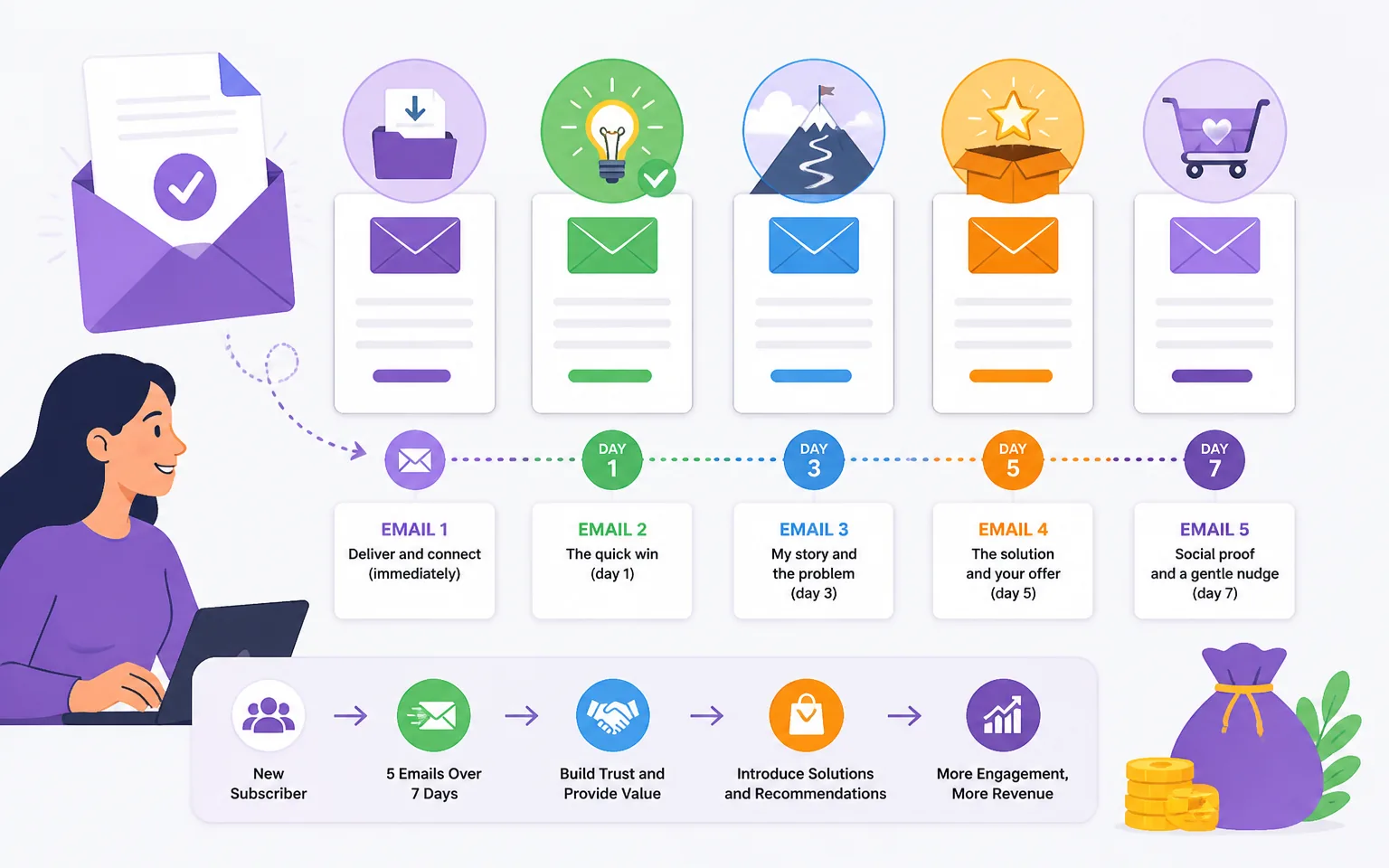
Here’s the exact structure I use, spaced over about seven days:
- Email 1 — Deliver and connect (immediately). Deliver the lead magnet, introduce myself in two sentences, and set expectations: what I’ll send, how often, and why it’s worth opening. No pitch.
- Email 2 — The quick win (day 1). One actionable tip that gets a result fast. If the tip naturally involves a tool I recommend, I mention it with an affiliate link — softly, as part of the instructions.
- Email 3 — My story and the problem (day 3). The struggle-to-solution narrative. This is where I earn trust, and where I introduce the core affiliate product as the thing that changed my results.
- Email 4 — Proof and objections (day 5). A mini case study with real numbers, plus answers to the two or three objections I hear most often.
- Email 5 — The direct offer (day 7). A clear recommendation with a reason to act now: a bonus I’ve created, a trial deadline, or a genuine discount.
The ratio matters: three emails of pure value and relationship for every one direct promotion. Subscribers can smell a list that exists only to sell to them, and they unsubscribe — or worse, stop opening, which quietly kills your deliverability.
Step Three: Use AI to Personalize and Scale
This is where affiliate email marketing has changed most since I started. AI has moved from novelty to core infrastructure in my workflow, and the gap between marketers who use it well and those who don’t is widening every quarter.
Segmentation Is the Multiplier
The same affiliate offer sent to everyone underperforms the same offer sent to the right segment. I tag subscribers by the lead magnet they joined from, the links they click, and the topics they engage with. Someone who clicked three links about email tools gets my email-software sequence; someone who reads my SEO content gets SEO-tool recommendations instead. Relevance is why automated emails drive something like 16x more revenue per send than generic broadcasts, according to benchmark data compiled by digital marketing researchers in 2026.
AI makes this practical for a one-person operation. Modern email platforms use machine learning to predict which subscribers are most likely to buy, pick send times per subscriber, and auto-segment by behavior. I walked through my full setup in my AI email segmentation and automation guide if you want the step-by-step.
Subject Lines and Copy
Nothing in an affiliate email matters if it doesn’t get opened. I draft every subject line with AI assistance now — generating ten variants, scoring them against what has historically worked for my list, and testing the top two. My process for this is detailed in my post on writing AI email subject lines people actually click. For body copy, AI drafts and I edit heavily: the facts, opinions, and recommendations are always mine, because the moment your list senses generic AI filler, trust evaporates — and trust is the entire asset.
Step Four: Promote Without Burning Your List
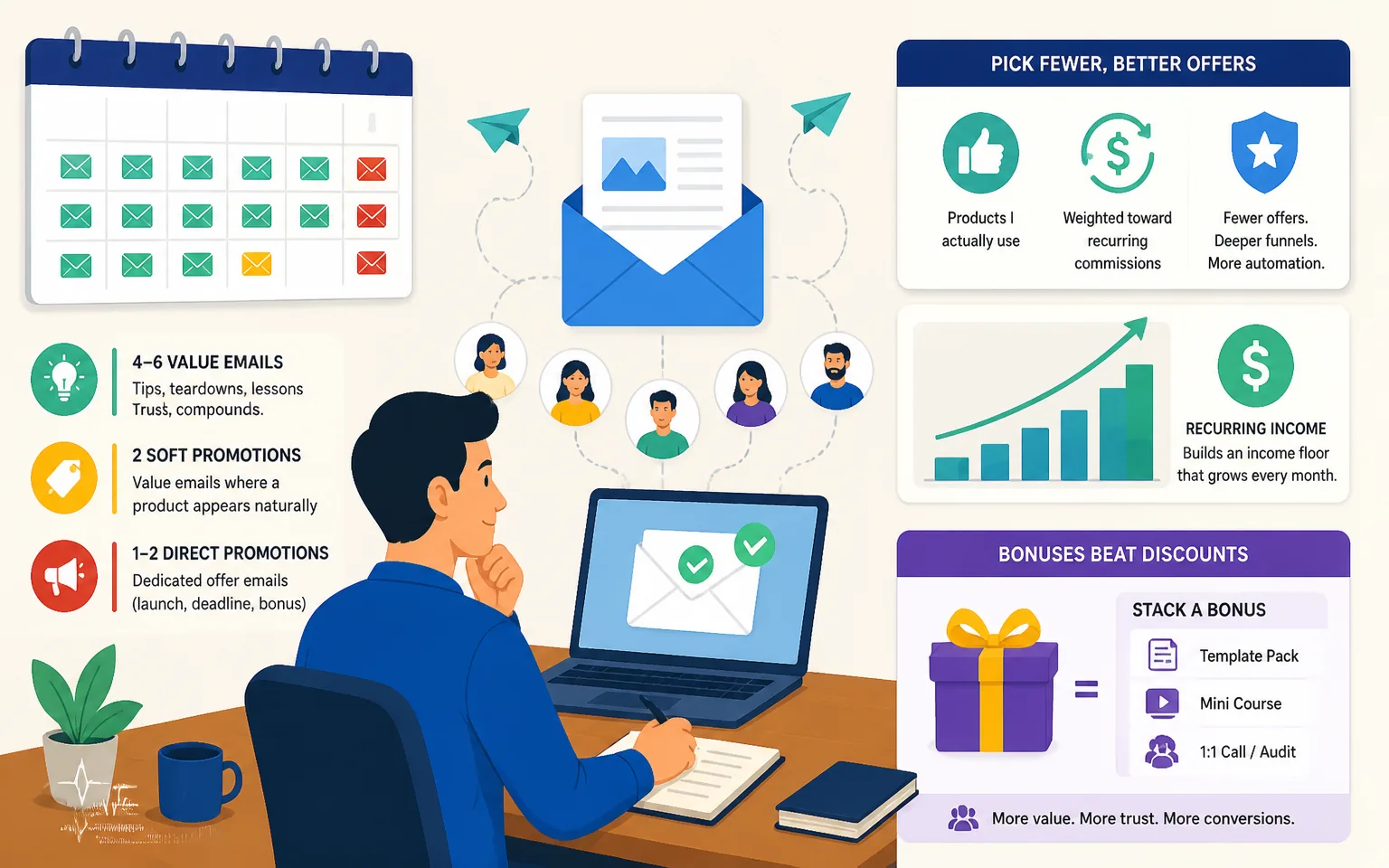
Sustainable affiliate email marketing is a rhythm, not a blitz. Here’s what my monthly cadence looks like: four to six value emails (tips, teardowns, lessons), two soft promotions (value emails where a product appears naturally), and one or two direct promotions (dedicated offer emails, usually tied to a launch, deadline, or bonus).
Pick Fewer, Better Offers
I promote a small stable of products I actually use, weighted toward recurring commissions. A $30 one-time commission is fine; 30% monthly recurring on a SaaS subscription builds an income floor that grows every month. This philosophy underpins my whole approach to scaling affiliate marketing with AI — fewer offers, deeper funnels, more automation per offer.
It helps that the supply side keeps expanding: around 80% of brands now run affiliate programs according to DemandSage’s 2026 analysis, so whatever your niche, there are quality recurring programs to choose from. Be picky. Every recommendation spends trust, and trust is the currency your list runs on.
Bonuses Beat Discounts
The single most effective direct-promotion tactic I use: stack a bonus. When I promote a tool, I add something only I can give — a template pack, a mini-course, a setup walkthrough. It differentiates my link from every other affiliate’s, justifies urgency honestly (“bonus expires Friday”), and often doubles conversion on the same offer.
Step Five: Stay Compliant and Deliverable
Two unglamorous things protect the whole system: disclosure and deliverability.
Disclosure. I include a clear affiliate disclosure in every email that contains affiliate links — a plain sentence near the links, not buried in the footer. The FTC requires disclosures to be clear and conspicuous, and beyond the legal requirement, transparency simply reads as honesty. I have never seen a disclosure hurt conversions; I have seen its absence destroy credibility.
Deliverability. Some affiliate links — especially raw network links — are associated with spam and can hurt inbox placement. I always link to my own blog post or a branded redirect instead of pasting raw affiliate URLs. I also prune non-openers quarterly and keep engagement high, because mailbox providers judge you by how your recent mail is received. With over 4.5 billion people using email daily according to Statista projections, the inbox is the most crowded room on the internet; senders with weak engagement simply don’t get through.
The Metrics I Actually Watch
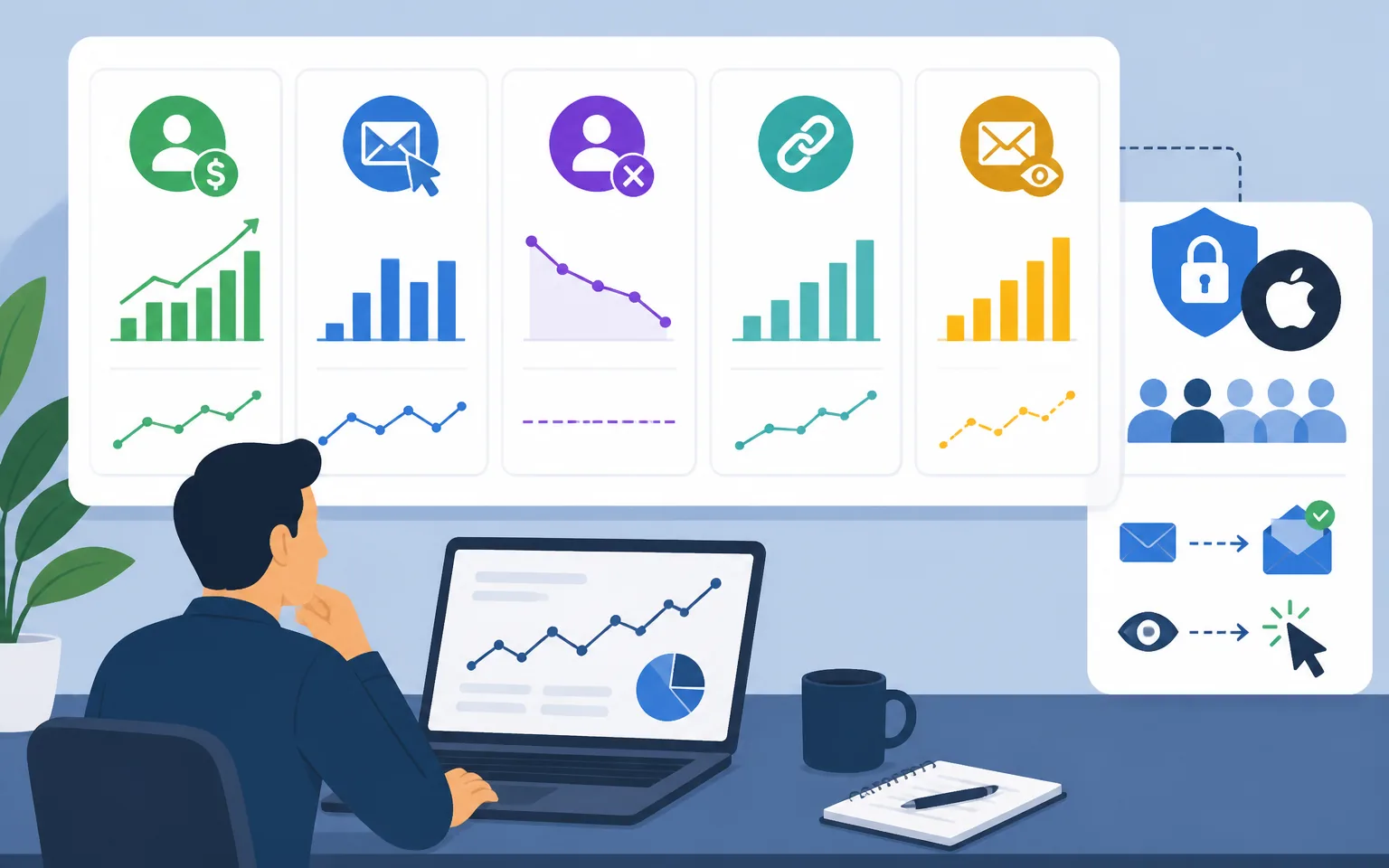
I keep my dashboard simple: revenue per subscriber per month (my north star — it forces balance between promotion and list health), click-through rate on promotional emails (my measure of offer relevance), unsubscribe rate on direct promotions (above 0.5% means I misjudged fit), and earnings per click by offer (which tells me which programs deserve more of my calendar). Open rate matters less than it used to — Apple’s Mail Privacy Protection inflates reported opens by 10–15% on Apple-heavy lists, so I treat opens as directional and clicks as truth.
Summary
Affiliate email marketing works because it stacks two compounding assets: a list you own outright and a small set of offers you genuinely stand behind. Neither works well without the other.
The mechanics are unglamorous. Capture buyers rather than browsers, run a welcome sequence that earns trust before it asks for anything, segment by real behaviour, and promote sparingly enough that a recommendation still means something.
Track revenue per subscriber per month above all else. It is the one metric that punishes you for over-promoting and rewards you for building an audience that actually wants to hear from you.
Frequently Asked Questions
How big does my email list need to be to earn affiliate income?
Smaller than you think. A focused list of 500 engaged subscribers in a buying niche can out-earn 10,000 cold subscribers. My first four-figure month came from a list under 2,000 people. Intent and trust beat raw size.
How often should I send affiliate promotions?
My working ratio is roughly three value emails for every promotional one. In practice that means one or two direct promotions per month, with soft mentions woven into regular content. If your unsubscribe rate climbs above half a percent on promos, pull back.
Can I put affiliate links directly in emails?
Usually yes, but check both your email platform’s policy and the affiliate program’s terms — Amazon Associates, notably, prohibits affiliate links in email. When in doubt, link to a page on your site that contains the affiliate link. It’s safer for compliance and better for deliverability.
Do I need to disclose affiliate links in every email?
Yes. The FTC requires clear and conspicuous disclosure wherever affiliate links appear, and email is no exception. One plain sentence near the links is enough.
What’s the best email platform for affiliate marketing?
The best platform is one that explicitly allows affiliate marketing and has strong automation. Several mainstream platforms restrict or ban affiliate-heavy senders, so read the acceptable-use policy before you commit. Look for behavioral tagging, visual automation builders, and AI-powered send optimization.
Final Thoughts: Build the Asset, Then Let It Compound
Affiliate email marketing rewards patience over hustle. The sequence you write this month will still be earning commissions next year, from subscribers you haven’t met yet, while you work on something else. That’s the quiet magic of it: every email you automate is a salesperson who never sleeps, never asks for a raise, and gets better every time you review the numbers.
Start small. One lead magnet, one five-email welcome sequence, one affiliate offer you genuinely believe in. Get that loop working, measure revenue per subscriber, then add segments and offers one at a time. In an industry heading past $20 billion and growing 15% a year, the affiliates who own their audience — rather than renting it from an algorithm — are the ones who will still be standing in five years. Your email list is how you own yours.