How to Monetize a Blog in 2026: My Realistic Playbook From First Post to First Payout

If you want the short answer: you monetize a blog in 2026 by stacking three income layers — affiliate offers matched to buyer-intent posts, an email list that you own, and display ads or digital products once traffic justifies them — and you use AI to compress the production work, not to replace your judgment. That’s the whole playbook. The rest of this article is me unpacking exactly how I’d execute it, step by step, if I were starting from zero today.
I’ve watched a lot of bloggers quit right before the curve bends. The data explains why: according to the Blogging Income Survey from Productive Blogging, it takes an average of 22 months to start making meaningful money from a blog — though around 30% of bloggers earn their first income within six months. Monetization isn’t a switch you flip. It’s a system you build. Here’s mine.
What Blog Monetization Actually Looks Like in 2026
Let’s set expectations with real numbers, because the “quit your job in 90 days” crowd has done this industry a lot of damage. Blogging income follows a power law: a small minority earns most of the money. Per Best Writing’s blogging statistics roundup, only about 2% of bloggers ever cross $100,000 a year. That sounds discouraging until you flip it: the difference between the 2% and everyone else is rarely talent. It’s niche selection, monetization fit, and persistence.
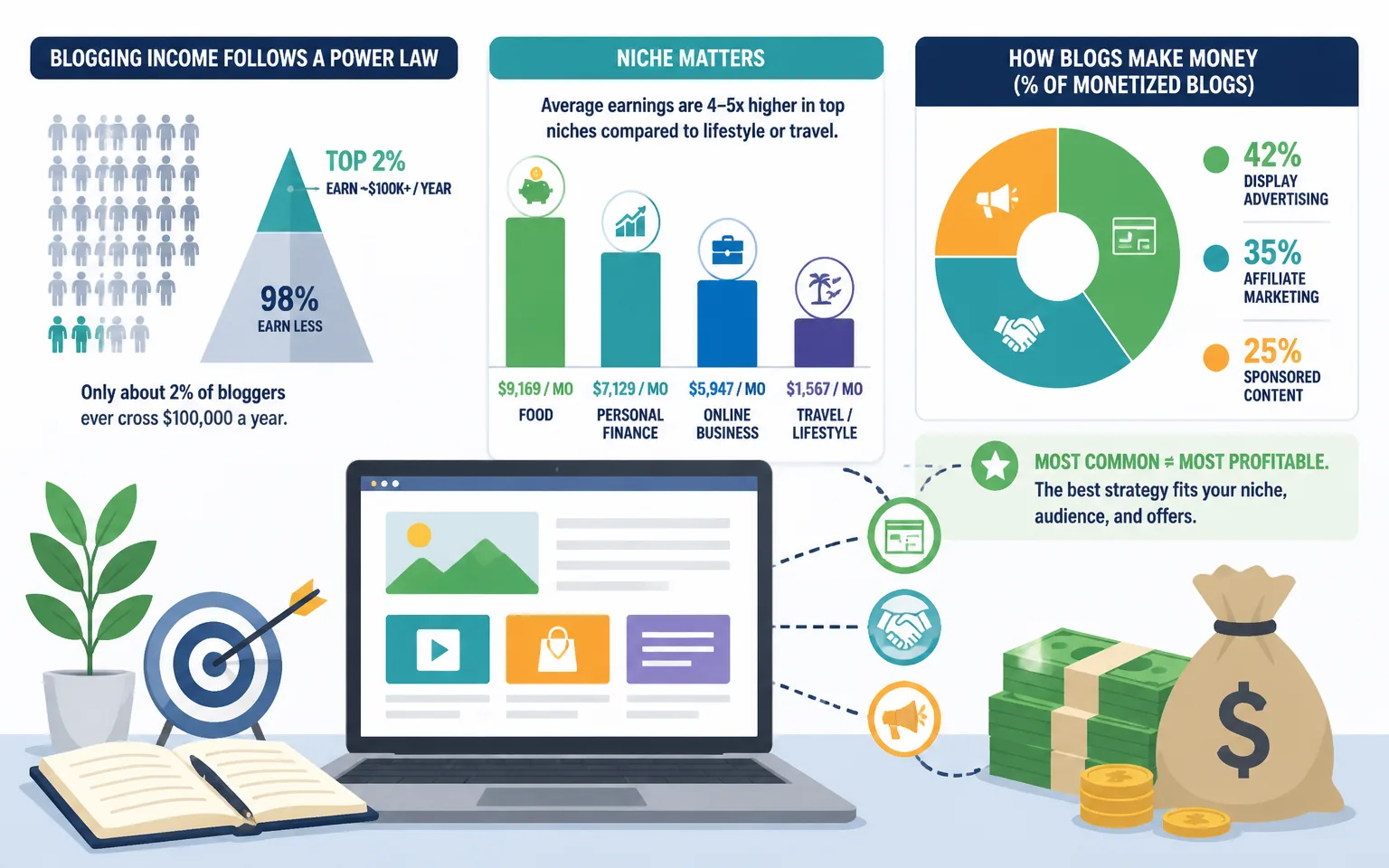
Niche matters more than almost anything. The 2026 Blogging Income Survey found that personal finance and online business blogs earn four to five times more on average than lifestyle or travel blogs, and food blogs post the highest median monthly income of any major niche at $9,169 per month. If you haven’t committed to a topic yet, I break down how to choose one with money in mind in my guide to the most profitable blogging niche ideas.
As for how blogs make money, the distribution is telling. Display advertising is the most common method (used by roughly 42% of monetized blogs), followed by affiliate marketing at 35% and sponsored content at 25%, according to Colorlib’s blogging statistics. But “most common” is not “most profitable” — and that distinction shapes everything below.
Step One: Match the Monetization Model to Your Traffic Level
The biggest mistake I see is bloggers bolting on the wrong model at the wrong time. Each income stream has a traffic threshold where it starts to make sense.
Display Ads: The Passive Layer (Needs Volume)
Display ads are the easiest money you’ll ever earn from a blog and also the smallest. Typical earnings run $5–25 per 1,000 pageviews depending on niche and ad network. Do the math: at 10,000 monthly pageviews you’re looking at $50–250 a month. That’s real, but it’s coffee money, not rent money. Premium networks like Mediavine and Raptive also have session minimums, so ads are a layer you add once traffic exists — never the foundation you build on.
Affiliate Marketing: The Highest Leverage Per Visitor
Affiliate marketing pays on outcomes, not impressions, which is why it works even for small blogs. A single conversion can pay $50–500+ in niches like software, hosting, and finance. The industry itself keeps expanding: Post Affiliate Pro projects global affiliate marketing spend to exceed $20 billion in 2026, and roughly 80% of brands now run an affiliate program per Publift’s industry statistics. Translation: whatever your niche, there are programs waiting for you.
Digital Products and Services: The Margin Play
Templates, courses, ebooks, coaching, freelance services. These convert a fraction of your audience at 90%+ margins, and they’re where the top earners diversify. But they need an audience that trusts you first — which is why I sequence them after affiliate income and email, not before.
Sponsored Content: Opportunistic, Not Foundational
Sponsorships pay well per placement but arrive unpredictably and scale linearly with your time. Take them when they come; don’t build the business plan around them.
Why I Put Affiliate Marketing at the Center of My Stack
My reasoning is simple: affiliate income is the only model that pays meaningfully at low traffic, requires no product creation, and improves as your content improves. The workflow that actually converts looks like this.
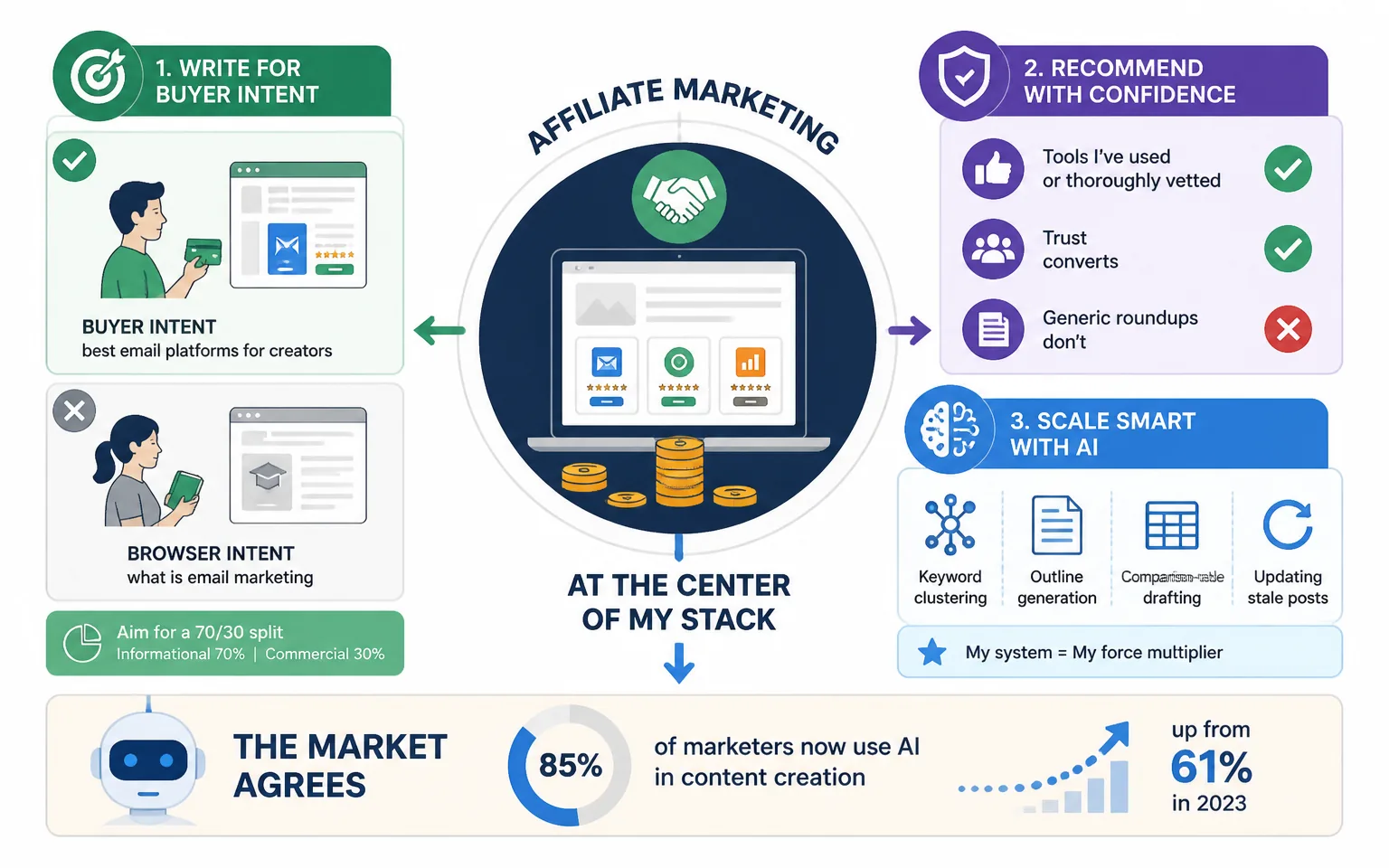
First, I write for buyer intent, not browser intent. A post titled “best email platforms for creators” attracts someone holding a credit card; “what is email marketing” attracts a student. Both have a place, but the first one pays. I aim for a 70/30 split between informational content (builds topical authority) and commercial content (converts).
Second, I only recommend tools I’ve used or thoroughly vetted. This isn’t just ethics — it’s economics. Trust converts. Generic roundups scraped from other roundups don’t.
Third, I scale the operation with AI where it doesn’t touch credibility: keyword clustering, outline generation, comparison-table drafting, updating stale posts. I documented my full system in how to use AI to scale affiliate marketing, and it’s the closest thing I have to a force multiplier. The market agrees on the direction: Affinco’s AI content statistics report that 85% of marketers now use AI in content creation, up from 61% in 2023.
The Email List: Your Highest-Leverage Asset
If I could only give a new blogger one instruction, it would be this: start collecting emails from day one, even with 50 visitors a month. Every other channel you rent — Google can rerank you, social platforms can throttle you — but the list is yours.
The numbers here are almost unfair. Blogs with email lists earn around seven times more per visitor than blogs without one. Email as a channel returns $36–45 for every $1 spent, per Litmus’s ROI research, and it converts at 4.24% versus roughly 0.59% for social media according to emailmonday’s compiled statistics. A thousand engaged subscribers will out-earn ten thousand drive-by pageviews in most niches I’ve worked in.
The mechanics: offer a lead magnet that solves one narrow problem (I show my exact process in creating AI lead magnets that grow your email list), place the opt-in above the fold and mid-post, and send a short welcome sequence that recommends your best affiliate fit in email three or four. From there, one value-driven email a week keeps the list warm. And yes, AI helps here too — organizations using AI-optimized subject lines see about a 26% lift in open rates, a tactic I broke down in my AI email subject lines guide.
How I Use AI Without Torching Reader Trust
AI is the biggest change to blogging economics since Google itself, but it cuts both ways. The productivity gains are real — content teams report roughly 40% faster production with generative AI in the mix. The risk is also real: Presenc AI’s research found that 52% of consumers reduce engagement when they suspect content is AI-generated.
So my rule is: AI drafts structure, I supply substance. Concretely, AI handles keyword clustering and search-intent mapping, first-pass outlines, meta descriptions, comparison tables, and refresh suggestions for decaying posts. I handle every opinion, every recommendation, every “here’s what happened when I tried this” — because that experience layer is exactly what readers (and, increasingly, AI search engines quoting your content) are looking for. Publish AI slop and you don’t just bore humans; you train ChatGPT and Perplexity to ignore your site as a source.
My 90-Day Monetization Roadmap
Here’s how I’d sequence everything above if I were starting today.
Days 1–30: Foundation
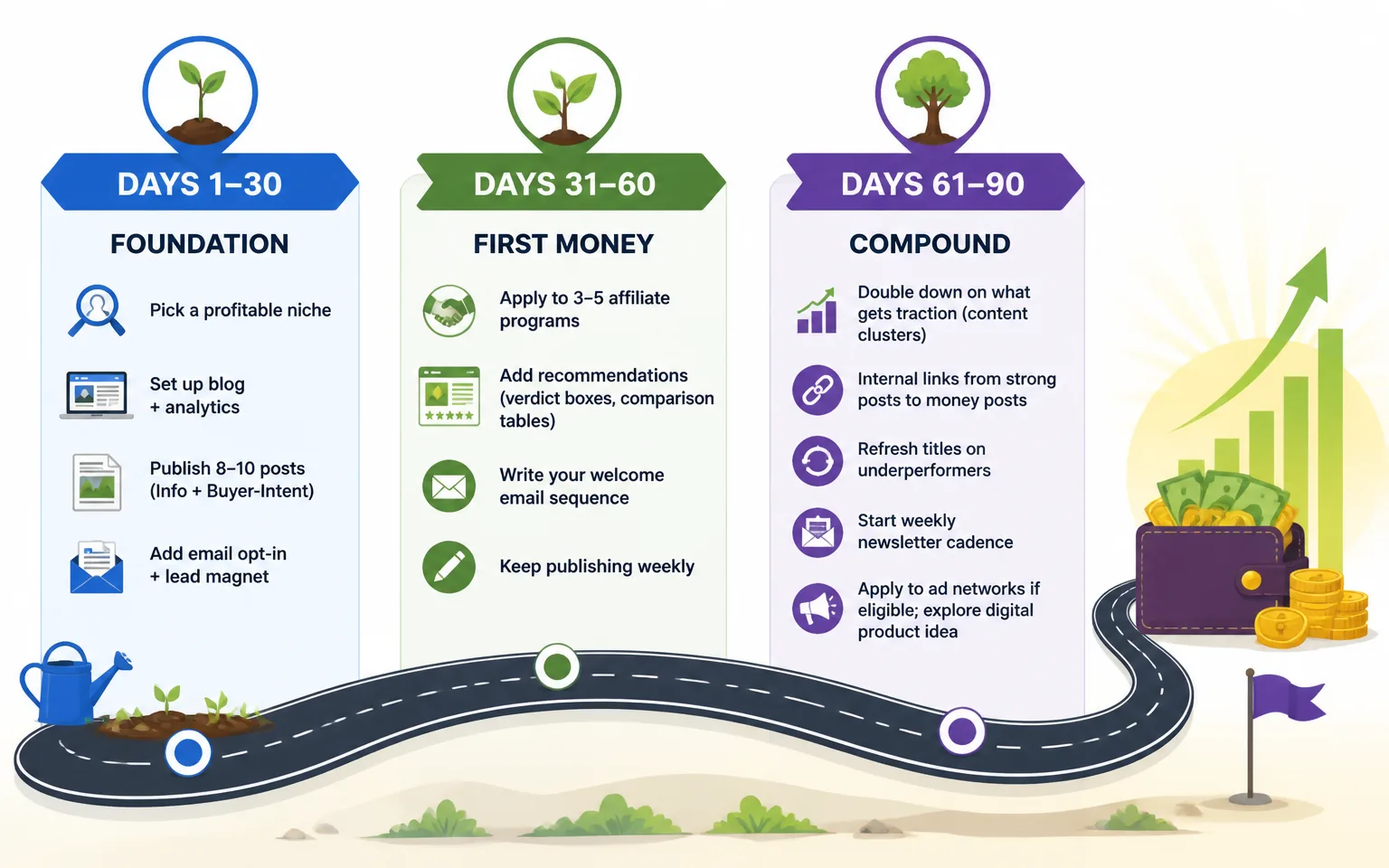
Pick a niche with proven monetization (finance, business, software, food — or a specific sub-niche you have real experience in). Set up the blog, install analytics, and publish 8–10 posts split between informational and buyer-intent topics. Add an email opt-in with a simple lead magnet before you have “enough” traffic to justify it. You’re building the machine, not the income, this month.
Days 31–60: First Money
Apply to 3–5 affiliate programs that fit your buyer-intent posts (most approve small blogs; some networks want a little traffic history). Weave recommendations into existing content naturally — top-of-post verdict boxes and comparison tables convert far better than links buried in paragraph twelve. Write your welcome email sequence. Keep publishing weekly.
Days 61–90: Compound
Double down on whatever got traction: more content in winning clusters, internal links from strong posts to money posts, refreshed titles on underperformers. Start a weekly newsletter cadence. If pageviews are trending toward ad-network minimums, queue that application. If a digital product idea keeps coming up in reader replies, outline it — but don’t build it until the list asks twice.
Track What’s Earning, Kill What Isn’t
Monetization without measurement is guesswork, and guesswork is expensive. From the first affiliate link onward, I track three numbers per post: sessions, click-through rate to offers, and earnings per thousand visitors (EPMV). That last one is the honest metric, because it lets you compare a post earning $12 from ads against a post earning $180 from two affiliate conversions on the same traffic.
The tooling doesn’t need to be fancy. Google Search Console tells you which queries send traffic, your affiliate dashboards tell you which pages convert, and a simple spreadsheet joins the two. Review it monthly. What you’ll almost always find is that 10–20% of your posts drive 80%+ of income — so those posts get first claim on your updating time, your best internal links, and your strongest calls to action.
This matters more every year because the competitive pool keeps growing. Demand Sage reports that over 90% of ecommerce businesses are expected to leverage affiliate marketing by 2026, which means more programs, better commissions — and more bloggers competing for the same buyer-intent keywords. The blogs that win aren’t the ones publishing the most; they’re the ones reinvesting attention into what already works. Measure, prune, double down. Boring advice, disproportionately profitable.
The Mistakes That Keep Blogs Broke
A few patterns I see over and over. Monetizing nothing for a year because “the blog isn’t ready” — affiliate links in post one cost you zero credibility if the recommendation is honest. Chasing ad revenue at 5,000 pageviews instead of conversions. Writing purely informational content and wondering why 30,000 visitors produce $80. Skipping email because it “feels early.” Spraying twelve affiliate programs across every post instead of going deep on three that fit. And the 2026-specific one: publishing unedited AI content at volume, which Google’s spam systems and human readers now punish with equal enthusiasm.

Frequently Asked Questions
How long does it take to monetize a blog?
You can technically add affiliate links on day one. Meaningful income typically takes 12–24 months — the survey average is 22 months, with the fastest 30% earning something within six months. Niche, consistency, and buyer-intent content are the biggest accelerators.
How much traffic do I need to make money blogging?
For affiliate income and services, you can earn with a few thousand targeted monthly visitors. Display ads need volume — premium networks generally want 50,000+ monthly sessions, and earnings run $5–25 per 1,000 pageviews.
What’s the most profitable way to monetize a blog?
Per visitor, it’s usually your own digital product sold to an email list, with affiliate marketing close behind. The highest-earning blogs stack multiple streams: affiliate + email + ads or products.
Can I monetize a blog that uses AI content?
Yes — if AI assists rather than authors. Use it for research, outlines, and optimization, then add first-hand experience and opinions. Fully automated content struggles to rank, convert, or get cited by AI search engines.
Do I need an email list to make money from my blog?
Strictly, no. Practically, it’s the single highest-ROI asset you can build — email returns roughly $36–45 per $1 spent and blogs with lists earn several times more per visitor. Start collecting subscribers immediately.
Final Thoughts
Monetizing a blog in 2026 isn’t a secret; it’s a sequence. Pick a niche where money already flows, publish buyer-intent content alongside authority content, put affiliate offers where decisions happen, capture emails from day one, and let AI compress the busywork while you supply the experience only you have. The bloggers who fail mostly quit at month eight of a 22-month curve. Build the system, keep shipping, and let the compounding do what it does.
Got a monetization question I didn’t cover? Reach out — I read every reply.
Related reading: How to Get Traffic to a New Blog in 2026: My Realistic Playbook From Zero to First Readers.