How AI Spam Filters Are Changing Email Deliverability in 2026

Last month I watched a client’s open rate fall off a cliff overnight — no list change, no send-time change, nothing different in the copy. The culprit wasn’t Gmail hating their brand. It was Gmail’s AI. Inbox providers have quietly rebuilt spam filtering around machine learning that reads behavior, not just headers, and if you’re still treating deliverability like a 2020 checklist of SPF and DKIM, you’re going to keep losing subscribers to a folder you never see. Here’s what’s actually happening inside these filters in 2026, and the exact changes I’ve made to keep my own campaigns landing in the inbox.
Why Email Deliverability Broke in 2026
For years, deliverability was mostly a technical checklist: authenticate your domain, don’t get reported as spam, keep your bounce rate low. That world is gone. Google and Yahoo’s bulk sender rules, first introduced in February 2024, matured into hard enforcement this year — senders hitting roughly 5,000 or more emails a day to consumer inboxes must now publish SPF, DKIM, and a DMARC record at p=quarantine or stronger, keep spam complaints under 0.30% (with a practical target under 0.10%), and support one-click unsubscribe under RFC 8058 (PowerDMARC, 2026). Starting in November 2025, Gmail moved from soft warnings to permanent 5xx rejections for messages that fail authentication or come from senders with elevated spam rates — meaning a mistake doesn’t just get deferred anymore, it bounces for good.
The scale of what this enforcement has already done is hard to overstate. According to PowerDMARC’s 2026 analysis of Google’s own enforcement data, the crackdown drove 265 billion fewer unauthenticated messages into Gmail inboxes in a single year — a 65% reduction — and pushed more than 500,000 previously unprotected domains among the world’s top ten million to finally publish a DMARC record. If you haven’t touched your DNS records since you set up email marketing, this is your sign.
The Real Shift: Filters Now Read Behavior, Not Just Headers
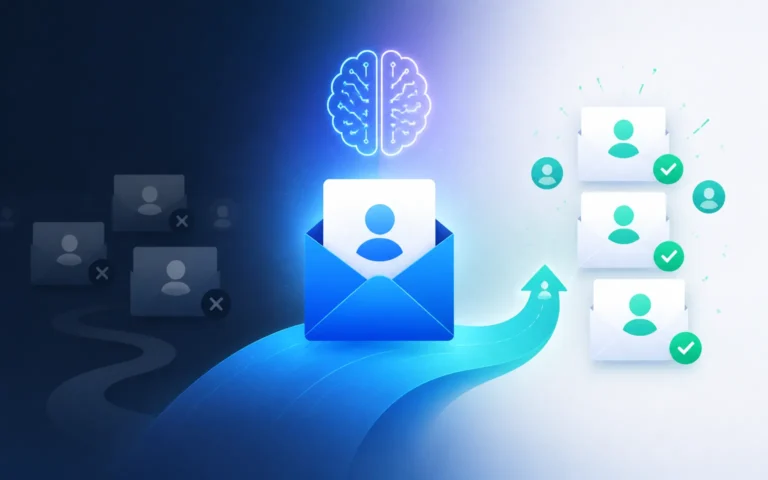
Authentication is table stakes. What actually decides whether you land in the inbox or the spam folder now is machine learning trained on how real recipients treat your mail. Google’s spam classifiers ingest sender reputation, complaint history, engagement patterns, and content structure together, and they adapt continuously instead of relying on static blocklists. Google has even rolled out a purpose-built model called RETVec (Resilient and Efficient Text Vectorizer) specifically to catch spam that uses deliberately misspelled or manipulated text to dodge older keyword-based filters (Clean Email, 2026).
That same research puts a number on something I’ve suspected for a while: more than 51% of all spam circulating today is itself AI-generated. Spammers are using the same large language models marketers use for drafting copy, which means inbox providers have had to get dramatically better at telling a legitimate AI-assisted newsletter from a mass-produced scam — and that distinction is made almost entirely by watching what your recipients actually do with your email.
How Inbox Placement Actually Looks Right Now
The averages are sobering. The global inbox placement rate sits around 83.1% across major providers, according to a 2026 study covering 15 email service providers, which means roughly one in six marketing emails never reaches the inbox at all (Shno.co, 2026). Placement also varies wildly by mailbox provider: Gmail delivers around 87.2% of mail to the inbox, while Yahoo lags badly at roughly 23% inbox placement, with the remainder landing in spam. Outlook sits in between at about 75.6%. If your list skews Yahoo-heavy — common in older consumer niches — that alone can explain a chronically weak open rate no amount of subject-line testing will fix.
DMARC adoption is climbing but still far from universal. Only about 52.1% of the top 1.8 million domains have any DMARC record at all, and more than half of those are still sitting at the weakest policy, p=none, which monitors but doesn’t actually block spoofed mail. Separately, DMARC adoption among active senders reached 64% in 2026, up from 61% the year before, meaning more than a third of senders are still sending essentially unprotected mail (Warmforge, 2026). Every one of those unprotected domains is a slightly higher-risk neighbor in the eyes of a spam classifier that groups mail by shared infrastructure and sending patterns.
What AI Spam Filters Are Actually Scoring You On
I used to think of spam filters as a gate you pass or fail at send time. That mental model is outdated. Modern filtering is closer to a continuously updated trust score built from several signals working together.
Sender reputation and infrastructure
Your sending domain and IP build a reputation over weeks, not single sends. A cold domain sending a large blast on day one looks statistically identical to a spammer standing up new infrastructure, regardless of how good your copy is. I warm every new sending domain gradually over two to three weeks before pushing full list volume.
Engagement signals
Opens, clicks, replies, delete-without-reading, and mark-as-spam are all fed back into the model in near real time. Filters increasingly reward senders who segment by engagement — sending richer or more frequent content to your active readers while easing off on cold segments — because that behavior mirrors what a legitimate publisher does and what a spammer never bothers to do (Mailbird, 2026).
Content and linguistic patterns
Here’s the part that surprises marketers who lean hard on AI drafting tools: filters don’t detect “AI-generated” content directly, they detect the behavioral and linguistic fingerprints that AI-generated spam tends to share — over-optimized keyword stuffing, repetitive sentence structure, and unnaturally uniform tone. An email written by AI and lightly edited by a human with real examples and specific detail reads nothing like the pattern these classifiers are trained to catch. One that’s copy-pasted straight out of a generic prompt, on the other hand, can trip the same signals spam does even when it’s a completely legitimate offer.
Nine Changes I Made to Stay Out of the Spam Folder
None of this is theoretical for me — these are the specific changes that pulled my own newsletter’s inbox placement back up over the past few months.
1. Published a real DMARC record and moved it to enforcement. I started at p=none to monitor, then moved to p=quarantine once I confirmed all legitimate senders were passing. Sitting at p=none forever, which is still true for the majority of domains with any DMARC record, doesn’t protect you from spoofing or help your reputation.
2. Set spam complaints as my top-line metric, not open rate. I check complaint rate weekly and treat anything approaching 0.10% as an emergency, well below the 0.30% hard threshold Gmail and Yahoo enforce.
3. Built a real one-click unsubscribe. RFC 8058 compliance isn’t optional anymore for anyone sending meaningful volume, and making it easy to leave paradoxically keeps my complaint rate down — annoyed subscribers who can’t find unsubscribe just hit “report spam” instead.
4. Segmented by engagement before every send. My most active 20% of subscribers get first priority and slightly different cadence than subscribers who haven’t opened in 90 days. I cover the mechanics of this in more depth in my guide to AI email segmentation and automation.
5. Suppressed chronic non-openers instead of re-sending to them. Every send to someone who hasn’t opened in six months is a small tax on my domain reputation, whether or not they ever complain.
6. Stopped copy-pasting AI drafts verbatim. I use AI heavily for first drafts, but every send gets specific numbers, names, and examples added by hand before it goes out, which breaks the repetitive-pattern fingerprint filters are trained to flag.
7. Warmed every new sending domain before scaling volume. Slow and boring beats fast and flagged.
8. Watched provider-specific placement, not blended averages. Given how far Yahoo’s roughly 23% inbox rate trails Gmail’s 87%, I now track deliverability by mailbox provider separately rather than looking at one blended number that hides where the real problem lives.
9. Fixed the deliverability basics that had nothing to do with AI at all. Broken authentication, bad list hygiene, and confusing sender names still cause a huge share of spam-folder placements. I keep a running list of the most common ones in my post on common email delivery issues and how to fix them.
The Metrics That Actually Predict Inbox Placement
Open rate is a lagging, unreliable signal — Apple Mail Privacy Protection alone makes it noisy for a big share of any list. The metrics that actually correlate with staying in the inbox are complaint rate, unsubscribe rate relative to sends, spam-trap hits, and authentication pass rate, tracked per mailbox provider rather than blended. I go deep on which numbers deserve your attention (and which ones are mostly noise) in Email Marketing Metrics That Matter. If you’re only watching open and click rate, you’re flying blind on the metric that actually determines whether those opens and clicks can even happen.
What This Means If You Use AI to Write Your Emails
AI drafting tools aren’t the problem — sloppy, unedited AI output at scale is. Given that over half of all spam is now AI-generated, filters have gotten very good at recognizing the statistical fingerprint of content nobody bothered to edit: predictable structure, generic claims, no specific detail. The fix isn’t abandoning AI, it’s treating the AI draft as a first pass rather than a final send. Add a real number, a real name, a detail only you would know, and vary your sentence rhythm the way an actual human writing quickly would. Reply.io’s 2026 guidance on this is blunt: sequences that read as templated, regardless of who or what wrote them, get penalized the same way regardless of intent (Reply.io, 2026).
A Quick Deliverability Audit You Can Run This Week
You don’t need an enterprise deliverability platform to get a real read on where you stand. Here’s the sequence I run whenever a client’s numbers look off, and it usually takes under an hour.
Start by pulling up your domain’s DMARC record with a free lookup tool and confirming three things: that it exists at all, what policy it’s set to, and whether your legitimate sending sources are actually passing alignment. A record stuck at p=none for over a year with no plan to progress is a red flag reviewers and filters both notice. Next, send test messages to seed accounts across Gmail, Yahoo, and Outlook and check placement directly rather than trusting your ESP’s aggregate deliverability score, since that blended number can hide a Yahoo-specific problem entirely. Then look at your complaint rate for the last 30 days broken out by segment — if one acquisition source or one email in a sequence is generating a disproportionate share of complaints, that’s usually where the real damage is happening, not across your list as a whole.
Finally, audit your last five sends for the AI-fingerprint problem described above: read them cold, as a recipient would, and ask whether the structure feels templated. If every paragraph is the same length and every sentence follows the same rhythm, that’s worth fixing regardless of what any filter thinks, because it’s also just weaker writing. Run this audit monthly rather than only when something breaks, and you’ll catch reputation drift while it’s still a small problem instead of a folder-wide one.
Frequently Asked Questions
Is my email marketing platform responsible for my deliverability?
Partly. A reputable ESP handles infrastructure-level reputation and shared IP hygiene, but your DNS authentication, list hygiene, content quality, and engagement patterns are entirely on you. A great platform on a poorly maintained domain still lands in spam.
Do I need to worry about bulk sender rules if I send fewer than 5,000 emails a day?
The 5,000-per-day threshold is where enforcement becomes mandatory, but the underlying best practices — authentication, low complaint rates, easy unsubscribe — improve deliverability at any volume. Waiting until you hit the threshold to fix your DMARC record means you’re already behind.
Why did my open rate drop even though my list didn’t change?
Check your spam complaint rate and authentication status first. A sudden drop with no list or content change is the classic signature of a reputation issue or an inbox provider tightening its filter, not a subscriber taste change.
Does using AI to write emails hurt deliverability?
Not inherently. What hurts deliverability is content that reads as templated and generic, which unedited AI drafts often do. Edited, specific, human-reviewed AI-assisted copy performs the same as any well-written email.
What’s the single highest-leverage fix if I only have time for one thing?
Get your DMARC record to at least p=quarantine and confirm your complaint rate is under 0.10%. Authentication and complaint rate are the two signals every major filter weighs most heavily, and both are entirely within your control.
Deliverability in 2026 isn’t a settings page you configure once. It’s an ongoing conversation with a machine-learning system that’s reading your subscribers’ behavior in real time and updating its opinion of you accordingly. Fix the authentication basics, respect the engagement signals, and treat every AI-assisted draft as a starting point rather than a finished send — and the inbox stays reachable.