Autonomous AI Marketing Agents: What They Are and How to Use Them

Six months ago, “AI agent” was a term I mostly heard in enterprise sales decks. Today it’s the thing my inbox, my client calls, and every marketing newsletter I open won’t stop talking about — and for good reason. We’ve crossed from “cool demo” to “actually running my email sequences while I sleep.” If you run marketing for a small business or a lean team, this is the year the gap between people using AI agents and people still copy-pasting into ChatGPT starts to show up in your numbers. I want to walk you through what these agents actually do, which ones are worth your time, and how to roll one out without torching your sender reputation or your customer list in the process.
What Is an AI Marketing Agent, Really?
Strip away the hype and an AI marketing agent is software that can plan a multi-step task, take actions across your tools, check its own results, and adjust — without you clicking “generate” at every stage. A chatbot answers a question. An agent finishes a job: it pulls a segment, drafts three subject lines, picks the best one based on past open rates, schedules the send, and reports back what happened.
The distinction matters because most “AI in marketing” over the last two years was really generative AI bolted onto a manual workflow — you still did the deciding and the clicking. Agents close that loop. By the end of 2026, 40% of enterprise applications are expected to feature task-specific AI agents, up from less than 5% in 2025, according to Azumo’s 2026 AI agent research. On the marketing side specifically, 34% of enterprise marketing teams now run at least one autonomous agent in production, more than double the 14% from Q4 2025.
Why 2026 Is the Tipping Point for Agentic Marketing
I don’t think this is a fad cycle, and the adoption curve backs that up. A CrewAI survey of 500 C-level executives at large organizations found that 100% of respondents plan to expand their use of agentic AI in 2026, with nearly three-quarters calling it a critical priority. More strikingly, 65% say they’re already using AI agents today, and 81% describe their rollout as either fully scaled or actively expanding, per the CrewAI 2026 State of Agentic AI Survey.
That same survey found organizations have automated 31% of their workflows using agentic AI on average, with plans to expand that by another third this year. The impact isn’t just “we saved time” — 75% report a high or very high impact on time savings, and 69% cite significant reductions in operational cost. Revenue generation shows up as a benefit for 62% of respondents. For a small business owner, that’s the pitch in one sentence: agents aren’t just a productivity toy, they’re starting to move the revenue line.
Smaller shops aren’t sitting this one out either. 79% of companies now report running some form of AI agent in production, according to Prefactor’s 2026 adoption survey — a number that would have seemed implausible eighteen months ago.
What AI Marketing Agents Can Actually Do Today
Forget the abstract definitions for a second. Here’s what’s actually shipping in 2026, broken down by the jobs I see small teams handing off first.
Email and Lifecycle Automation
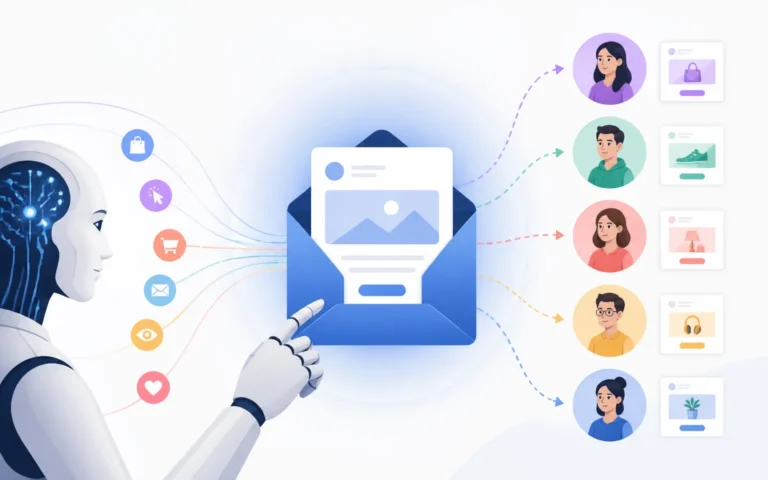
This is where agents earn their keep fastest, because email has clean triggers (a signup, a cart abandonment, a re-engagement window) and clean feedback (opens, clicks, replies). Modern email agents don’t just personalize subject lines — they analyze your audience data and past campaign performance to predict optimal send times per subscriber, generate on-brand copy variants, and segment audiences based on actual behavior rather than static tags, as outlined in Ventureharbour’s rundown of AI email marketing tools. If you’ve read my piece on using AI for email personalization, agents are the natural next step: the personalization engine plus the decision-making about when and to whom to send.
Content and Campaign Operations
The second wave is campaign ops — the unglamorous work of setting up a campaign, autoposting across channels, capturing and routing leads, updating the CRM, and producing the weekly report nobody wants to build by hand. Tools built specifically for this run marketing operations end to end across hundreds of integrations, effectively acting as an operations coordinator that never misses a step, per Tofu HQ’s 2026 review of marketing agents.
Lead Routing and Sales Handoff
The third category connects marketing to revenue directly — full-funnel agents that track intent signals, trigger outbound sequences, and hand qualified leads to sales with context attached, rather than a name and an email address dropped into a spreadsheet. Organizations integrating AI agents into this handoff have seen an average 23% increase in lead conversion rates over twelve months, and the workflows that succeed report 4.1x to 5.3x ROI relative to the process they replaced, based on the same Azumo research cited earlier.
The Best AI Agent Tools for Small Business Marketing Right Now
I’m not going to pretend there’s one winner — the right tool depends on whether email, content, or lead-gen is your bottleneck. But a few consistently show up as the strongest starting points for small teams. Platforms built around email and lifecycle automation integrate dozens of purpose-built agents with hundreds of tool connections, making them a natural fit if list-based revenue is your main channel, according to Warmly’s 2026 roundup of AI agents for small business. If you’d rather compare a wider spread of options before committing budget, my earlier post on the best AI marketing tools is a good companion read — most of what’s listed there now ships an agent mode, not just a generation feature.
Whichever tool you pick, the pattern worth noticing is that 92% of marketers now use AI in some form within automated workflows, and 87% used generative AI in at least one workflow in 2026 — up sharply from 51% in 2024, per Omnibound’s agentic AI marketing statistics report. Sitting out entirely is quickly becoming the riskier choice, not the safer one.
One thing I keep repeating to clients: an agent isn’t a strategy, it’s an execution layer for one. If you don’t already have a clear picture of your audience, offer, and channel priorities, adding an autonomous agent just means you’ll be wrong faster and at greater volume. I laid out the planning side of this in my earlier post on building an AI marketing strategy for a small business — read that first if you haven’t nailed down your core positioning yet, then come back and layer agents on top of a plan that’s already working. Agents amplify whatever strategy you feed them, good or bad.
How to Deploy Your First AI Marketing Agent Without Breaking Anything
Here’s the process I actually use with clients, condensed:
- Pick one narrow, high-volume, low-risk task. Re-engagement emails to a dormant segment, not your flagship product launch. You want reps and data, not drama.
- Give the agent a real brief, not a vague goal. Brand voice examples, forbidden claims, approved offers, and a hard cap on send frequency. Agents drift when the brief is thin.
- Keep a human in the approval loop for the first two weeks. Review outputs before they go out. Once error rates are near zero, move to spot-checking.
- Set explicit success metrics before you launch. Not “improve engagement” — a specific number, a specific timeframe.
- Log everything the agent decides, not just what it sent. When something goes wrong, you need to see the reasoning, not just the output.
That last step matters more than it sounds. The overall marketing automation market has grown to roughly $8.08 billion in 2026 and is projected to reach $8.70 billion by 2027, driven largely by this kind of AI integration, according to SEOprofy’s 2026 marketing automation statistics report — which tells you the tooling isn’t going away, so building the review habit now pays off for years, not months.
Where Agents Still Fail (and How to Avoid Becoming a Statistic)
I’d be doing you a disservice if I only sold the upside. Roughly 29% of attempted agent deployments get abandoned within 90 days, according to the Gartner research cited by Azumo. The top failure modes, in order, are unclear success criteria (41% of failures), poor tool or data access (33%), and brand-voice drift that leaks into customer-facing output. None of those are AI capability problems — they’re planning problems. If you skip step 2 and step 4 from the deployment process above, you’re the most likely candidate for that 29%.
The other honest gap: even with the surge in adoption, nearly two-thirds of enterprises have only experimented with agents, and fewer than 10% have scaled them to deliver real, sustained value per the CrewAI survey. Piloting is easy. Operationalizing is where most teams stall — usually because nobody assigned an owner to watch the agent after week one.
For a small business, that ownership gap is actually your advantage. You don’t have five layers of approval slowing down a fix, and you don’t need a formal steering committee to decide the agent needs a tighter brief. The businesses I’ve seen get this right treat the first month less like a “launch” and more like training a new hire: close supervision at first, clear feedback when something’s off, and a gradual handoff of trust as the track record builds.
A Simple 30-Day Rollout Plan
If you want a concrete starting point rather than a philosophy, here’s roughly what I’d run:
Week 1: Choose your task (re-engagement email is my default recommendation), write the brief, and connect the agent to a sandbox or test segment only.
Week 2: Launch to 10–15% of the real segment with full human review before send. Track opens, clicks, unsubscribes, and complaint rate daily.
Week 3: If error and complaint rates are flat or improving, expand to the full segment. Move to spot-checking one in five sends instead of reviewing every one.
Week 4: Compare results against the specific metric you set in step 4 of the deployment process. Decide: expand to a second task, adjust the brief, or pause and diagnose.
This mirrors how customer interactions automated by AI agents are expected to grow overall — from 3.3 billion in 2025 to more than 34 billion by 2027 — a curve steep enough that starting small now beats trying to catch up later.
Frequently Asked Questions
Do I need a developer to set up an AI marketing agent?
Not for most small-business use cases in 2026. The mainstream tools are built for marketers, with visual workflow builders and pre-set integrations. You’ll want technical help only if you’re connecting a custom data source or building genuinely novel logic.
Will an AI agent damage my email deliverability if something goes wrong?
It can, which is exactly why the human-review window in weeks one and two matters. Cap send volume, watch complaint rates daily, and give the agent a hard stop rule (for example, pause automatically if complaints exceed a set threshold) rather than trusting it to self-correct.
How is an AI marketing agent different from the automation I already have in my email platform?
Traditional automation follows a fixed if-this-then-that path you built once. An agent makes judgment calls inside guardrails — choosing send time, copy variant, or audience slice based on live data — and can be redirected with plain-language instructions instead of rebuilding a workflow diagram.
What’s the single biggest reason agent projects fail?
Unclear success criteria, by a wide margin. Teams launch an agent to “improve marketing” instead of a specific, measurable, time-bound goal, so there’s no way to tell if it’s working — and no trigger to intervene when it isn’t.
Should a small business start with email, content, or lead routing?
Start wherever you already have the most volume and the clearest existing metrics — for most small businesses that’s email, because you already know your baseline open and click rates and can measure improvement immediately.
Agentic AI in marketing isn’t a future trend anymore — it’s a 2026 reality that’s already reshaping which small businesses can compete with much bigger budgets. The teams winning right now aren’t the ones with the fanciest agent stack; they’re the ones who picked one task, wrote a real brief, watched it closely for two weeks, and then let the data tell them what to automate next.