How to Build an AI Affiliate Marketing Funnel That Converts in 2026

The Direct Answer: What an AI Affiliate Marketing Funnel Actually Is
An AI affiliate marketing funnel is a step-by-step path that turns a cold visitor into a repeat buyer, where artificial intelligence handles the heavy lifting at every stage: attracting traffic, capturing emails, personalizing recommendations, and nurturing subscribers until they click your affiliate link and buy. I have built these funnels for my own projects and for clients, and the difference between a funnel and a random blog post is the difference between a leaky bucket and a well. The numbers back this up. The global affiliate marketing market is worth just over $20 billion in 2026, and U.S. businesses alone are spending $13.81 billion this year, up 11.3% from 2025, according to Publift’s affiliate marketing report. That money is chasing structured funnels, not one-off reviews. In this guide I will walk you through the exact architecture I use, the AI tools that make each stage faster, and the mistakes that quietly drain your commissions.
Why Most Affiliate Marketers Fail Without a Funnel
Here is the uncomfortable truth I learned early: publishing content and sprinkling affiliate links is a strategy that leaves most of the money on the table. The average affiliate conversion rate across all niches sits at roughly 2.1%, and for cold traffic it can drop to 0.5-1%, per SQ Magazine’s 2026 benchmarks. That means for every 100 strangers who land on your page, one or two might buy – if you are lucky and never see them again. A funnel changes the math because it captures the other 98 people before they leave.
The reason a funnel wins is memory. Affiliate marketing is heavily concentrated at the top and middle of the buyer journey, with awareness and consideration stages receiving the highest adoption at 56% and 58% respectively, according to Remoby’s benchmark analysis. In plain terms, most people are still deciding when they meet you. If you cannot follow up, you lose them to whoever emails them next. A funnel makes sure that “next” is you.
The Cost of Skipping the Middle
Affiliates who use email marketing earn 66.4% more than those who do not, and email marketing is the primary traffic source for about 23% of affiliates today. I have watched creators with smaller audiences out-earn bigger ones purely because they built a list and a nurture sequence. Reach is nice; owned attention pays.
The Five Stages of an AI-Powered Affiliate Funnel
Every funnel I build has five stages: attract, capture, nurture, convert, and retain. AI touches all five, but it is not magic – it is leverage. Let me break down each stage and the role AI plays.
Stage One: Attract Traffic With AI-Assisted Content
The top of the funnel is about being found. I use AI to research keywords, draft outlines, and produce comparison content at a pace that would have taken a team a few years ago. The payoff is compounding: content marketing and SEO remain the backbone of affiliate discovery, and mobile-first funnels are now standard because short-form video and social platforms dominate how people find products. One data point reshaped how I think about traffic sources entirely – referral traffic from large language models converts at 1.66% for sign-ups versus just 0.15% from traditional search, an 11x improvement, according to FirstPromoter’s 2026 data. That tells me optimizing for AI search engines is no longer optional. I dig deeper into that shift in my guide on how to use AI to scale affiliate marketing.
Practically, AI helps me identify the questions buyers ask right before purchase and build content around them. Marketers using video content enhanced by AI editing or scripting tools report 49% higher conversion rates, per Hostinger’s affiliate statistics, which is why I now script short explainer videos for every money page.
Stage Two: Capture Emails With Smart Lead Magnets
Traffic you do not capture is traffic you rent. The capture stage exists to convert anonymous visitors into subscribers you own. A well-optimized landing page achieves a 20-40% opt-in rate, which means a properly built capture page can double your email list from the same traffic. The lever here is the lead magnet – a free, specific, instantly useful resource that solves one problem your affiliate product solves more fully.
AI has made lead magnets almost trivially fast to produce. I can generate a checklist, a mini course, or a personalized quiz in an afternoon. This matters because a segmented list is worth $1-$3 per subscriber per month, so every extra opt-in is measurable recurring value. If you want a full playbook on this, I wrote a detailed post on using AI lead magnets to grow your email list that pairs directly with this stage.
Stage Three: Nurture With Personalized Email Sequences
This is where the real money hides, and where most affiliates quit. The nurture stage builds trust through a sequence of emails before you ever hard-sell. Email marketing delivers an average return of roughly 42:1 in 2026 and drives about 84% of direct sales during promotional windows for affiliate businesses, according to Amra and Elma’s funnel research. Those returns come from sequencing, not blasting.
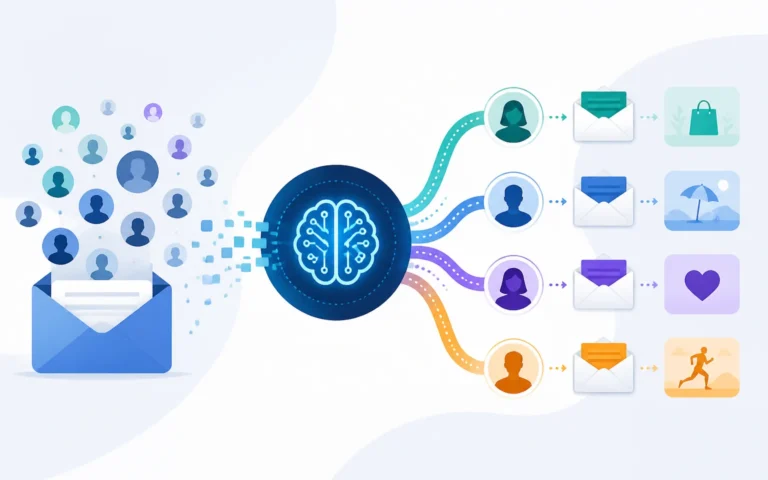
AI supercharges nurture in three ways: it writes and A/B tests subject lines, it segments your list by behavior automatically, and it personalizes send times and content. Personalization is not a nice-to-have – 81% of consumers favor brands that customize their experiences, per involve.me’s personalization data. I structure every nurture flow around a welcome sequence; you can see the exact framework in my breakdown of the high-converting welcome email sequence.
Stage Four: Convert With Trust-Driven Recommendations
The conversion stage is where the affiliate link finally does its job – but only after trust is established. The magic metric here stunned me: AI-matched affiliate and influencer referral programs deliver an average 16.4% conversion rate for warm audiences, compared to the 0.5-1% for cold traffic, per SQ Magazine. Warm plus relevant plus timely beats cold every single time.
My conversion assets are honest, detailed product reviews and comparison pages that answer objections before the buyer raises them. AI helps me draft these faster and spot gaps competitors leave open, but I always add real experience and specifics – that is what earns the click. I explain my full framework in how to write high-converting affiliate product reviews.
Stage Five: Retain and Reactivate for Recurring Commissions
The funnel does not end at the first sale. Retention is where lifetime value multiplies. Brands that use three or more channels in a campaign see a 287% higher purchase rate than single-channel efforts, per Hostinger, so I follow buyers across email, retargeting, and content. AI-driven win-back and re-engagement sequences quietly recover subscribers who went cold, and pointing people toward recurring-commission products means one nurtured customer can pay you monthly for years.
The AI Tools I Use at Each Funnel Stage
Tools change constantly, so I focus on categories rather than brand loyalty. For attraction, I use AI writing and SEO assistants to research and draft. For capture, I use AI page builders and quiz tools that adapt questions to the visitor. For nurture, I rely on email platforms with built-in AI segmentation and subject-line testing. For conversion, I use AI analytics that show which content actually drives clicks. And for retention, I lean on automation platforms that trigger sequences based on behavior.
The reason this matters financially: personalized popups based on browsing habits produced 38.5% more purchases, per Hostinger, and email programs in ecommerce now reach ROI levels near 52:1 when AI personalization is layered in. The tools are not the strategy, but the right tool removes the friction that kills momentum.
A Word of Caution on Over-Automation
AI can write, segment, and send – but it cannot be trusted to be you. I have seen funnels tank because every email sounded like a robot wrote it, because it did. My rule: AI drafts, I edit, and the voice stays human. Trust is the currency of affiliate marketing, and generic content spends it fast. Use AI to remove drudgery, not to remove yourself.
How to Build Your First AI Affiliate Funnel in a Weekend
You do not need a huge audience or budget to start. Here is the compressed version of what I would do if I were starting today. First, pick one affiliate product you genuinely believe in, ideally one with recurring commissions. Second, create one AI-assisted lead magnet that solves the small version of the problem that product solves fully. Third, build a simple capture page targeting that 20-40% opt-in rate. Fourth, write a five-email welcome-and-nurture sequence with AI as your drafting assistant. Fifth, place your affiliate recommendation in emails four and five, after you have delivered real value.
That is a complete funnel. It will not be perfect, but a live funnel beats a perfect plan every time. Given that 84% of brands now run affiliate programs, per Publift, the products and commissions are waiting – the bottleneck is almost always the funnel, not the offer. Once your first funnel earns, you clone the structure for the next product and the next niche.
Common Mistakes That Break AI Affiliate Funnels
The first mistake is skipping the capture stage entirely and sending cold traffic straight to an affiliate link – that is how you get stuck at a 1% conversion rate forever. The second is over-relying on AI for voice, which erodes the trust the whole funnel depends on. The third is promoting too many products at once; a confused subscriber does not buy. The fourth is ignoring mobile, even though mobile-first funnels are now the default for discovery and conversion. The fifth, and most common, is quitting during the nurture stage because the sales are not instant. Nurture compounds. The affiliate who emails consistently for ninety days almost always beats the one who gives up at day ten.
Frequently Asked Questions
Do I need a website to build an AI affiliate funnel?
A simple landing page and an email service are enough to start, though a content site dramatically improves your top-of-funnel traffic over time. Many creators begin with a single capture page and a link in their social bio, then add a full site as they grow. The non-negotiable piece is the email list – that is the asset you own regardless of platform changes.
How much does it cost to start an AI affiliate funnel?
You can launch for the price of an email marketing tool and an AI writing assistant, often under the cost of a modest monthly subscription. Since a segmented list is worth $1-$3 per subscriber per month, a funnel typically pays for its own tools once you pass a few hundred engaged subscribers. Start lean and reinvest what the funnel earns.
Is AI-generated affiliate content penalized by Google?
Google rewards helpful, experience-driven content regardless of how it was produced, and penalizes thin, unhelpful content regardless of who wrote it. The safe approach is to use AI as a drafting assistant while adding your own testing, examples, and genuine recommendations. Content that demonstrates real experience consistently outperforms generic AI output.
How long before an affiliate funnel becomes profitable?
Most funnels I build show early conversions within the first nurture cycle of one to two weeks, but meaningful, stable income usually takes two to three months of consistent traffic and list growth. The compounding nature of email means the funnel that looks slow in month one often accelerates sharply by month three as your list and trust grow.
What is the single most important stage of the funnel?
Email capture and nurture, without question. It is the stage most affiliates skip and the one that separates people earning pocket change from those earning a real income. Given that affiliates using email earn 66.4% more, the middle of the funnel is where the leverage lives.
Final Thoughts: Build the System, Not Just the Post
If you take one idea from this guide, let it be this: affiliate income is a system, not a lucky post. AI has lowered the cost of building that system to almost nothing, which means the advantage now goes to whoever actually builds it. The market is growing toward a projected $27.78 billion by 2027, per Publift, and that growth will flow to marketers with real funnels, not scattered links. Start with one product, one lead magnet, and one nurture sequence this week. Let AI handle the drudgery, keep your voice human, and give the funnel time to compound. That is exactly how I built mine, and it is the most reliable path I know to affiliate income that lasts.