How to Scale Affiliate Marketing With AI

When I started in affiliate marketing, scaling meant one thing: more hours. More articles written by hand, more emails drafted one at a time, more spreadsheets, more late nights. In 2026, that equation has completely changed. Artificial intelligence has gone from a novelty I experimented with to the operating system that runs the bulk of my affiliate business. And the numbers back up why I made the shift: roughly 79.3% of affiliate marketers have now adopted AI-driven content creation, and in the broader creator economy that figure climbs to about 96% of affiliate marketing creators using AI in their workflows (DemandSage, 2026). If you are not building AI into how you research, write, promote, and optimize, you are competing against people who are — and they are moving far faster than you.
One rule to build in from day one: follow the FTC’s endorsement guidelines, which require clear, conspicuous disclosure of affiliate relationships in your content.
In this guide I am going to walk you through exactly how I use AI to scale an affiliate business in 2026, from keyword research all the way to email automation and performance optimization. This is not theory. It is the workflow I run every week, and I will be honest about where AI helps, where it hurts, and where you still need a human in the loop. If you are newer to the model itself, I would start with my primer on what affiliate networks are before going deeper here.
Why AI and Affiliate Marketing Fit Together So Well in 2026
Affiliate marketing has always been a volume-and-relevance game. You win by reaching the right buyers at the right moment with the right recommendation, and by doing that at a scale that makes the commissions add up. AI happens to be extraordinarily good at exactly those tasks: generating content quickly, personalizing it, analyzing data, and spotting patterns a human would miss.
The financial context matters too. The global affiliate marketing industry is valued at roughly $18.5 to $20 billion in 2026 and is forecast to reach $31.7 billion by 2031 (Affiliate Statistics, 2026). In the United States alone, advertisers will spend $13.81 billion on affiliate marketing in 2026, up 11.3% from $12.42 billion in 2025 (eMarketer, 2026). This is not a shrinking niche. It is a growing channel, and AI is the lever that lets a small operator capture a meaningful slice of it.
There is a productivity story underneath all of this. Marketing teams using AI across multiple core functions report an average 44% increase in marketing output and ROI versus non-AI peers, and 91% of marketing professionals now actively incorporate AI tools into their daily workflows (DemandSage AI in Marketing, 2026). For a solo affiliate or a lean team, that 44% lift is the difference between publishing four pieces of content a month and publishing twelve.
The Discovery Shift: Why AI Search Changes Affiliate Strategy
Before we get into tactics, you need to understand the single biggest structural change of 2026: how people find products. Generative AI chatbots have reshaped the shopping journey that affiliate marketing depends on. Shopping-related queries on ChatGPT grew faster than any other query type between December 2024 and June 2025 (eMarketer, 2026). Buyers increasingly ask an AI assistant “what is the best email marketing tool for a small business?” instead of typing that into a search bar and scrolling ten blue links.
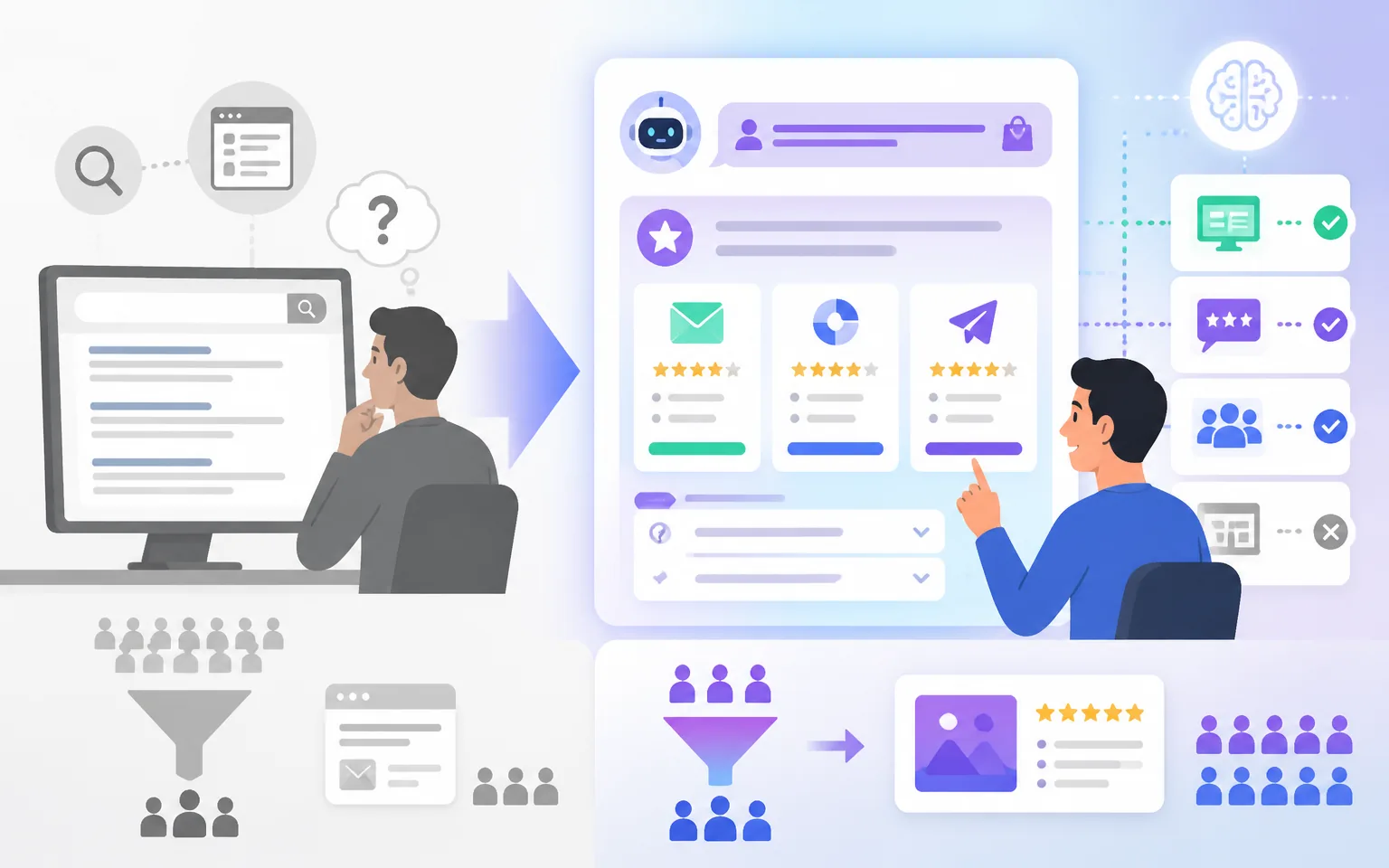
Here is the opportunity. AI systems cite structured, decision-focused pages — comparison tables, FAQs, and specs — when users ask buying questions, and that pre-sold traffic converts roughly 3 to 4 times better than regular search traffic (MarTech, 2026). Even more striking: brand-owned site content accounts for just 5 to 10% of the sources AI search pulls from, while affiliate and user-generated content can make up significantly more. In other words, affiliate publishers are uniquely positioned to be the content that AI assistants recommend. That reframes everything I do — I am no longer just writing for Google, I am writing to be cited by AI.
If you want the deeper SEO angle on this, I covered it separately in my piece on how AI is changing SEO strategies. For now, just hold onto the principle: structured, genuinely helpful comparison content is the highest-leverage asset in affiliate marketing right now.
Step 1: AI-Powered Keyword and Topic Research
Everything starts with finding the right opportunities. I used to spend hours in keyword tools manually clustering terms. Now I run a hybrid process. I still pull raw keyword data from a dedicated SEO tool, but I hand the export to an AI model and ask it to cluster terms by buyer intent, group them into content hubs, and flag which clusters signal commercial intent versus pure information seeking.
The reason this matters: commercial-intent keywords are where affiliate commissions live. When someone searches “best low-code platform for startups,” they are closer to a purchase than someone searching “what is low-code.” AI is excellent at sorting that distinction at scale across thousands of keywords in minutes. Given that 96% of AI-using marketers cite content speed as their top reason for adoption, reporting an average 68% reduction in time-to-publish (DemandSage, 2026), the research phase is where that time savings begins.
My practical workflow looks like this. First, I gather seed keywords from a tool and competitor pages. Second, I prompt AI to build a topical map — a pillar topic surrounded by supporting clusters. Third, I ask it to prioritize based on a mix of search volume, competition, and how naturally each topic supports a product recommendation. The output is a publishing roadmap I can execute for the next quarter.
Step 2: Scaling Content Creation Without Losing Quality
This is where most people either win big or shoot themselves in the foot. AI can write fast, but AI writing without editorial judgment produces thin, generic content that AI search engines and human readers both ignore. The data is clear that automation works — AI content marketing can deliver up to 748% ROI in some campaigns (SQ Magazine, 2026) — but that return depends entirely on how you use the tool.
My rule is simple: AI drafts, humans direct and verify. I never publish a raw AI draft. Instead I use AI to produce a structured first draft from a detailed brief that includes the target keyword, the buyer persona, the products I am recommending, and the specific comparison points I want covered. Then I layer in my own experience, real opinions, and first-hand testing notes. That personal layer is what separates content that ranks and converts from content that gets buried.
I lean heavily on three content formats because AI search engines favor them and they convert well: detailed comparison posts, structured listicles, and FAQ-rich buyer guides. If listicles are part of your plan, my guide on how to write a listicle blog post pairs well with an AI-assisted workflow. The format gives AI a clear structure to fill, and it gives readers the scannable, decision-focused layout they want.
One caution from experience: marketers report that video content enhanced by AI editing and scripting tools delivers 49% higher conversion rates (DemandSage, 2026), so I no longer treat written content as the whole strategy. I use AI to script short product videos and repurpose written guides into video, which compounds the reach of every piece I create.
Step 3: AI for Email Marketing and List Monetization
Your email list is the one asset in affiliate marketing you actually own. AI has made it dramatically more profitable to run. AI-driven marketing automation yields about 544% ROI — roughly $5.44 for every dollar spent over three years (SQ Magazine, 2026), and a large share of that comes from email.
Here is how I apply it. I use AI to write segmented email sequences tailored to where a subscriber sits in the funnel — a new subscriber gets an educational nurture sequence, while an engaged subscriber who clicked a product link gets a more direct recommendation flow. AI generates subject line variations for testing, drafts the body copy, and helps me personalize at a scale I could never hit manually. The personalization angle is significant: AI-powered personalization in e-commerce can drive up to 400% ROI and cut acquisition costs by as much as 50% (SQ Magazine, 2026).
The tooling matters here. Platforms that combine AI with email automation let you trigger flows based on behavior automatically. If you are choosing a stack, my comparison of email marketing practices and tools is a useful starting point. Whatever you choose, the principle holds: let AI handle the volume of drafting and segmentation, and reserve your judgment for strategy and offer selection.
Step 4: AI-Driven Optimization, Analytics, and Fraud Detection
Scaling is not only about producing more — it is about producing smarter. This is where AI quietly does some of its most valuable work. AI revolutionizes affiliate marketing by enabling smarter data analysis, predictive insights, and fraud detection, all of which contribute to higher ROI for advertisers and more earnings for affiliates (DemandSage, 2026).
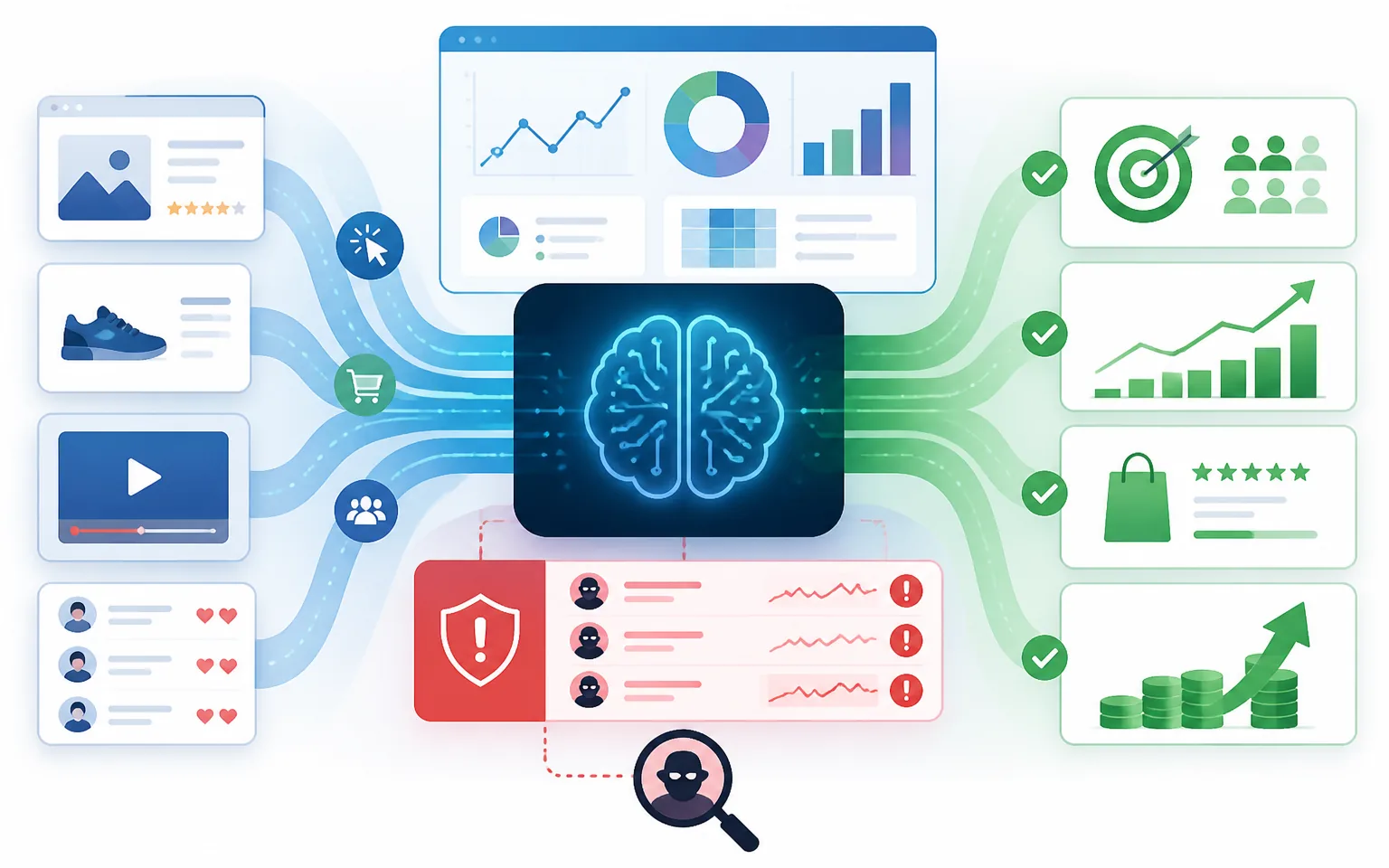
I feed my performance data into AI to spot which content pieces drive conversions versus clicks, which products underperform relative to their traffic, and where I am leaving money on the table. AI-driven campaigns typically deliver a 15 to 40% uplift in marketing ROI through better targeting, higher conversions, and cost savings (SQ Magazine, 2026). That uplift compounds. A 25% improvement on a portfolio of fifty articles is a meaningful raise.
On the defensive side, affiliate fraud has always been a tax on the industry, and AI fraud detection now catches suspicious click and conversion patterns far faster than manual review. For anyone running their own program or working with a network, this is no longer optional infrastructure.
Step 5: Choosing the Right AI-Friendly Affiliate Programs
If you are going to lean into AI, it makes sense to promote products your audience is actively searching for — and AI tools themselves are one of the hottest categories. The demand is real: 81% of marketing leaders say AI has significantly improved team productivity and strategic execution in 2026 (DemandSage, 2026), which means buyers are hunting for recommendations constantly.
I balance my portfolio across evergreen categories like email platforms, hosting, and funnel software, and faster-moving categories like AI writing and video tools. The evergreen products provide stable recurring commissions; the AI tools provide the high-intent, high-search-volume traffic that AI assistants love to cite. When you are evaluating which programs to join, my framework for choosing the right affiliate network for your business still applies — the AI layer changes how you promote, not the fundamentals of what makes a good program.
The Honest Limitations: Where I Keep AI on a Short Leash
I would not be giving you a useful playbook if I only sold you the upside. AI has real failure modes in affiliate marketing, and pretending otherwise costs people money and trust.
First, accuracy. AI confidently invents facts, statistics, prices, and product features. Every claim in a buyer guide has to be verified against the source, because a single fabricated spec destroys reader trust and can violate advertising disclosure rules. Second, sameness. When 79% of the industry uses similar tools with similar prompts, the baseline output converges, and undifferentiated content loses. Your edge is the human layer — real testing, real opinions, real experience. Third, over-automation of relationships. Affiliate marketing still runs on trust between you and your audience, and a fully automated, soulless funnel erodes that. I covered the broader risks in my article on the disadvantages of AI in business, and those cautions apply directly here.
The compensation landscape reinforces the human point. Creator compensation models continue shifting toward hybrid structures that combine flat fees with affiliate commissions (eMarketer, 2026), which tells you that brands still value the human trust a creator brings. AI scales your output; it does not replace your credibility.
My Recommended 2026 AI Affiliate Workflow, Start to Finish
Pulling it together, here is the loop I run. I start with AI-assisted keyword and topic research to build a quarter of decision-focused content ideas. I write detailed briefs and use AI to draft, then I add my own testing and opinions and verify every fact. I structure content as comparisons, listicles, and FAQ-rich guides so AI search engines cite it. I repurpose the best pieces into AI-scripted video. I capture readers into an email list and run AI-personalized nurture sequences. Finally, I feed performance data back into AI to find the next round of optimizations. Then I repeat.
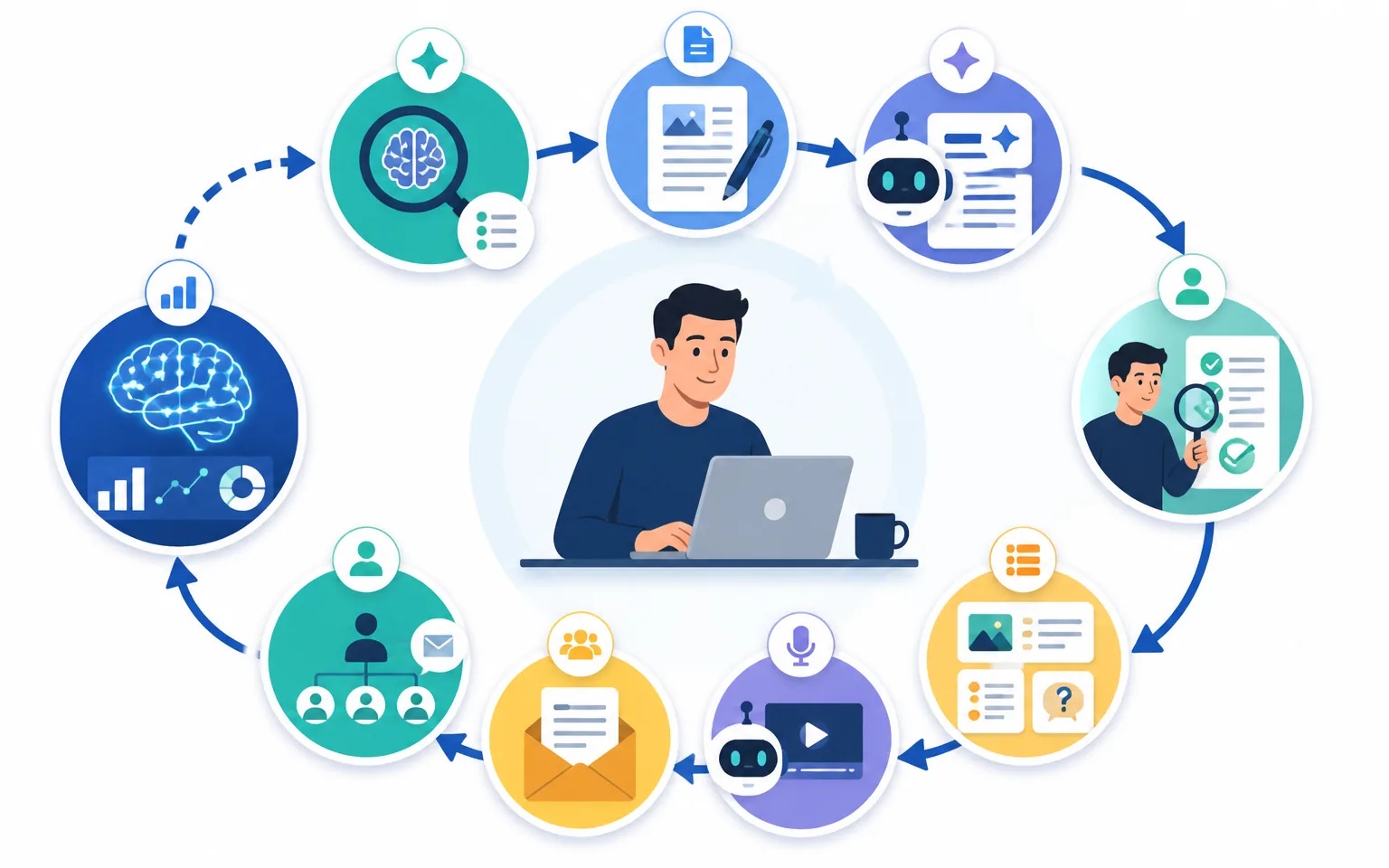
That loop is why a solo operator can now compete with a small agency. With 91% of marketing professionals using AI daily (DemandSage, 2026), the tools are no longer a competitive advantage on their own — how thoughtfully you combine them with genuine human expertise is.
Frequently Asked Questions
Is AI-generated affiliate content penalized by Google?
No — Google penalizes unhelpful, low-quality content regardless of how it is produced. AI-assisted content that is accurate, original, and genuinely useful performs well. The risk is publishing raw, unedited AI output that adds no real value. With AI search citing structured, decision-focused pages that convert 3 to 4 times better than regular search (MarTech, 2026), quality is the whole game.
How much can AI actually improve my affiliate ROI?
It depends on execution, but the data is encouraging. AI-driven campaigns typically deliver a 15 to 40% uplift in marketing ROI, and AI marketing automation has shown roughly 544% ROI over three years (SQ Magazine, 2026). The biggest gains come from combining AI content production with AI-personalized email and continuous optimization.
Do I still need an email list if AI search is driving traffic?
Absolutely — arguably more than ever. AI search traffic is powerful but you do not control it. An email list is an owned asset, and AI-personalized email delivers some of the highest ROI in the entire channel. Treat AI search as the top of your funnel and email as the asset that monetizes it over time.
Which AI tools should a beginner start with?
Start with one strong writing and research assistant, one email automation platform with AI features, and one analytics workflow. Resist the urge to buy a dozen tools. Master the loop of research, draft, verify, publish, and optimize before adding complexity.
Will AI replace affiliate marketers entirely?
No. AI replaces tasks, not the marketer. The shift toward hybrid creator compensation models (eMarketer, 2026) shows brands still pay for human trust and credibility. AI amplifies a good marketer and exposes a lazy one.
Final Thoughts
Scaling affiliate marketing in 2026 is not about working more hours — it is about building an AI-powered system that does the heavy lifting while you supply the judgment, the testing, and the trust. The industry is growing toward $31.7 billion by 2031 (Affiliate Statistics, 2026), AI search is rewarding exactly the kind of structured, helpful content affiliates are best at producing, and the productivity gains are real for anyone willing to build the workflow.
My advice: pick one step from this playbook this week and implement it. Cluster your keywords with AI, or set up a single AI-personalized email sequence, or restructure one post into a proper comparison page. Build the loop one piece at a time, keep a human firmly in the loop, and let the compounding do its work. That is how I scaled, and it is the most durable approach I know for the years ahead.
Related reading: Abandoned Cart Email Sequence: How I Recover Lost Sales on Autopilot in 2026.
Related reading: 5 Reasons Why Business Email is Important for Your Company.
Related reading: How to Write Affiliate Product Reviews That Convert in 2026.