Topical Authority: The Pillar-Cluster Playbook

Topical authority is the single biggest force shaping who ranks on Google and who gets cited in AI search in 2026. When I started publishing on byskh.com, I ignored it — I just wrote one great guide, built a few backlinks, and waited for Google to reward me.
The pillar-and-cluster model works precisely because it aligns with Google’s guidance on helpful, people-first content — demonstrable depth and expertise on a topic are what earn rankings and AI citations.
That worked for a while. It does not anymore.
The biggest shift I have watched over the last eighteen months is that Google — and now ChatGPT, Gemini, and Perplexity — no longer rank pages in isolation. They rank topics.
The sites that own a topic are the ones that built real topical authority through interconnected clusters of content. Google now evaluates expertise by content cluster rather than by domain overall.
That means a modest site with deep, consistent coverage of one subject routinely outranks a far stronger domain that treats that subject as an afterthought. This is the most important strategic change in SEO since the Penguin update.
In this guide I will show you exactly how I think about topical authority in 2026. I will cover why pillar-and-cluster architecture became the standard, and the practical steps I use to plan, build, and measure a cluster that earns rankings and AI citations at once.
Key Takeaways on Building Topical Authority
- Topical authority is now ranked by content cluster, not by domain — deep coverage of one subject beats a single long guide.
- Sites that implement content clusters correctly see an average 40% increase in organic traffic (Digital Applied, 2026).
- Aim for 10 to 20 interconnected articles per topic; a site with ~20 articles outranks one with a single 5,000-word guide.
- Hub-and-spoke internal linking lifts AI citation rates from roughly 12% to 41% for pillar queries.
- Structured clusters earn 3.2× more AI citations than disconnected archives (Yext, 6.8M citations).
- Front-load your most quotable, stat-backed claims — 44.2% of LLM citations come from the first 30% of a page.
- Measure at the cluster level and expect a 40 to 70% rankings lift within three to six months.

What Topical Authority Actually Means in 2026
Topical authority is your site’s demonstrated depth and credibility on a specific subject. It is measured by how comprehensively and coherently you cover it — not by your domain rating or the age of your site.
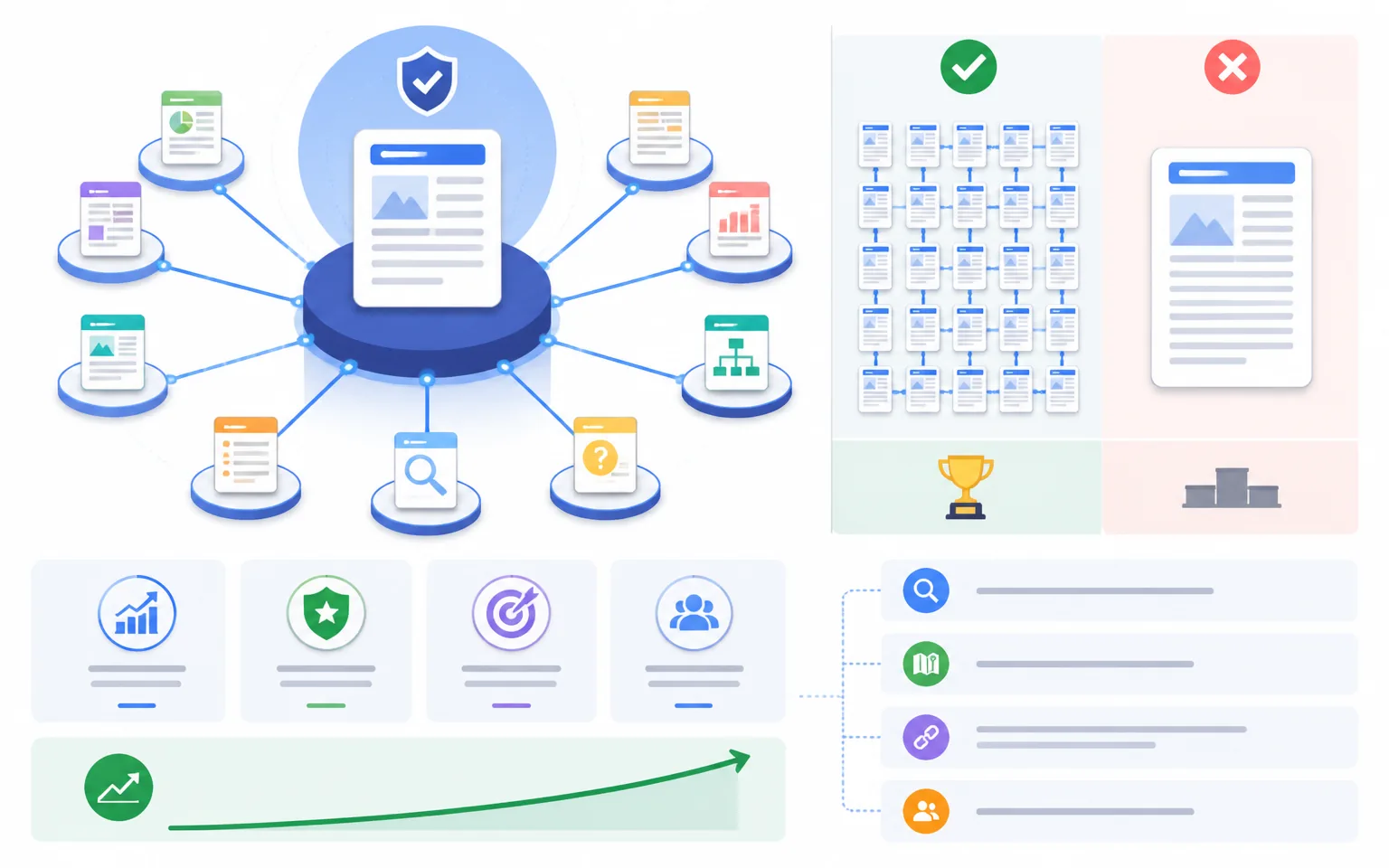
The distinction matters now more than ever. Search engines reward sites that show long-term topic commitment, so authority tends to grow steadily rather than explode overnight.
The payoff is real. Sites that implement content clusters correctly see an average 40% increase in organic traffic compared with non-clustered strategies, according to Digital Applied’s 2026 topic authority guide.
The mechanism is simpler than the jargon suggests. When you publish many interconnected articles about one subject and link them intelligently, you give algorithms a map of your expertise.
That map signals real depth: the pillar, the subtopics, the edge cases, and the questions people actually ask. Google is now enforcing a clear principle here.
A site with roughly 20 interconnected articles on a subject will consistently outrank a site with one 5,000-word guide on the same subject. Depth distributed across a cluster beats depth crammed into a single page.
If you are still chasing one keyword with one article and moving on, you are playing a game that ended years ago. The teams winning today think in clusters from the very first keyword they research.
Why Pillar-and-Cluster Architecture Became the Standard
The model is simple in structure. You build one comprehensive pillar page on a broad topic, then surround it with narrower cluster pages that each go deep on a single subtopic.
Every cluster page links up to the pillar, and the pillar links back down to each cluster page. This bi-directional linking concentrates topical authority and keeps your priority pages within three clicks of your homepage.
Here is why this works so well right now. AI engines like ChatGPT, Gemini, and Perplexity read your internal link structure to decide which pages belong to a cluster and which page is the hub.
When your pillar receives links from multiple cluster pages using descriptive, consistent anchor text, large language models classify it as the citation-worthy source. The internal link graph is now a signal machines read to find the expert.
The performance gap is measurable. Sites with hub-and-spoke internal linking see AI citation rates climb from roughly 12% to 41% for pillar topic queries, per Memorable Design’s 2026 internal linking analysis.
That is more than a tripling of how often AI engines name you as a source. The pattern repeats in larger datasets too.
Yext’s 2025 AI Citation Study, which examined 6.8 million citations, found that sites with structured topic clusters earn 3.2× more AI citations than sites with disconnected archives. In 2026, cluster architecture is the price of entry.
I covered the broader mechanics of getting found in AI answers in my guide on GEO and AEO optimization for AI search. Topical authority is the structural foundation everything in that guide sits on.
Step One: Map the Topic Before You Write a Word
The most common mistake I see is people building clusters by instinct rather than research. You cannot demonstrate comprehensive coverage of a topic you have not first mapped.
Before I write a single article, I build a topic map. The pillar sits at the center, with every meaningful subtopic, question, comparison, and use case branching off it.
Start with the seed keyword, then expand into the questions and adjacent terms real searchers use. This is the discipline I walk through in my post on how to conduct keyword research for SEO.
The difference now is the goal. You are not hunting for one keyword to win — you are inventorying an entire territory to own.
A practical target has emerged from 2026 studies: aim for 10 to 20 cluster articles per topic to genuinely signal authority to Google. Fewer than ten looks like dabbling; more than twenty usually means you lead the topic.
As you map, tag which pieces are pillar-level and which are cluster-level. A pillar page is typically a 3,000 to 5,000 word overview of the broad topic.
Cluster pages run 1,500 to 2,500 words and cover specific subtopics in depth. Supporting pages — FAQs, case studies, glossaries — catch the long-tail queries the pillar and clusters do not address directly.
Step Two: Build the Pillar as a True Hub
Your pillar page has one job: be the definitive, scannable overview that links out to everything else. It should satisfy a reader on its own while signposting the deeper cluster pages.
Think of it as a table of contents that also happens to be a great article. Content depth on the pillar matters more than it used to, especially for AI visibility.
Pages above 20,000 characters average roughly 10 AI citations each, versus just 2.4 for pages under 500 characters, per the citation data in Memorable Design’s 2026 study. That is a strong case for making your pillar genuinely comprehensive.
But comprehensiveness is not padding. Every section should earn its place by answering a real question your topic map surfaced.
Placement of your strongest material matters too. Citation analysis shows 44.2% of all LLM citations come from the first 30% of a text, 31.1% from the middle, and 24.7% from the final third.
In plain terms: front-load your most quotable, statistic-backed claims. If your best insight is buried in paragraph forty, an AI engine is far less likely to surface it.
Step Three: Write Cluster Pages That Go Deep, Not Wide
Each cluster page should obsess over one subtopic. Resist re-explaining the whole pillar topic at the top of every article — that creates cannibalization where your own pages fight for the same query.
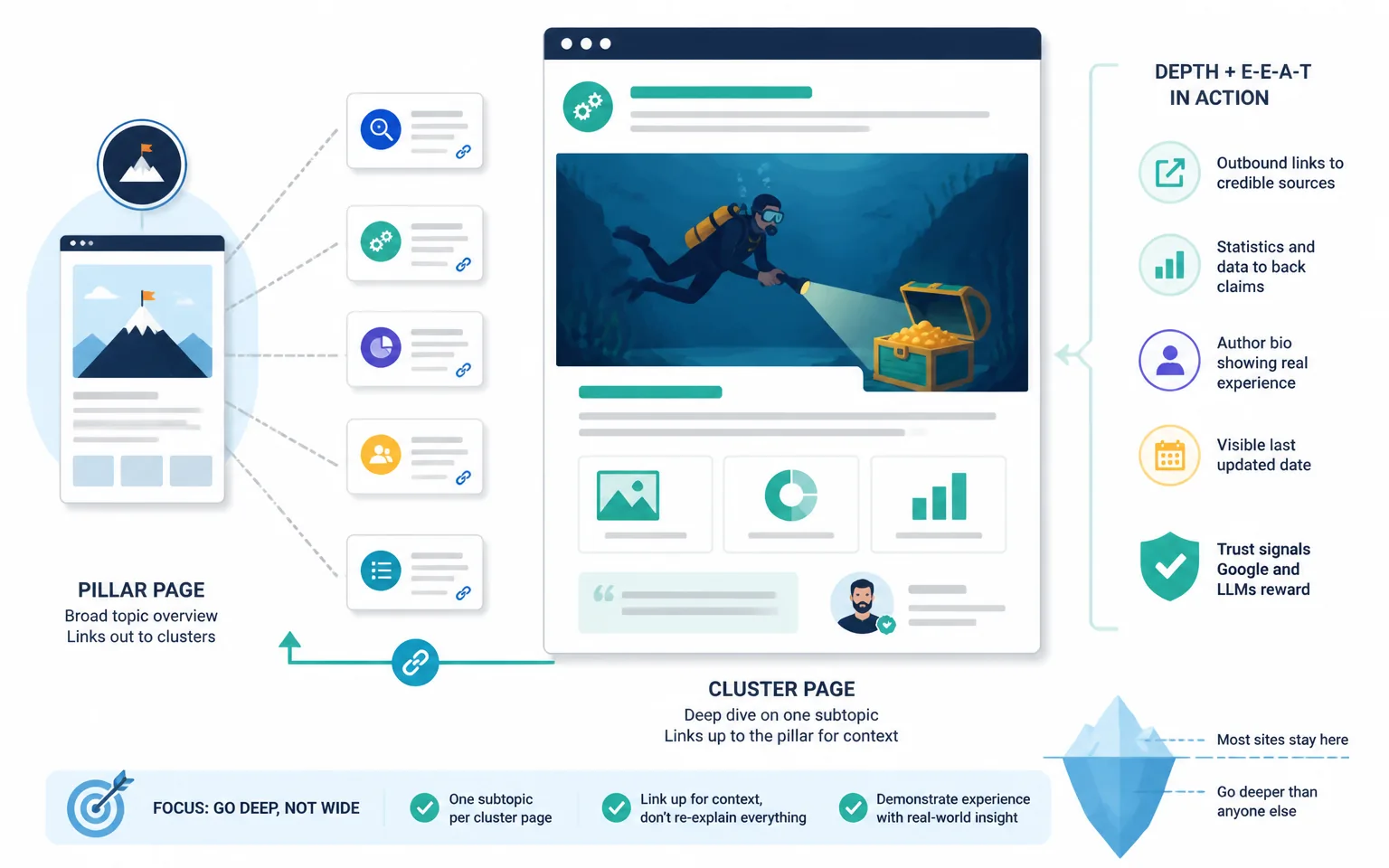
Instead, link up to the pillar for context and spend your words going deeper than anyone else has on that narrow slice. This is where E-E-A-T becomes concrete rather than abstract.
Google’s Helpful Content system evaluates topical depth, E-E-A-T signals, and the coherence of your internal link graph together. The most reliable way to demonstrate experience is to write from things you have actually done.
HubSpot’s State of AEO 2026 report analyzed citations from ChatGPT, Gemini, Perplexity, and Google AI Overviews between December 2025 and March 2026. It found that pages with outbound links, statistics, author bios, and visible “last updated” dates correlate with higher citation rates.
Those four elements are trust signals, not decoration. Both Google and LLMs reward them.
When I write cluster pages, I treat the on-page fundamentals as non-negotiable. I keep the full pre-publish discipline in my on-page SEO checklist, covering the title, heading, schema, and metadata work each page needs.
Step Four: Wire the Internal Links Deliberately
This is the step most people rush, and it separates a real cluster from a pile of related articles. Internal links tell algorithms which pages form a topic and which page is the hub.
The discipline is simple but easy to neglect. Every cluster page links up to the pillar with descriptive anchor text, the pillar links down to each cluster page, and related cluster pages link sideways where it helps the reader.
The cost of neglecting this is severe and invisible. An estimated 25% of web pages receive zero internal links, and large-site analysis suggests fewer than half get enough to be reliably discovered, per Digital Applied’s architecture guide.
Orphan pages do not just rank poorly — they often never get crawled or indexed at all. If you have published something good and watched it sink without a trace, weak internal linking is a likely culprit.
I dig into discoverability in my post on getting indexed by Google fast, and internal links are the first lever I pull there.
Use semantically consistent anchor text. When multiple cluster pages link to your pillar with descriptive, on-topic anchors, LLMs classify the pillar as the authoritative source. Generic anchors like “click here” waste the strongest signal you can send.
Step Five: Measure at the Cluster Level, Not the Page Level
Here is the mindset shift that took me longest to internalize. Stop judging individual articles and start judging the cluster as a unit.
Measure the combined organic traffic, rankings, and authority signals for the pillar and all its cluster pages as a group. Authority is rising when more pages rank, rankings stabilize, and new content indexes faster than before.
Those three signals together tell you the cluster is gaining ground even when no single page has had a breakout moment. The timeline is encouraging if you are patient.
Publishing at least 25 authoritative articles in one tightly connected cluster leads to a 40 to 70% increase in keyword rankings within three to six months, per Digital Applied’s cluster performance data.
Businesses transitioning fully from keyword-focused SEO to the cluster model report traffic increases of 50% to 300% within six to twelve months. The growth is rarely instant, but it compounds and tends to be far more durable than one viral post.
For the broader framework a cluster sits within, I keep my full SEO blueprint for ranking higher on Google as the reference. Topical authority is one pillar of that blueprint, not a replacement for it.
A Practical 90-Day Plan to Launch Your First Cluster
If you want to act rather than just nod along, here is the approach I would follow. In the first two weeks, pick one topic you genuinely have experience with and map it fully — pillar plus 10 to 20 cluster ideas.
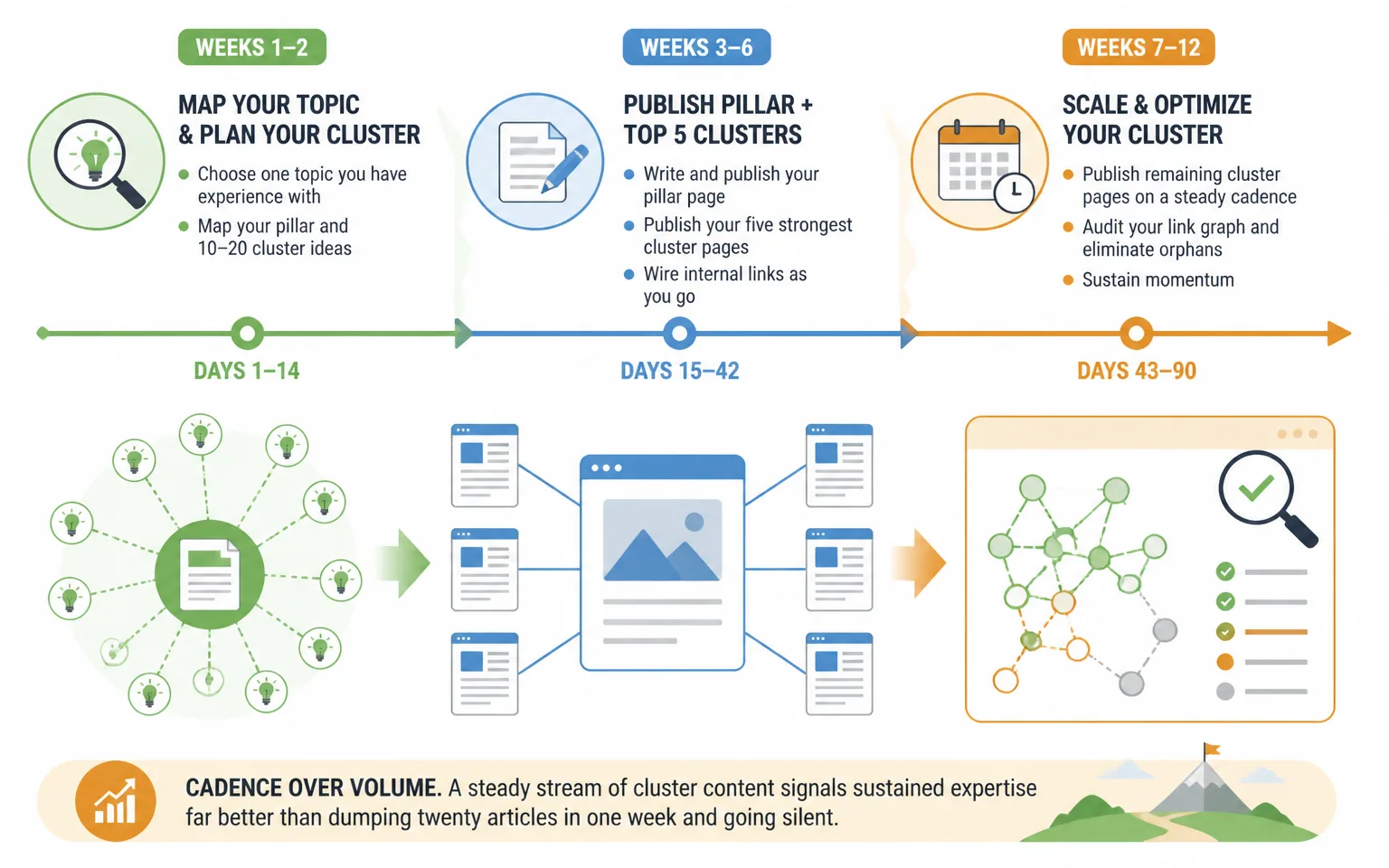
In weeks three through six, write and publish the pillar and your five strongest cluster pages. Wire the internal links as you go rather than retrofitting them later.
In weeks seven through twelve, publish the remaining cluster pages on a steady cadence and audit your link graph to eliminate orphans. The cadence matters as much as the volume.
Search engines reward long-term topic commitment. A steady stream of cluster content signals sustained expertise far better than dumping twenty articles in one week and going silent.
Summary
Topical authority is won by owning an entire topic, not a single keyword. You build it with a pillar-and-cluster structure: one comprehensive pillar page surrounded by 10 to 20 deep cluster pages, all wired together with descriptive internal links.
That structure is what Google and AI engines read to decide who the expert is. Done well, it delivers roughly 40% more organic traffic, 3.2× more AI citations, and a 40 to 70% rankings lift within three to six months.
Map your topic first, build the pillar as a true hub, write cluster pages that go deep on one subtopic each, link everything deliberately, and measure the cluster as a single unit. Then keep publishing on a steady cadence.
Frequently Asked Questions
How many articles do I need to build topical authority?
Most 2026 studies converge on 10 to 20 interconnected cluster articles per topic as the threshold for signaling authority to Google. A site with around 20 interconnected articles will outrank one with a single long guide. Aim for 10 to 20 as the practical floor on a competitive topic.
What is the difference between domain authority and topical authority?
Domain authority is a site-wide strength estimate, while topical authority is your demonstrated depth on one subject. The key 2026 reality is that Google evaluates expertise by content cluster, not by domain overall. A modest site with deep coverage can beat a much stronger domain that covers the topic shallowly.
Does topical authority help with AI search and not just Google?
Yes, and arguably more so. Sites with structured clusters earn 3.2× more AI citations than disconnected archives, per Yext’s 2025 study of 6.8 million citations. Hub-and-spoke linking lifts AI citation rates from roughly 12% to 41% for pillar queries.
How long before I see results from a topic cluster?
Expect a 40 to 70% increase in keyword rankings within three to six months once you build a tightly connected cluster of roughly 25 articles. Traffic gains of 50 to 300% follow within six to twelve months for sites that fully adopt the model. Growth is steady and compounding rather than instant.
Where should I place my most important information on a page?
Front-load it. Citation analysis shows 44.2% of LLM citations come from the first 30% of a text. Put your most quotable, statistic-backed claims in the introduction and opening sections.
Conclusion: Own the Topic, Not Just the Keyword
The era of winning with a single great article is over. In 2026, search engines and AI assistants reward sites that show deep, structured, consistent expertise across an entire topic.
They read your pillar-and-cluster architecture as the proof. The numbers make the case plainly: 40% average traffic lifts from proper clusters, a tripling of AI citation rates from hub-and-spoke linking, and 3.2× more AI citations for clustered sites.
None of that requires a bigger domain or a fatter backlink budget. It requires picking a topic you can own, mapping it honestly, and building the pillar and clusters so the machines can see what you built.
Pick one topic this week. Map it, then build the hub.
Then keep showing up — that steady commitment is how topical authority is won in 2026.