Blog Content Audit: What Auditing 116 Posts Taught Me

A blog content audit is a systematic review of every post you have published, scored against traffic, search intent, overlap and freshness, so you can decide which pages to keep, update, merge or remove. I ran one on my own blog this month across 116 published posts, and the results were uncomfortable enough that I stopped publishing daily.
This is not a theoretical guide. Every number below comes from my own site.
The short version: I had been treating publishing volume as a growth strategy. The audit showed that volume was actively working against me. Ahrefs analysed roughly 14 billion web pages and found 96.55% of them get no traffic at all from Google — and a big chunk of my archive was sitting comfortably in that 96.55%.
Key Takeaways From My Blog Content Audit
- Volume is not a moat. With 96.55% of pages earning zero Google traffic, adding a 117th mediocre post does nothing except dilute the 116 already there.
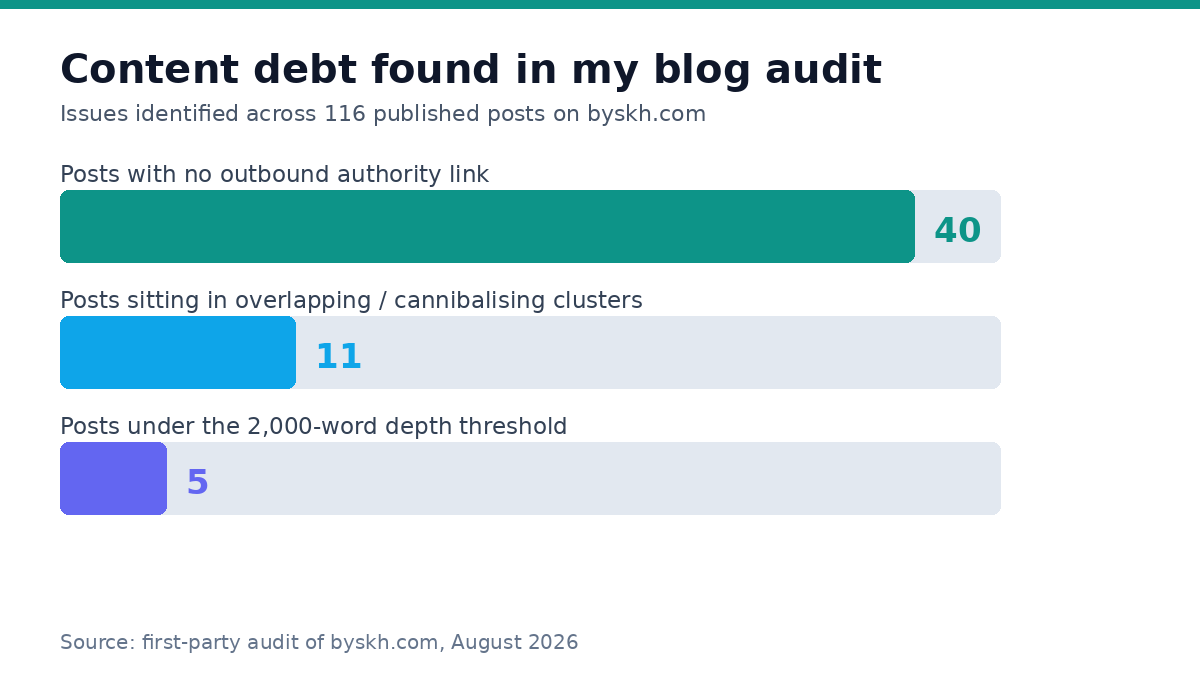
- 40 of my 116 posts had zero outbound authority links — no citations, no sources, no evidence. That is the single clearest signal of undifferentiated content.
- 11 posts sat in overlapping clusters competing with each other for the same query, which splits ranking signals rather than compounding them.
- Consolidation beats creation. Backlinko merged two cannibalising articles and reported a 466% year-over-year increase in clicks from that single change.
- Refreshing outperforms writing new. HubSpot’s historical optimisation programme lifted organic views of old posts by an average of 106%.
- Quality, not technical bugs, drives “Crawled – currently not indexed.” Since the helpful content classifier moved into core ranking, that status usually points at duplication and thinness.
- Audit quarterly, not annually. A 90-day cadence catches decay before rankings collapse.
What Is a Blog Content Audit?
A blog content audit is an inventory plus a judgement. First you list every URL you own. Then you attach performance data to each one and make an explicit decision about its future.
The inventory part is easy. The judgement part is where most people quit, because the honest answer for a lot of posts is “this should never have existed.”
The decision set is deliberately small: keep, update, consolidate, or remove. Four options, no maybes. A post that stays in “I’ll look at it later” limbo is a post that keeps draining crawl budget and diluting your topical signals for another year.
How an audit differs from a content refresh
A refresh fixes one post. An audit decides which posts deserve a refresh in the first place.
I already had a process for updating individual articles — you can see my approach in my guide to fixing content decay. What I did not have was a way to choose which articles to spend that effort on, so I was refreshing whatever I happened to remember.
The audit turns that guesswork into a ranked queue. That is its entire value.
Why I Audited My Own Blog Before Writing Another Word
The trigger was Google Search Console. A large share of my posts were showing “Crawled – currently not indexed” — Google had fetched them, looked at them, and decided they did not earn a slot in the index.
My first instinct was technical. It usually is. But current analyses of that status put the cause at quality or duplication roughly 80% of the time rather than crawling bugs, and once I actually read my own archive that explanation fit uncomfortably well.
Google is explicit about the mechanism. Its documentation on the helpful content system describes a site-wide signal: content on sites judged to have relatively high amounts of unhelpful material is less likely to perform well, including the good pages.
That last part is what changed my behaviour. My weak posts were not neutral dead weight. They were a tax on my strong ones.
The Numbers From My Audit
Here is what 116 posts actually looked like when I scored them honestly.
Forty posts with no outbound authority links
Forty articles — 34% of the archive — cited nothing. No study, no documentation, no named source. They asserted things and moved on.
That pattern is the fingerprint of content written to fill a slot rather than to answer a question. It is also a missed experience signal, because linking to the sources you actually consulted is one of the cheapest ways to show a page was researched by someone.
Eleven posts cannibalising each other
I had five separate posts about affiliate networks, three about web hosting, and three about low-code platforms. Different titles, near-identical intent.
Cannibalisation dilutes link equity and ranking signals across multiple URLs and makes search engines alternate between them, which is why Backlinko’s consolidation of two competing articles produced a 466% year-over-year lift in clicks once the signals pointed at one page.
Five thin posts on one topic will never outrank one authoritative post on that topic. I had built the wrong shape.
Five posts below the depth threshold
Only five posts fell under 2,000 words, which sounds like good news until you notice the pattern: the thinnest posts were also the oldest and the least linked. Thinness rarely arrives alone.
How to Run a Blog Content Audit Step by Step
Here is the exact sequence I used. It takes an afternoon for a hundred-post blog.
Step one: build the inventory
Export every published URL with its title, slug, publish date, word count, category and internal link count. A CMS export or a crawl works equally well.
Do not skip word count and internal links. Those two columns predict most of your findings before you look at any traffic data.
Step two: attach performance data
Pull 12 months of clicks, impressions and average position per URL from Search Console. Twelve months matters because seasonal posts look dead in the wrong quarter.
Add conversions if you track them. A post with 40 visits and three email signups is worth more than one with 400 visits and none — and given that pruning decisions hinge on business value rather than raw traffic, that column often reverses your instincts.
Step three: score each post
I used five criteria, each scored 0 to 2: search demand, current performance, uniqueness of angle, evidence quality (outbound citations, first-hand data), and freshness.
Anything scoring 8–10 is a keeper. Anything at 4–7 is a refresh candidate. Below 4, the post is either merge material or deletion material.
Step four: cluster before you decide
Group posts by target query, not by category. This is where cannibalisation becomes visible, because two posts filed under different categories can still chase the same search.
My affiliate cluster only looked absurd once the five posts sat next to each other in a spreadsheet row. Filed separately, each one seemed reasonable.
Step five: assign one of four actions
Every URL gets exactly one action: keep, update, consolidate, or remove. Write the action in the sheet. Ambiguity is how audits die.
Step six: execute in batches and re-measure
Do six to ten posts per session. Batching keeps the work finishable, and it lets you attribute results.
Give it time before judging. Cannibalisation fixes typically show initial movement in two to four weeks with full impact over two to three months, so measuring at day seven tells you nothing useful.
The Four Decisions Explained
Keep
The post ranks, converts, or owns a query you care about. Leave it alone and point internal links at it.
Keepers are also your consolidation targets. When you merge weaker posts, this is where the content goes.
Update
The post has real demand behind it but the execution has aged. This is the highest-return action in the whole audit.
HubSpot’s historical optimisation work raised monthly organic views on updated posts by an average of 106% and roughly tripled the leads those posts generated — without a single new article being written.
My update checklist is short: refresh statistics with current sources, add outbound citations, deepen the thinnest section, add a direct answer in the opening paragraph, and fix internal links.
Consolidate
Two or more posts chase the same intent. Pick the strongest URL, fold the unique material from the others into it, then 301-redirect the losers to the winner.
Redirect — never delete outright — when the old URLs have any backlinks or history. You want that equity to land somewhere useful.
Remove
The post has no demand, no links, no conversions and no strategic role. Delete it and let the URL 410, or redirect it to the closest relevant page.
Pruning genuinely works: documented case studies report organic traffic gains ranging from roughly 23% to over 100% after removing or consolidating underperformers, and one detailed pruning case study found deleting pages improved performance across the pages that remained.
Be conservative on your first pass. Deleting is the one action you cannot easily undo.
Auditing for AI Search, Not Just Google
An audit in 2026 has a second job: making your pages citable by AI systems.
Large language models pull short, self-contained, well-sourced passages. A 900-word post with no citations and vague claims is invisible to them in a way that goes beyond ranking — there is simply nothing quotable to lift.
So I added AI-readiness columns to my audit sheet: does the post answer its question in the first paragraph, does it carry attributed statistics, does it use question-shaped headings, and does it include a genuine FAQ section?
Removing weak pages also concentrates the signals models use to decide what your site is authoritative about. It is the same logic that makes a tight pillar-and-cluster structure outperform a sprawling archive.
The Mistake I Made For a Year
I published on a daily schedule because that is what the advice said to do. Consistency compounds, publish or perish, feed the algorithm.
The advice is not wrong so much as incomplete. Consistency compounds when each piece is differentiated. When it is not, you are manufacturing the exact site-wide pattern Google’s helpful content system is designed to demote.
I now publish twice a week with a hard quality gate. A post ships only if it has a genuinely differentiated angle — first-hand data, a worked example, a named case study, or a contrarian position — and only if no existing post already targets that intent.
If it fails the gate, I expand an existing post instead. Skipping a publishing day is a legitimate outcome, and it took me 116 posts to learn that.
Tools That Made the Audit Practical
You need less tooling than you think. Google Search Console supplies the performance data, a spreadsheet holds the scoring, and any crawler produces the inventory.
The only genuinely useful paid addition is a rank tracker that shows URL-level ranking flips, because that is the fastest way to confirm suspected cannibalisation. Everything else is judgement, and no tool supplies that.
One practical note: do the scoring in a single sitting if you can. Standards drift when an audit stretches across weeks, and inconsistent scoring produces an unusable queue.
A Ninety-Day Audit Cadence
A full audit once a year is too slow. Content decays continuously, and by the time you notice a ranking drop the traffic is long gone.
My cadence now runs quarterly. Each quarter I re-pull Search Console data, flag any post that lost more than 20% of its clicks, and add it to the refresh queue — the same triage I describe in my internal linking process, since decayed posts are usually under-linked posts.
Full re-scoring of the entire archive happens once a year. The quarterly pass is just triage, and it takes about an hour.
Summary
A blog content audit replaces guesswork with a ranked queue. You inventory every post, attach real performance data, score it against demand and quality, cluster by intent, and assign one of four actions: keep, update, consolidate, or remove.
My own audit of 116 posts found 40 articles with no outbound citations, 11 posts cannibalising each other, and five below the depth threshold. The fix was not writing more — it was consolidating clusters, refreshing high-demand posts, and cutting the publishing schedule in half.
The uncomfortable conclusion is that on a small site, restraint outperforms output. Fewer, deeper, better-sourced pages get indexed, rank, and get cited. A larger archive of thin pages drags down everything you have already published.
Frequently Asked Questions
How often should I run a blog content audit?
Run a full audit annually and a lightweight quarterly triage pass. The quarterly pass only looks for posts that lost significant clicks or slipped in average position, which takes about an hour and catches decay before it becomes a collapse.
How many posts do I need before an audit is worth doing?
Around 30 published posts is the practical floor. Below that you can hold the whole archive in your head; above it, overlap and decay start hiding from you and a spreadsheet becomes necessary.
Will deleting blog posts hurt my SEO?
Deleting genuinely worthless pages usually helps, because it concentrates crawl budget and quality signals on pages that can rank. The risk is deleting a page that has backlinks or historical value, so check referring domains first and redirect rather than delete whenever a page has any equity attached.
What is the difference between content pruning and a content audit?
Pruning is one possible outcome of an audit, not a synonym for it. The audit evaluates everything and produces four possible actions; pruning is only the removal action, and on most sites it applies to a minority of pages.
How do I know if two posts are cannibalising each other?
Check Search Console for a single query where two of your URLs alternate as the ranking page across weeks. Rotating URLs, declining click-through on your intended page, and neither page building position are the three reliable symptoms.
Should I update the publish date when I refresh a post?
Update it only when the revision is substantial — new sections, new data, restructured content. Changing the date on a cosmetic edit is a trust signal you are spending for nothing, and readers notice when a “2026 update” contains 2023 information.
Does a content audit help with AI search visibility?
Yes, in two ways. It removes thin pages that dilute what models understand your site to be about, and the refresh work — adding attributed statistics, answer-first openings and real FAQ sections — creates the short, self-contained passages AI systems actually quote.
Final Thoughts
Auditing my own blog was the most useful week of SEO work I have done, and almost none of it involved writing.
The instinct when traffic stalls is to publish more. The audit showed me the opposite: my archive already contained the answer, buried under posts that should have been merged or never written.
Start with your inventory this week. Score twenty posts, cluster them by intent, and act on the first ten. You will almost certainly find that your best move is not a new article — it is fixing one you already have.