How to Fact-Check AI Content Before You Publish (2026 Workflow)

To fact-check AI content before you publish, break the draft into individual claims, rank each one by how much damage it would do if it were wrong, and verify the risky ones at the primary source — not at another article that quotes the source. That single discipline is the difference between AI-assisted publishing that builds authority and AI-assisted publishing that quietly poisons a domain.
I have been running byskh.com with an AI-assisted writing pipeline for over a year, and I want to be direct about what I learned the expensive way: the model is not the weak link. My review process was. When I tightened the fact-check step, indexing improved, and so did the quality of the questions readers sent me.
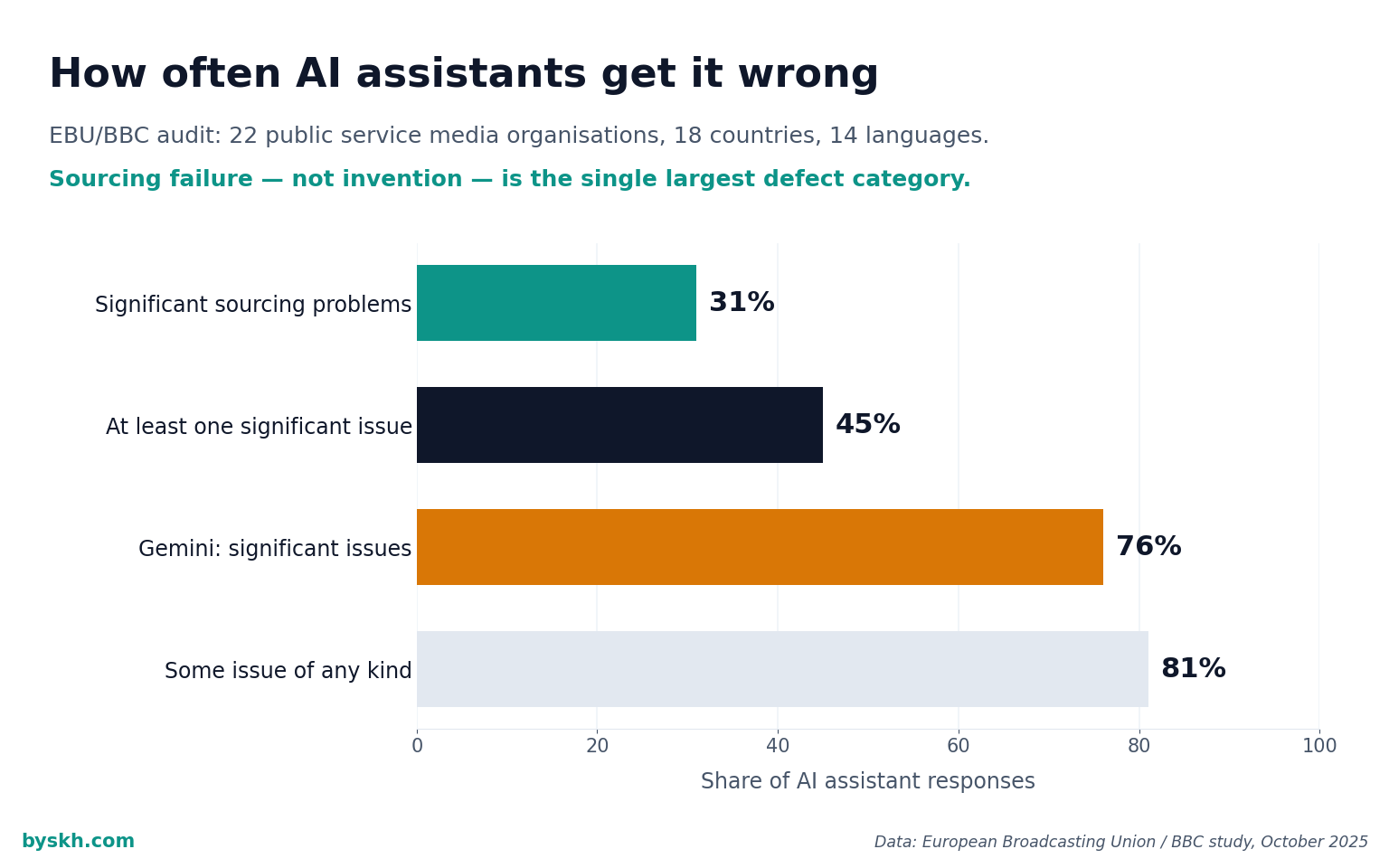
The stakes are not theoretical. The largest study of its kind, run by the European Broadcasting Union with the BBC, found that 45% of AI assistant responses contained at least one significant issue, across 22 public service media organisations, 18 countries and 14 languages. Eighty-one percent had some kind of problem.
This guide is the exact workflow I use. It is not a checklist I invented in the abstract — it is what survived contact with 100-plus published posts, a few embarrassing corrections, and one indexing slump I brought on myself.
Key Takeaways on How to Fact-Check AI Content
- Verification is a claim-level job, not a document-level job. Reading a draft “carefully” catches almost nothing; extracting claims into a list catches most of it.
- Sourcing is the most common failure, not invention. The EBU/BBC audit found 31% of all responses had significant sourcing problems — missing, incorrect, or fabricated citations.
- More reasoning does not mean fewer factual errors. OpenAI’s own system card reported its o3 model hallucinating on 33% of PersonQA questions versus 16% for the older o1, a reminder that newer is not automatically safer.
- Google does not penalise AI writing — it penalises undifferentiated, low-value pages. Verified, sourced content is one of the clearest ways to separate yourself from the pile.
- The cheapest fix is a claim ledger. A five-column table per post, kept as a file, turns fact-checking from a vibe into a repeatable process you can audit months later.
- Businesses are already liable for what their AI says. A Canadian tribunal held an airline responsible for its chatbot’s bad advice, and that logic extends to published content.
Why AI Content Needs Fact-Checking More Than Ever in 2026
The short answer: the output got more fluent faster than it got more accurate, and fluency is exactly what disarms a reviewer.
A confidently written wrong sentence reads better than a hedged right one. That is the trap. When I review a draft that sounds like me, my brain treats it as already-verified, and I skim. Fluency is a comprehension shortcut, and AI writing exploits it perfectly.
Scale makes it worse. Reader trust in AI-sourced information is also rising faster than accuracy is: the Reuters Institute reports that weekly use of AI chatbots for news climbed from 7% to 10% of all audiences between its 2025 and 2026 reports, with much higher usage among under-25s. Errors now propagate into a second layer of AI answers that cite you.
That is the part most publishers miss. If an AI assistant scrapes your unverified statistic and repeats it in an answer, your error becomes someone else’s “source.” Covering the EBU findings, Forbes noted Gemini performed worst in the audit, with significant issues in 76% of responses — driven largely by sourcing failures rather than pure invention.
So the job is not “catch the robot lying.” The job is catching a specific, boring, high-frequency failure: a real-sounding number attached to a source that does not actually say it.
The Three Error Types AI Actually Produces
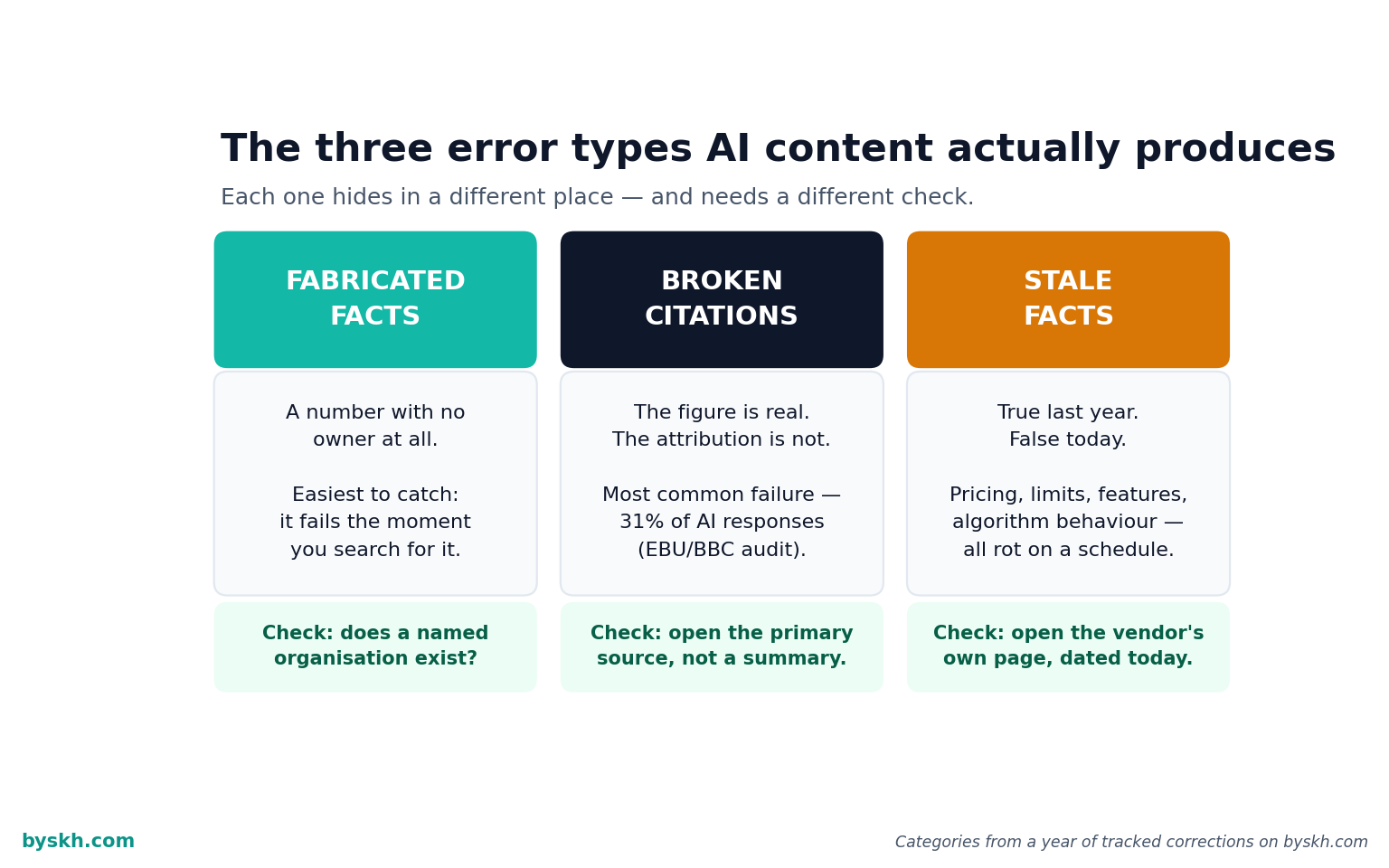
After tracking my own corrections for a year, essentially every error I have caught falls into one of three buckets. Naming them matters, because each one hides in a different place and needs a different check.
Fabricated facts and figures
This is the famous one and, in my experience, the least common. A model produces a plausible number — “73% of marketers report” — with no underlying source at all. It is easy to catch precisely because it fails immediately when you search for it.
My tell: suspiciously round or suspiciously specific numbers with no named organisation attached. Any statistic in a draft that arrives without an owner is guilty until proven innocent.
Broken or invented citations
This is the dangerous one, and the data agrees: sourcing problems affected 31% of responses in the EBU/BBC audit, roughly double the rate of any other single defect category they measured. The statistic is often real. The attribution is wrong.
What that looks like in practice: the right figure credited to the wrong organisation, the right organisation credited with the wrong year, or a URL that is structurally believable but returns a 404. I have caught all three in my own drafts, and none of them look wrong on the page.
Stale facts that were true last year
This is the sneakiest category, because nothing is fabricated — it is simply expired. Pricing tiers, feature names, algorithm behaviour, platform limits, and adoption percentages all rot on a schedule, and a model trained on last year’s web will state them with total confidence.
I now treat any claim about a product’s price, limits, or feature set as automatically stale until I open the vendor’s own page. This is also where most reader corrections come from, in my experience — not from invented facts, but from facts that quietly stopped being true.
My Six-Step Workflow to Fact-Check AI Content
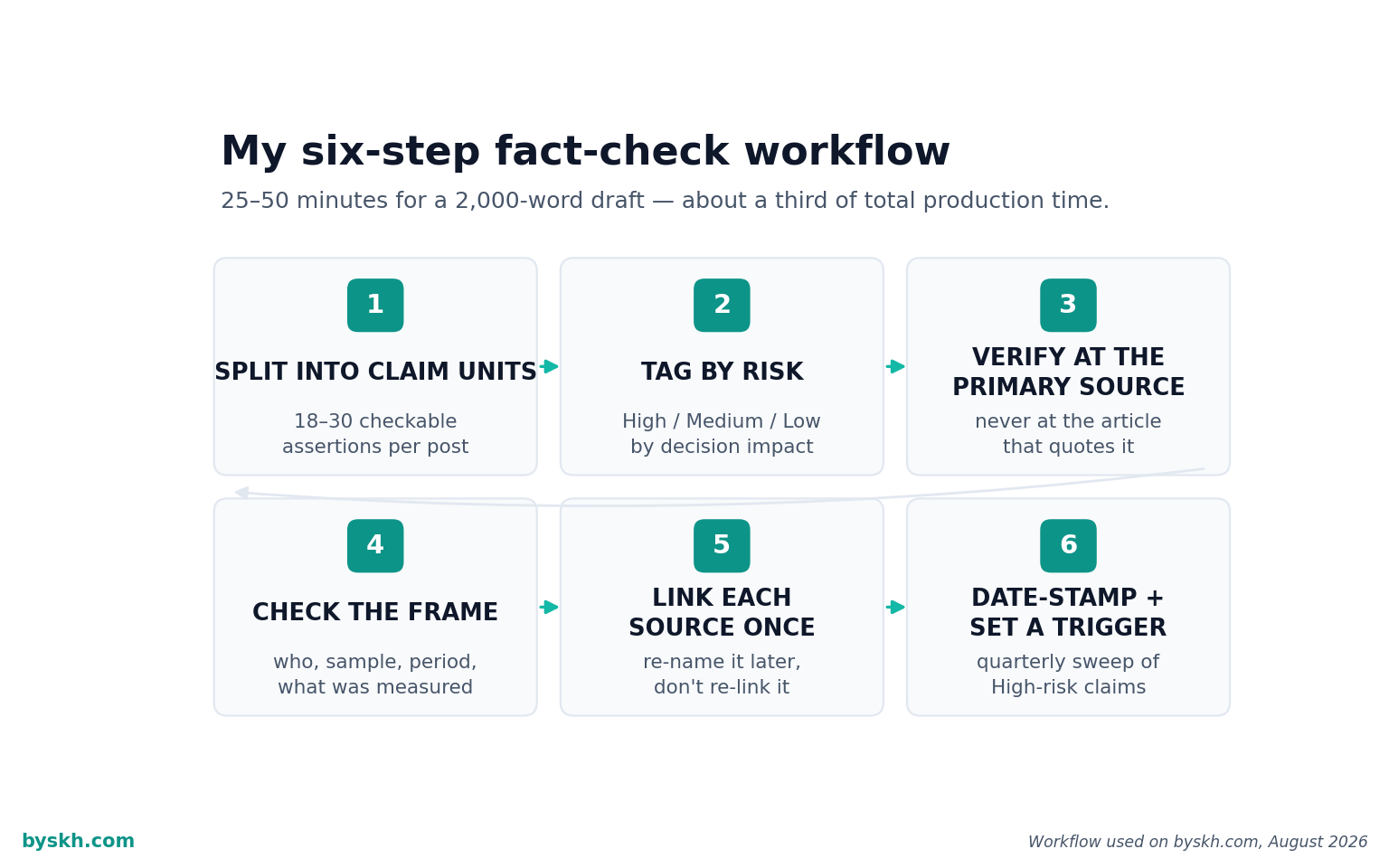
Here is the process end to end. It takes me between 25 and 50 minutes for a 2,000-word article, which is roughly a third of the total production time — and yes, that ratio is the point.
Step one: split the draft into claim units
Before I edit a single sentence, I extract every factual assertion into a numbered list. A claim unit is anything a reasonable reader could check: a statistic, a date, a named study, a product capability, a price, a causal statement.
A typical 2,000-word post of mine yields 18 to 30 claim units. Opinions, recommendations, and my own experience do not go on the list — those are mine to defend, not to verify.
This step alone changes the outcome more than anything else I do. Reading prose activates comprehension; reading a numbered list of assertions activates scepticism. They are different mental modes, and only the second one catches errors.
Step two: tag every claim by risk
I mark each claim High, Medium, or Low. High means being wrong would mislead someone into a decision — money, legal exposure, health, or a technical choice that is hard to reverse. Medium means it would damage credibility. Low means it is a colour detail.
Everything High gets verified at the primary source, no exceptions. Medium gets verified or softened. Low gets cut if verifying it costs more than it is worth — and cutting is a legitimate outcome. A statistic you cannot verify is not a statistic, it is a decoration.
Step three: verify at the primary source, never the summary
This is the rule I break least and regret breaking most. If a claim says “according to a study by X,” I go to X’s own publication, not to the blog post that summarised it.
Secondary coverage introduces drift with remarkable reliability: a percentage of a subgroup becomes a percentage of everyone, a range becomes its most dramatic endpoint, and a correlation becomes a cause. I have watched a single figure mutate across three articles before it reached my draft.
When the primary source is paywalled or genuinely unreachable, I do one of two things: cite the most reputable secondary source explicitly as secondary, or drop the claim. I do not launder a summary into a primary citation.
Step four: check the number and the frame
Getting the digits right is only half the job. The frame around a number — sample, population, timeframe, and method — is where most honest-looking errors live.
Take the EBU figure I opened with. “45% of AI answers are wrong” is a misreading. The correct frame is 45% of responses contained at least one *significant issue*, on news questions, judged by journalists, across four named assistants. Same number, very different claim.
So for each surviving statistic I record four things: who measured it, on what sample, over what period, and what exactly was measured. If I cannot fill in all four, the claim is not ready to publish.
Step five: link once, attribute the rest by name
Every distinct external source gets exactly one hyperlink in a post. When I reference the same source again later, I name it in the text without re-linking.
This is partly a reader-experience rule and partly a discipline forcing function: if I find myself wanting to link one source eight times, I have written a post that rests on a single source and I need to go find corroboration. Diversity of sourcing is itself a quality signal, and I apply the same logic to the internal links and citations discussed in my guide to E-E-A-T trust signals.
Step six: date-stamp and set a re-verify trigger
Every High-risk claim gets a verification date in my ledger, plus a trigger describing what would make it stale — a pricing page change, a new annual report, an algorithm update.
Quarterly, I sweep the ledger for claims older than twelve months and anything whose trigger has fired. This is unglamorous and it is the reason my older posts do not slowly become wrong. Fact-checking at publication is a one-time act; keeping content true is a maintenance schedule.
The Claim Ledger I Keep for Every Post
The ledger is a plain table, one row per claim, stored alongside the draft. Five columns: the claim, the source, the risk tag, the verification date, and the staleness trigger.
Here is a real row from this article. Claim: “45% of AI assistant responses contained at least one significant issue.” Source: EBU/BBC study, October 2025, 22 organisations. Risk: High. Verified: 24 August 2026. Trigger: EBU publishes a follow-up wave.
Why bother writing it down? Three reasons, all of which I learned by not doing it. First, it makes the quarterly refresh mechanical instead of archaeological. Second, when a reader challenges a number, I can answer in one minute instead of one afternoon. Third, it makes the honest gaps visible — a row with an empty source column is a claim I have not actually checked, and prose is very good at hiding that from me.
I keep mine as a simple markdown table in the same folder as the draft. A spreadsheet works equally well. The format matters far less than the existence.
What Fact-Checking Does for SEO and AI Search Visibility
Google has been unusually clear that its concern is quality rather than production method. Its official guidance on AI-generated content states that focusing on the quality of content, rather than how content is produced, is the useful guiding principle. Using AI to produce genuinely helpful content is fine; using it to mass-produce pages for rankings is spam.
The practical consequence shows up in Search Console rather than in a manual action. Pages that Google crawls but declines to index are the visible symptom, and Search Engine Journal’s analysis of why pages get stuck in “Crawled – currently not indexed” puts thin, duplicative, low-demand content at the top of the causes.
I lived this. A stretch of my own posts sat in that status for months, and the common factor was not the AI — it was that the pages carried no verified, attributed information a reader could not get from ten other sites. Google’s own search relations team has since used undifferentiated AI-generated content as the live example when discussing site-level quality doubts.
Verification is the cheapest differentiator available, because most publishers skip it. A page with four primary-source citations, four correctly framed statistics, and an explicit verification date is structurally different from the generic version of the same article — and both search engines and AI answer engines can see the difference.
There is a second benefit that took me longer to notice: correctly attributed statistics make you quotable. AI answer engines lift short, self-contained, clearly sourced passages. Being right in an extractable format is an increasingly direct route to being cited, which is the same principle I applied when building out my approach to AI copywriting.
Where Fact-Checking Failed Me
Three failures, in the spirit of not writing another flawless-process article.
I trusted a number because it was everywhere. A widely repeated engagement statistic appeared in dozens of marketing blogs, so I used it. It traced back to a vendor infographic with no methodology. Ubiquity is not verification — it is usually just one unsourced claim with good distribution.
I verified the statistic and not the sentence. The number was right, the source was right, and my sentence around it implied causation the study explicitly declined to claim. Nothing in my ledger caught it, because my ledger checked claims and not framing. That is why step four exists now.
I let a URL through that looked correct. A model produced a citation URL matching a publisher’s normal structure exactly. It 404’d. Now every external link gets an HTTP check before publish — mechanical, thirty seconds, catches a class of error that no amount of careful reading will.
Tools I Use, and the One I Stopped Trusting
My stack is deliberately boring. Primary sources and official documentation do the heavy lifting. A second AI model gets used as an adversary, never as an authority — I paste a claim and ask what would have to be true for it to be false, which surfaces framing problems well. Search Console tells me whether pages are being indexed, and a link checker catches dead citations.
The tool I stopped trusting is the AI detector. Detectors measure how a text reads, not whether it is true, and they flag careful human editing as machine-written with depressing regularity. Optimising for a detector score actively degrades writing. Nothing in Google’s guidance rewards a detection score; it rewards usefulness.
The related habit worth dropping is the “make it sound less AI” rewrite pass. It changes cadence, not correctness. A verified article in plain prose beats an unverified article with artisanal sentence rhythm every single time — a point I make at more length in my guide to using ChatGPT for marketing.
The Legal and Commercial Cost of Getting It Wrong
Published errors are not only a credibility problem. In Moffatt v. Air Canada, a British Columbia tribunal held the airline liable for incorrect bereavement-fare advice given by its own chatbot, rejecting the argument that the bot was a separate entity, and awarded the passenger $812.
The dollar figure is trivial. The principle is not. Legal analysts at the American Bar Association noted the tribunal found the company had failed to take reasonable care to ensure the information was accurate — a duty that does not evaporate because a machine produced the text.
If you publish AI-assisted comparison content, pricing pages, health or finance information, or anything a reader acts on, “the model said it” is not a defence anyone has successfully used. Reasonable care is the standard, and a documented verification process is what reasonable care looks like on paper.
Summary
Fact-checking AI content is a claim-level discipline. Extract the assertions, tag them by risk, verify the risky ones at the primary source, check the frame as carefully as the number, cite each source once, and record a verification date with a staleness trigger.
The failure mode to design against is not fabrication. It is a real statistic wearing the wrong attribution, or a fact that was true eighteen months ago — both of which read perfectly.
None of this is exciting work, and that is precisely why it is a competitive advantage in 2026. Most publishers using AI have accelerated drafting without touching verification. The gap between those two speeds is where trust, indexing, and citations are won or lost.
Frequently Asked Questions
How long should fact-checking an AI-written article take?
For a 2,000-word article I budget 25 to 50 minutes, roughly a third of total production time. If verification is taking under ten minutes, you are almost certainly skimming rather than checking claims individually. The time scales with the number of statistics, not the word count.
Can I use AI to fact-check AI content?
Partially. A second model is useful for finding weak framing, spotting unsupported causal language, and generating counterarguments to a claim. It is not reliable for verifying whether a specific statistic is real, because that is the exact task it fails at. Use it to find suspects, then verify the suspects yourself at the source.
Does Google penalise AI-generated content?
No. Google’s stated position is that it evaluates quality rather than production method, and AI-assisted content that is genuinely helpful is acceptable. What gets suppressed is mass-produced, undifferentiated content created primarily to rank, which is a description many AI content operations unfortunately fit.
What is the most common AI factual error?
Sourcing errors, not invented facts. The EBU/BBC research found significant sourcing problems in 31% of responses — missing, incorrect, or fabricated citations — making misattribution substantially more common than outright fabrication. The statistic is often real; the credit is wrong.
Do I need to disclose that content was AI-assisted?
There is no universal legal requirement for editorial content in most jurisdictions, though sector rules and platform policies vary and advertising claims carry their own substantiation obligations. I disclose because it is honest and because it costs nothing when the work is verified. Disclosure is not a substitute for accuracy, and accuracy is what actually carries legal and reputational weight.
How often should I re-verify published statistics?
I sweep High-risk claims quarterly and re-verify anything older than twelve months. Pricing, product features, and platform policies should be checked whenever their staleness trigger fires rather than on a calendar, because those change without warning and are the most common source of reader corrections.
Conclusion
AI made drafting nearly free. It did not make verification free, and the publishers who understand that gap are the ones whose content will still be indexed, cited, and trusted a year from now.
Start smaller than you think you need to. Take your next draft, extract the claims into a numbered list, and tag them by risk. You will find something wrong in the first article you try it on — I always do — and that single habit will do more for your content quality than any tool you could buy.